

Summary:
- Ripple survey shows 72% of finance leaders believe digital assets are now necessary to stay competitive.
- Stablecoins lead adoption, with 74% seeing them as tools for cash flow and capital efficiency.
- Fintechs are building, while corporates prefer partnering with external providers.
- Custody and security are top priorities for banks and asset managers exploring tokenization.
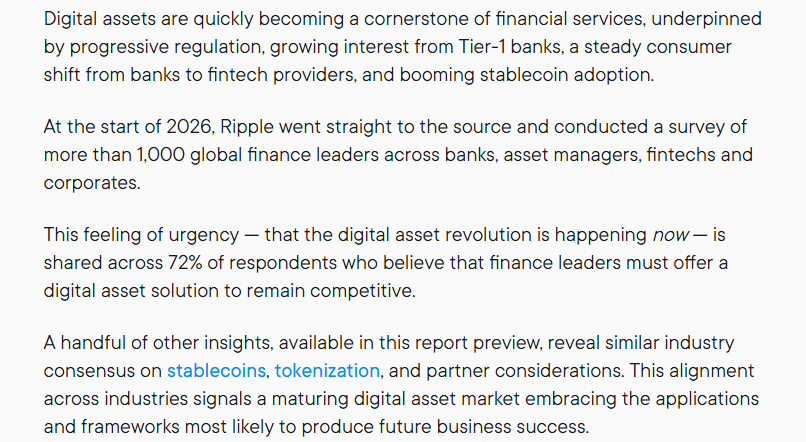
The conversation around digital assets inside financial institutions is changing. It's becoming a baseline expectation and a new survey from Ripple, based on responses from over 1,000 global finance leaders, shows just how far that shift has gone. According to the findings, 72% of respondents believe companies need to offer digital asset solutions to remain competitive. Digital assets are no longer seen as a side initiative and they're starting to sit alongside core financial services. The survey covered a wide range of institutions, including banks, asset managers, fintech firms and corporates.
Across the board, the focus has moved beyond basic awareness. Ripple noted that firms are increasingly looking at whether they should build their own systems, buy existing solutions, or partner with external providers. That shift signals a more practical phase of adoption, where infrastructure and execution matter most. Several factors are driving this change like regulation is slowly becoming clearer in key markets and large financial institutions are showing more interest. Also fintech platforms continue to push new use cases into the mainstream. At the center of it all are stablecoins.
Stablecoins Lead the Conversation
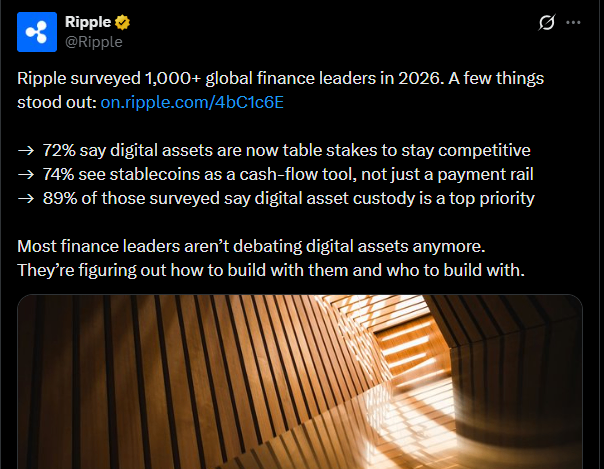
Among all digital asset use cases, stablecoins stand out as the most widely supported. According to the survey, 74% of respondents believe stablecoins can improve cash flow and unlock trapped working capital. That's a strong signal that institutions are looking beyond simple payments. Ripple described this shift in thinking clearly:
Stablecoins can move money faster and more efficiently than traditional systems, especially across borders. But beyond speed, they offer flexibility in how funds are managed. For businesses, that can mean better liquidity, quicker settlements, and fewer delays tied to traditional banking processes. The survey also shows a split in how different types of firms are approaching adoption. Fintech companies appear more willing to build their own solutions. Around 47% of fintech respondents said they plan to develop internal digital asset systems. That approach gives them more control, but also requires deeper technical investment. Corporates, on the other hand, are leaning toward partnerships. About 74% said they prefer working with external providers. This difference reflects how each group views digital assets. For fintechs, it's often a core part of the business model. For corporates, it's more about adding new capabilities without taking on full infrastructure complexity.
Custody and Tokenization Shape Institutional Focus
While stablecoins dominate current use cases, another area is quietly gaining attention that is tokenization. Tokenization refers to representing real-world assets, such as bonds or funds, on a blockchain. It's often discussed as a long-term shift, but the survey suggests institutions are already preparing for it. One of the biggest concerns in this space is custody. In simple terms, custody is about how digital assets are stored and protected. Unlike traditional assets, digital tokens require secure key management. Losing access can mean losing the asset entirely. That's why 89% of respondents evaluating tokenization partners said secure storage is a top priority.
Other related areas also ranked highly. Token lifecycle management - how assets are issued, managed and eventually redeemed - was cited by 82% of respondents. Primary distribution, or how tokens are first offered to investors, came in at 80%. These numbers show that institutions are thinking carefully about the full process. Banks, in particular, are also looking for guidance. The survey found that 85% of bank respondents see pre-issuance structuring as important, compared to 76% of asset managers. That suggests many institutions are still in the planning phase, working out how to structure digital asset offerings before bringing them to market. Ripple summarized the broader picture in its findings:
The takeaway is very clear and adoption already started and Digital assets are becoming part of the system.
Closing Thoughts
Financial institutions are moving from exploration to action. They're deciding how to integrate digital assets into real operations. Stablecoins are leading because they offer immediate value. Custody is gaining focus because security is non-negotiable and tokenization is building in the background as the next step. There's still uncertainty in some areas, especially around regulation and long-term standards. But the overall trend is clear enough.