

Summary:
- Ethereum Foundation researcher Nico says Ethereum accounts can begin preparing for future quantum threats without waiting for a hard fork.
- The proposed SPHINCS- signature system could add post-quantum account protection for roughly $0.07 per account at current gas costs.
- The approach works at the wallet level through smart contracts, allowing developers to experiment before any network-wide upgrade.
- Researchers say the proposal has undergone an initial review with Anthropic's Fable model, though additional audits and testing are still planned.
- The work supports Ethereum's broader roadmap, which continues to prioritize privacy, security and long-term post-quantum readiness.
The conversation around quantum computing has become more active across the crypto industry this year, but Ethereum researchers believe users may not need to wait for a major network upgrade before taking the first steps toward stronger protection. According to Nico, who leads the Ethereum Foundation's privacy-focused Kohaku project, Ethereum accounts can already begin experimenting with post-quantum security through wallet-level solutions rather than protocol changes. In a post published on X in June 2026, Nico wrote:
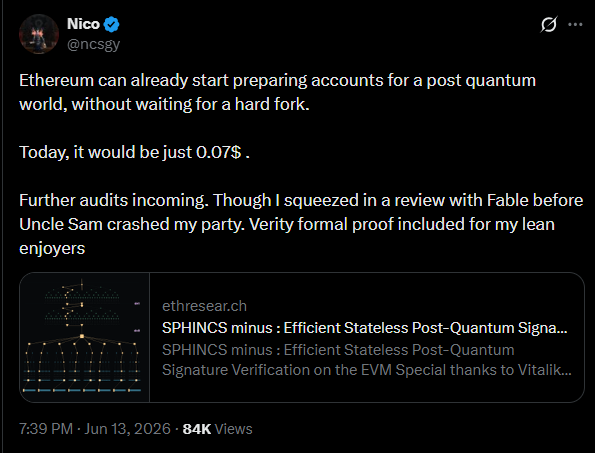
The proposal focuses on protecting individual accounts instead of upgrading Ethereum's consensus rules. That distinction is important because it allows wallet developers to introduce additional security using smart contract logic while Ethereum's core developers continue researching larger protocol-level improvements. According to Nico, adding this protection would currently cost around $0.07 per account, making early testing practical even before quantum-resistant cryptography becomes a network-wide standard. The proposal reflects a broader view shared by many researchers that migrating cryptographic systems could take years, making it worthwhile to begin preparing long before quantum computers become capable of breaking today's encryption. That approach mirrors similar discussions taking place throughout the blockchain industry, where both Bitcoin and Ethereum developers are increasingly exploring how to transition toward quantum-resistant cryptography without disrupting existing networks.
SPHINCS- aims to make post-quantum signatures practical on Ethereum
The proposal centers on SPHINCS-, a new family of stateless post-quantum digital signatures designed specifically for the Ethereum Virtual Machine (EVM). The research, published through Ethereum Research, builds on earlier work involving SPHINCS+, a well-known hash-based signature system developed to resist attacks from future quantum computers. Unlike many cryptographic proposals that require protocol upgrades or specialized precompiled contracts, SPHINCS- is designed to work within Ethereum's existing rules. Its primary objective is straightforward: reduce the cost of verifying post-quantum signatures directly on-chain while remaining practical enough for wallet applications.
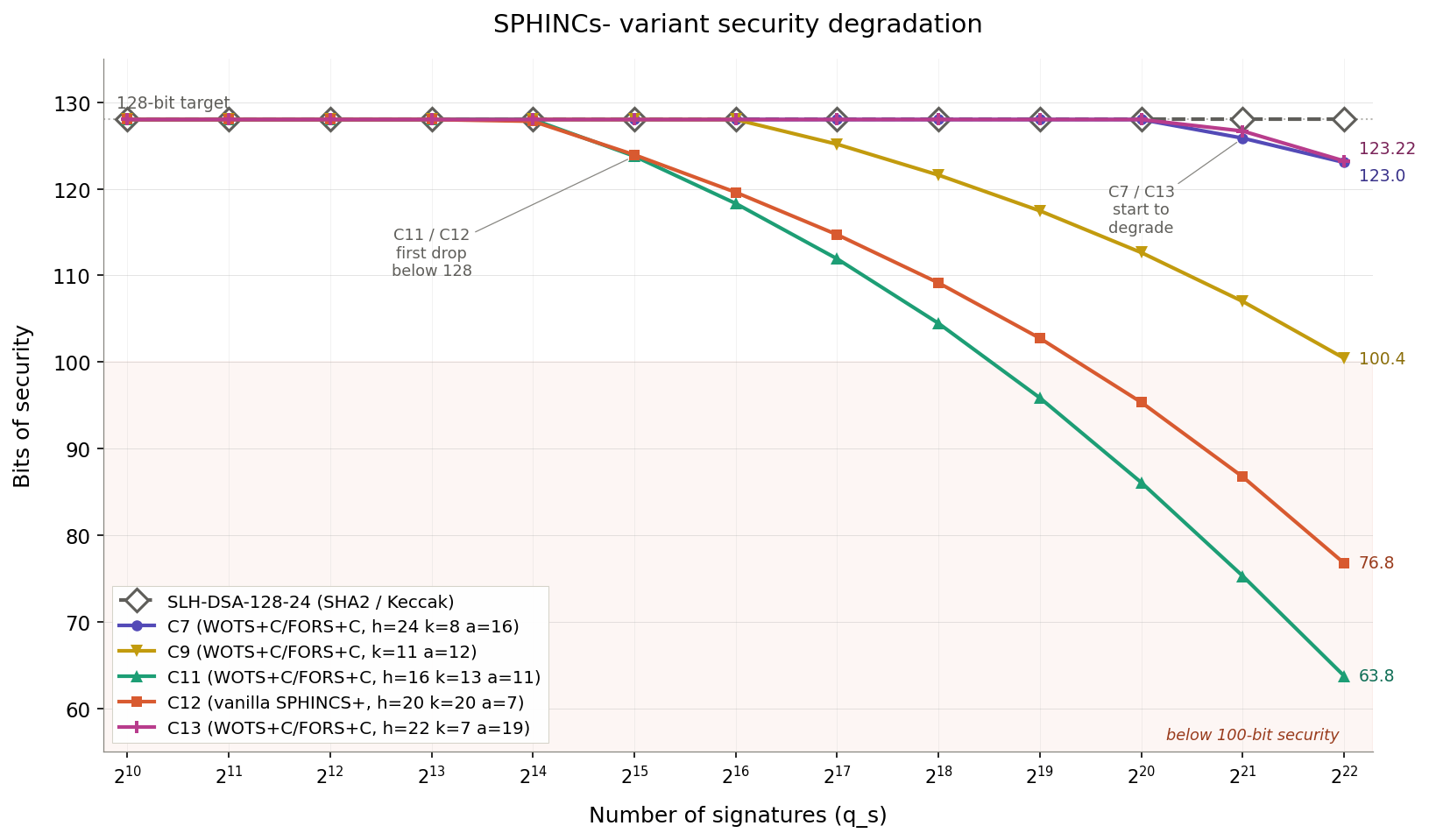
According to the research, one optimized implementation known as C13 can verify a post-quantum signature using roughly 127,000 gas, while producing signatures of approximately 3,704 bytes. The researchers also note that the implementation includes a formal verification using Lean 4 through the Verity framework, providing mathematical proof that the implementation behaves as intended. Today, both Ethereum and Bitcoin rely primarily on ECDSA, a widely used digital signature algorithm that secures ownership of blockchain assets. While ECDSA remains secure against today's computers, many cryptographers believe sufficiently advanced quantum computers could eventually solve the mathematical problems that make these signatures secure. Hash-based signature systems such as SPHINCS- are designed differently. They use cryptographic hash functions that researchers believe will remain resistant even in a post-quantum world. Although practical quantum computers capable of attacking blockchain cryptography do not yet exist, many researchers argue that designing migration paths today is significantly easier than attempting emergency upgrades years later.
Research continues, but developers see an opportunity to start early
The proposal is still in the research phase, and Nico has been careful not to present it as a finished solution. According to the project, the design has already completed an initial review using Anthropic's Fable model, with additional independent security audits planned before broader adoption is considered. The Ethereum Research paper also outlines several current limitations. Some configuration settings remain experimental rather than standardized. Certain implementations support only bounded numbers of signatures, and there are technical differences between versions built around Ethereum's native Keccak hashing function and those aligned with standards published by the National Institute of Standards and Technology (NIST). These limitations mean further testing is still required before wallet providers could deploy the technology at scale. Even so, researchers believe the proposal demonstrates something important: account-level quantum protection does not necessarily need to wait for a future Ethereum hard fork.
That gradual approach could prove especially valuable for institutions, treasury managers and other high-value wallet operators seeking additional protection well before any mandatory network migration occurs. The proposal also aligns with Ethereum's long-term technical roadmap, which continues to list privacy, security and post-quantum cryptography among its core research priorities. For now, the message from Ethereum researchers is measured. There is no evidence that quantum computers pose an immediate risk to blockchain networks. However, preparing early gives developers more time to test new cryptographic systems, improve wallet infrastructure and build confidence before the technology becomes necessary. If SPHINCS- continues to perform well through future audits and community review, Ethereum users may eventually gain access to practical quantum-resistant account protection years before any protocol-wide transition becomes necessary.
READ MORE: Zcash Restores Orchard After Emergency Upgrade Fixes Critical Vulnerability