

Summary:
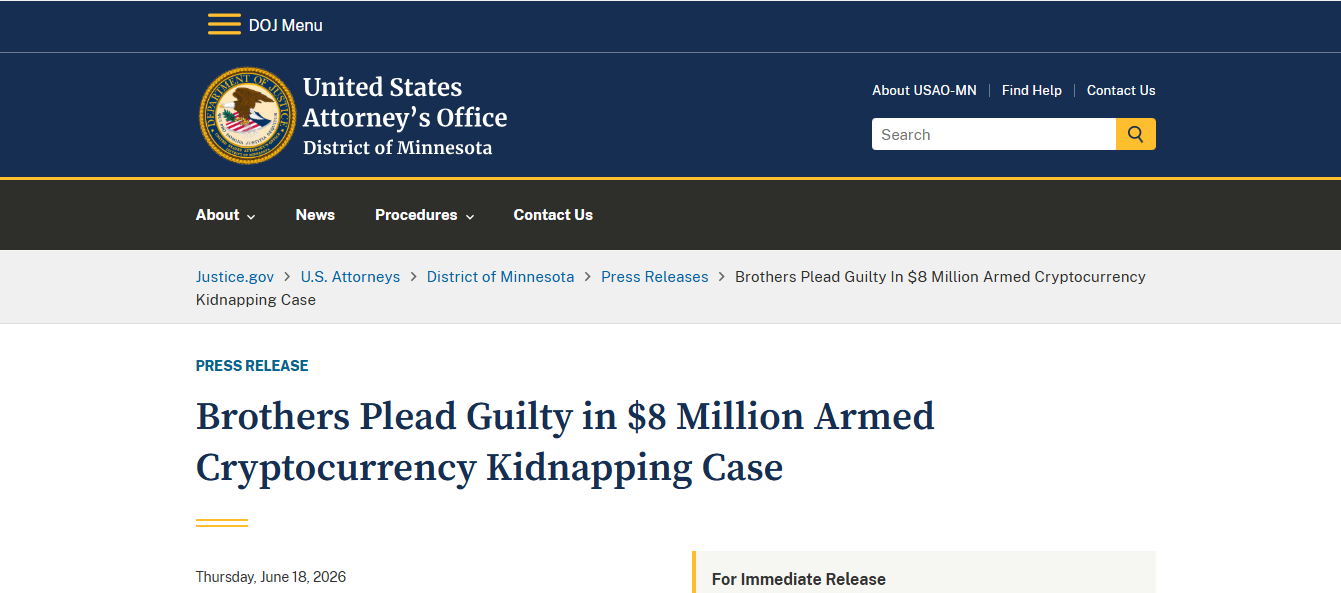
- Two Texas brothers have pleaded guilty to federal robbery charges tied to an $8 million cryptocurrency kidnapping in Minnesota.
- Prosecutors said the victims were held at gunpoint for hours while the attackers forced transfers from online accounts and hardware wallets.
- Both defendants admitted to using firearms during the robbery and agreed to pay more than $8 million in restitution.
- The case comes as crypto-related kidnappings continue to increase, with CertiK reporting a 75% rise in physical attacks during 2025.
- The incident highlights a growing security challenge as criminals increasingly target crypto holders in the real world rather than through online exploits.
Two Texas brothers have pleaded guilty to federal robbery charges after U.S. prosecutors accused them of kidnapping a Minnesota family and forcing the transfer of more than $8 million in cryptocurrency. According to the U.S. Attorney's Office for the District of Minnesota, Isiah Angelo Garcia and Raymond Christian Garcia entered guilty pleas to Interference with Commerce by Robbery, a federal offense carrying a maximum prison sentence of 20 years. Announcing the guilty pleas, U.S. Attorney Daniel Rosen said:
The case centers on an attack that prosecutors say took place on September 19, 2025, when the brothers allegedly traveled from Texas to Minnesota to target a family believed to hold substantial cryptocurrency assets. According to court documents, the victims-a husband, wife, and their son-were confronted at gunpoint before being forced into a carefully planned robbery aimed at accessing their digital assets. Prosecutors said the attackers separated the family during the ordeal. The victim's wife and son were allegedly held inside the family home for approximately nine hours, while the victim himself was taken to a family cabin roughly three hours away. Authorities said he was forced to transfer approximately $8 million worth of cryptocurrency from both online exchange accounts and hardware wallets while under armed threat. Unlike many crypto thefts that happen entirely online, this case involved direct physical coercion. Investigators say the attackers used intimidation and violence to obtain access to digital assets. The kidnapping reportedly began to unravel after the victim's son managed to place an emergency call. Washington County Sheriff's deputies responded to the incident, later recovering both a rifle and a shotgun. Prosecutors also cited surveillance footage and additional evidence linking the brothers to the crime. As part of their plea agreements, both defendants admitted that firearms were used during the robbery. Federal prosecutors also said the brothers agreed to pay more than $8 million in restitution to the victims. Sentencing dates have not yet been announced.
Crypto crime is increasingly moving from online exploits to real-world attacks
The Minnesota case reflects a broader trend that security researchers have been tracking over the past two years. While crypto headlines often focus on smart contract exploits, phishing campaigns, or exchange breaches, an increasing number of criminals are targeting investors physically. These incidents-sometimes referred to as "wrench attacks"-rely on threats, kidnapping, or violence instead of technical hacking. Because cryptocurrency transactions are irreversible once confirmed, victims forced to sign transactions under duress often have little opportunity to recover stolen funds. Security firm CertiK reported earlier this year that crypto-related kidnappings and physical assaults increased by 75% during 2025 compared with the previous year.
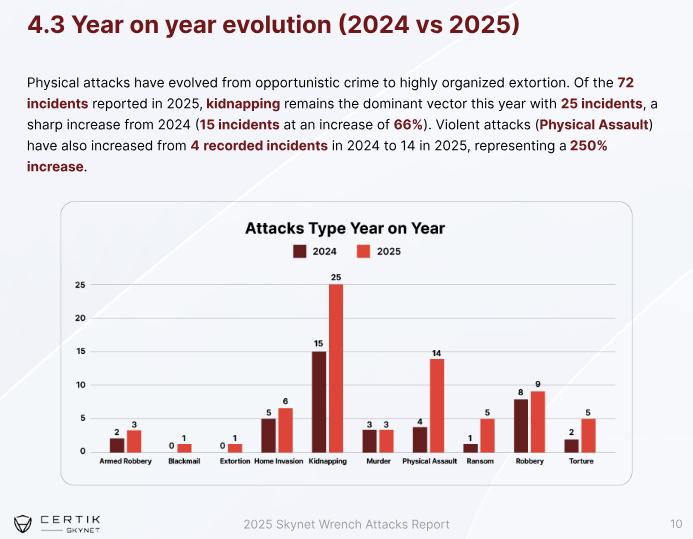
According to the firm's research, losses tied to these attacks reached approximately $101 million during the first four months of 2026 alone, showing that physical security has become an increasingly important concern for digital asset holders. The rise comes alongside growing cryptocurrency adoption worldwide. As more individuals hold significant amounts of digital assets, attackers appear increasingly willing to bypass technical defenses altogether and instead target wallet owners directly. Several recent incidents across Europe, North America, and Asia have involved kidnappings, home invasions, or extortion attempts against individuals believed to control large crypto holdings. Security experts say many of these attacks begin with publicly available information gathered through social media, business records, or previous blockchain activity. For investors, this has shifted the conversation beyond wallet security and private key protection. Personal privacy, limiting public disclosure of holdings, and maintaining operational security have become just as important as protecting digital infrastructure. The latest guilty pleas also demonstrate that law enforcement agencies are devoting increasing attention to violent crimes involving digital assets. Federal prosecutors treated the case as an armed robbery, reflecting the seriousness of the underlying violence.
READ MORE: Iran War and AI Spending Could Push Bitcoin to $126K in 2026, Says Arthur Hayes
The case highlights a growing challenge as crypto adoption expands
Although blockchain technology continues to improve transaction security, the Minnesota kidnapping illustrates that the biggest vulnerability is sometimes not the technology itself, but the people using it. The alleged attackers did not exploit a flaw in blockchain software or break encryption. Instead, prosecutors say they relied on intimidation, firearms, and prolonged detention to force the victim to authorize legitimate cryptocurrency transfers. That distinction matters because no wallet or blockchain can prevent a transaction that its owner is forced to approve under threat. As cryptocurrency becomes more integrated into everyday finance, experts increasingly warn that physical security deserves the same level of attention as cybersecurity. High-net-worth individuals, institutional investors, and even retail holders may all need to reconsider how much information about their holdings is publicly visible.
For law enforcement, the case also reflects the changing nature of financial crime. Traditional armed robberies increasingly intersect with digital assets, requiring investigators to combine physical evidence, blockchain tracing, surveillance footage, and financial forensics. While the Garcia brothers have now admitted their roles in the robbery, the broader issue remains. Reports from security firms suggest that physical attacks against crypto holders are becoming more common each year. As adoption continues to expand globally, protecting cryptocurrency may increasingly involve more than securing private keys-it may also require protecting the people who control them.
READ MORE: G7 Flags North Korea's Crypto Hack Spree as Global Security Threat