

Summary:
- Gustavo Petro says Colombia's Caribbean coast could become a Bitcoin mining hub.
- Cities like Barranquilla, Santa Marta, and Riohacha highlighted for potential development.
- Plan focuses on using surplus renewable energy to attract mining investment.
- Inspiration drawn from Paraguay's rise to a top global Bitcoin mining location.
- Proposal includes possible participation from the Wayúu Indigenous community.
Gustavo Petro is putting forward a different kind of economic idea. In a recent post, Petro pointed to Colombia's Caribbean coast as a potential hub for Bitcoin mining. The idea is simple to take unused or underutilized renewable energy and turn it into economic output through mining activity. He specifically named cities like Barranquilla, Santa Marta, and Riohacha as candidates for hosting mining operations. These areas already sit close to energy resources that could support large-scale infrastructure if properly developed. Petro framed the idea by looking at how other countries have approached the same opportunity:
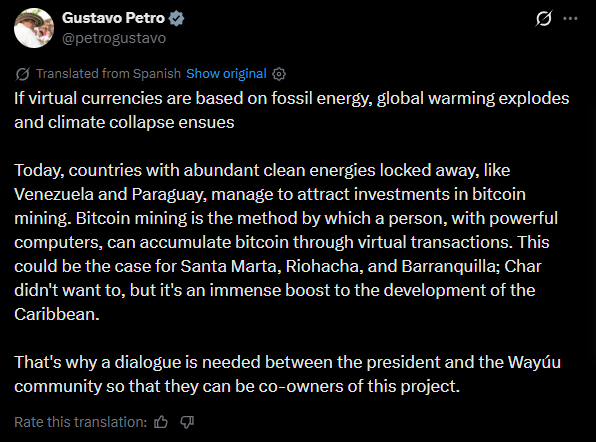
There's a clear direction behind this. Instead of letting excess electricity go unused, the government is exploring whether it can be converted into a steady revenue stream. Mining operations, which rely heavily on electricity, fit into that model. Petro also suggested that the Wayúu community - one of the largest Indigenous groups in the region, could be included as co-owners in such projects. It signals an attempt to tie local economic participation into what would otherwise be a capital-heavy, external investment-driven industry.
Paraguay's Playbook and Why It Matters
The comparison to Paraguay reflects a real shift in how smaller economies are approaching Bitcoin mining. Paraguay has quietly become one of the largest mining hubs in the world, largely because of its hydroelectric capacity. A detailed breakdown shared by industry observers highlights just how significant that advantage is:

Paraguay has approximately 4.3% of the global hashrate, about 43 EH/s as of Q2 2026. Paraguay became a mining hub because of policy, also there was excess energy with limited local demand. Mining simply gave that energy a buyer. Colombia may be in a similar position. Reports suggest that around 75% of the country's electricity comes from renewable sources, which is significantly higher than the global average. That creates a window where energy supply could exceed immediate domestic needs in certain regions. For mining companies, that kind of setup is attractive. Lower energy costs often determine where operations are built and in recent years, there's been a shift away from traditional hubs toward regions that can offer both affordability and stability. At the same time, global mining dynamics are changing. In the United States, many large operators are starting to pivot toward AI and high-performance computing workloads, which often generate higher returns than Bitcoin mining alone.
READ MORE: Aave Challenges ETH Freeze in Court as $71M Recovery Funds Hang in Balance
Timing, Challenges, and What Comes Next
While the idea is gaining attention, the timeline raises questions. Gustavo Petro is nearing the end of his presidential term, which concludes in August. That leaves a narrow window to move from concept to execution. He is also not running in the upcoming election due to constitutional limits, meaning any long-term implementation would likely fall to the next administration. That creates uncertainty. Large-scale mining infrastructure requires planning, regulatory clarity, and long-term commitments from both public and private sectors. Without continuity in policy, projects like this can stall before they begin.
There are also environmental concerns to consider. Petro himself has previously raised issues around Bitcoin mining powered by fossil fuels, linking it to broader climate risks. The current proposal tries to address that by focusing on renewable energy, but scaling mining operations still brings infrastructure and resource questions. Then there's the economic angle. Analysts have pointed out that mining can help countries convert idle electricity into revenue, but the benefits depend on the projects. Local participation, tax frameworks, and energy pricing all play a role in determining whether the gains stay within the country or flow outward.
Closing Thoughts
Still, more governments are starting to look at Bitcoin mining as an energy strategy. It's about using what already exists - power generation capacity in a way that creates additional value. For Colombia, the Caribbean coast could become a testing ground for that idea. If the conditions line up, it may follow a path similar to Paraguay. If not, it remains another example of how countries are experimenting with crypto's role in real-world infrastructure. In places like Colombia, it's being framed as a tool for regional development, energy optimization, and economic inclusion - all at once.