

Summary:
- Humanity Protocol confirmed a security incident involving compromised private keys belonging to a member of the Humanity Foundation.
- Onchain investigators estimate that more than $30 million worth of H tokens were stolen.
- The H token fell around 85%, dropping from roughly $0.70 to near $0.08.
- Arkham Intelligence reported that the attacker was actively swapping stolen tokens through decentralized exchanges.
- PeckShield later reported two separate minting events of 100 million H tokens each, bringing newly minted supply to 200 million tokens.
- The incident adds to a growing list of major private key compromises affecting the crypto industry in 2026.
Humanity Protocol, the decentralized identity project often referred to as the "Chinese Worldcoin," is facing one of the most serious crises in its history after a private key compromise reportedly led to the theft of more than $30 million worth of H tokens and triggered an 85% collapse in the project's native asset. The incident unfolded rapidly on Tuesday, sending shockwaves across the community as users watched the token's price collapse while reports emerged of suspicious wallet activity linked to the protocol. It initially appeared to be a security breach involving a limited number of wallets but soon evolved into a broader concern about token supply, liquidity, and ecosystem security after blockchain monitoring firms identified additional token minting activity worth hundreds of millions of H tokens. The result was a sharp loss of market confidence that pushed the token to its lowest levels since launch and placed Humanity Protocol under intense scrutiny. The project's founder and CEO, Terence Kwok, publicly acknowledged the incident in a statement shared on X:
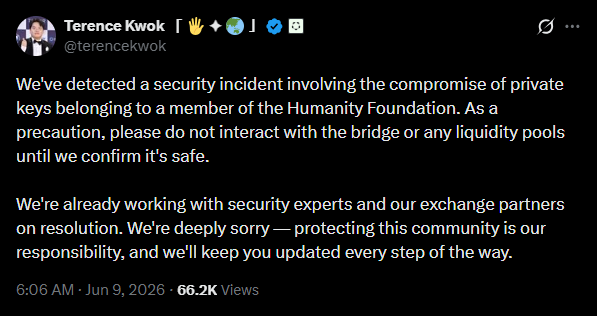
Kwok urged users to avoid interacting with the protocol's bridge and liquidity pools until further notice, signaling that the team was prioritizing containment efforts while investigating the scope of the compromise. At the time of the announcement, the project did not disclose exactly how the keys were compromised or whether additional infrastructure had been affected. Humanity Protocol is a decentralized identity network built around proof-of-humanity verification. The platform uses privacy-preserving palm biometrics and operates on a zkEVM-based blockchain architecture designed to verify unique human identities without exposing personal information. The concept has drawn comparisons to Worldcoin, though Humanity Protocol has pursued a different technical approach centered on biometric palm recognition rather than iris scanning.
READ MORE: Fake Google Ads Targeting Uniswap Users Steal $400K, Analysts Warn
Onchain Investigators Trace More Than $30 Million in Stolen Tokens
As the incident unfolded, blockchain investigators began tracking suspicious movements linked to wallets associated with Humanity Protocol. Onchain investigator Specter reported that wallets connected to the project appeared to be compromised in an ongoing attack and estimated that losses had already exceeded $30 million.
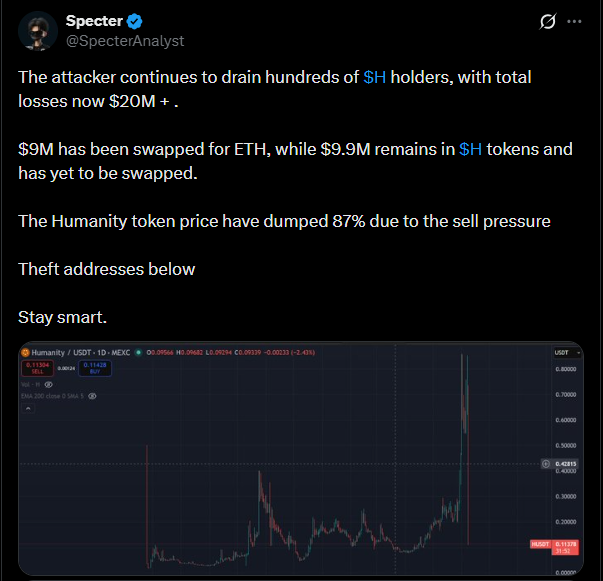
According to Specter's analysis, the attacker appeared to gain access to addresses linked to the protocol and began moving large amounts of H tokens through the ecosystem. Blockchain intelligence platform Arkham later published similar findings. Arkham reported that the exploiter had stolen more than $30 million worth of H tokens and was actively swapping the assets across decentralized exchanges, including Kyber Network and PancakeSwap. The movement of stolen tokens onto decentralized exchanges intensified selling pressure almost immediately. Unlike centralized platforms, decentralized exchanges allow users to swap assets directly onchain, making them a common destination for attackers attempting to liquidate stolen funds. As large quantities of H entered liquidity pools, market participants rushed to exit positions, accelerating the decline. According to CoinGecko data, the token dropped approximately 85.3% within hours, falling from around $0.70 to nearly $0.08.
The collapse erased hundreds of millions of dollars in market value and instantly transformed what had begun as a security incident into a full-scale market crisis. For many traders, the speed of the decline raised concerns not only about the exploit itself but also about the potential impact on future token supply. Those concerns intensified shortly afterward.
READ MORE: US Seized Nearly $1 Billion in Iranian Crypto, Treasury Secretary Says
Fresh Token Minting Raises New Questions
While the market was still reacting to reports of the exploit, blockchain security firm PeckShield identified additional activity involving the H token supply. In a post shared on X, PeckShield reported that another 100 million H tokens had been minted on BNB Chain. Roughly an hour later, the firm reported a second minting event involving another 100 million H tokens.

Together, the two minting transactions added 200 million newly created H tokens to circulation or treasury-controlled wallets, depending on how the tokens were allocated. At the time of writing, Humanity Protocol had not publicly provided a detailed explanation regarding the purpose of the minting activity or whether it was connected to remediation efforts following the exploit.
The timing nevertheless drew significant attention from market participants because it occurred during a period of extreme volatility and uncertainty. In situations involving token compromises, projects sometimes mint replacement tokens as part of recovery plans, treasury operations, or liquidity management efforts. However, investors typically look for clear communication regarding such actions, particularly when confidence has already been shaken by a security incident. The combination of a major exploit, aggressive token selling, and the appearance of hundreds of millions of newly minted tokens created a difficult environment for the project as it attempted to reassure users and partners. The coming days will likely be critical in determining whether Humanity Protocol can stabilize its ecosystem and restore confidence among token holders. The incident also highlights a broader trend affecting the digital asset industry. Private key compromises remain one of the most damaging attack vectors in crypto, not because of flaws in blockchain technology itself, but because control over critical wallets often grants attackers direct access to assets, treasury funds, governance permissions, or token contracts. According to CertiK, wallet and private key compromises were the second-most expensive attack category in May, resulting in approximately $13.7 million in losses.
Several notable incidents have already occurred this year, including attacks involving Step Finance, Resolv, Volo Vault, Echo Bridge, Bankr, Polymarket, StablR, Stake DAO, Gravity Bridge, and Alephium Bridge. One of the largest incidents occurred in April when attackers linked to North Korea's Lazarus Group reportedly gained access to Drift Protocol security council administrative keys, contributing to losses of approximately $280 million. Against that backdrop, the Humanity Protocol exploit serves as another reminder that even projects built around identity verification and advanced cryptographic systems remain vulnerable when private keys are compromised. For now, the project's future may depend on how effectively it can investigate the breach, communicate with users, and rebuild trust after one of the most dramatic token collapses of the year.
READ MORE: Zcash Restores Orchard After Emergency Upgrade Fixes Critical Vulnerability