

Summary:
- US Treasury Secretary Scott Bessent says the United States has seized roughly $1 billion worth of Iranian cryptocurrency assets.
- The figure is nearly double the amount publicly disclosed by US authorities in late April.
- The seizures are part of Operation Economic Fury, a financial pressure campaign launched against Iran in March 2025.
- Bessent said the operation includes crypto seizures, bank account freezes and property confiscations conducted with international partners.
- The Treasury secretary suggested some affected wallet owners may not yet realize their crypto assets have been seized.
- The announcement highlights the growing role of cryptocurrency in sanctions enforcement and international financial pressure campaigns.
- The latest disclosure marks one of the largest publicly acknowledged crypto seizure efforts tied to a geopolitical conflict.
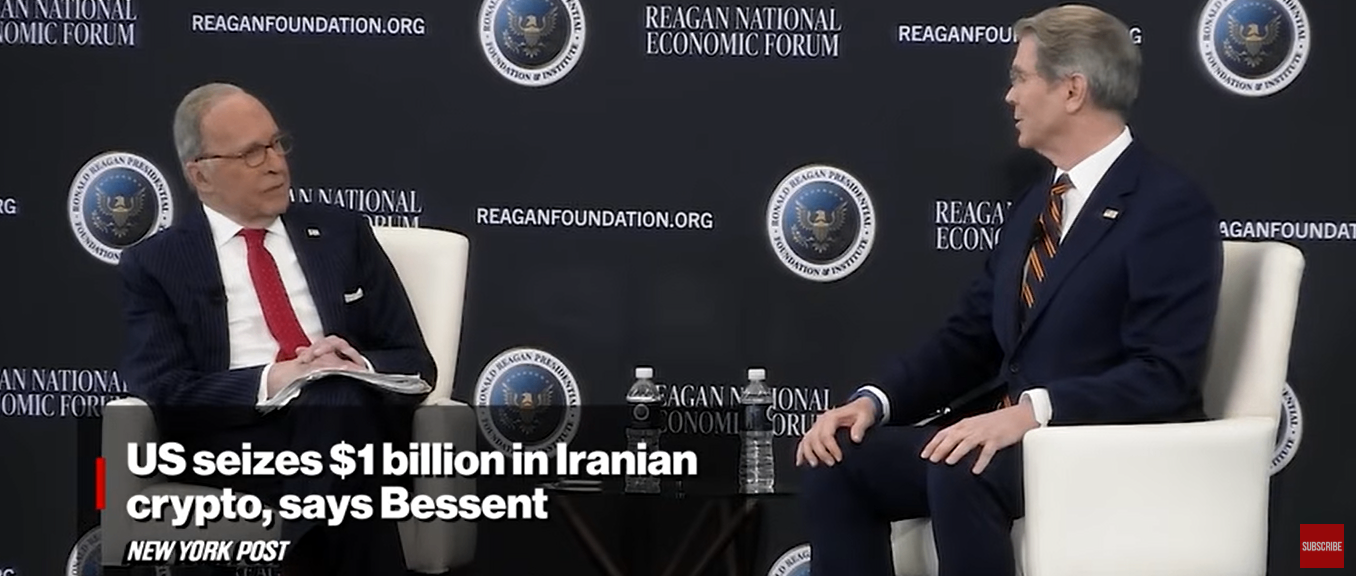
The United States has dramatically increased its reported seizure of Iranian cryptocurrency assets, with Treasury Secretary Scott Bessent revealing that authorities have now confiscated roughly $1 billion in digital assets linked to Iran. The announcement came during Bessent's appearance at the Reagan National Economic Forum, where he discussed the broader economic strategy being used by Washington to pressure Tehran. While previous government disclosures pointed to hundreds of millions of dollars in seized cryptocurrency, the latest figure suggests the scale of those efforts has expanded significantly in recent months. Speaking at the event, Bessent said: "I believe that we have seized about a billion dollars of their crypto." He followed that statement with a remark that quickly drew attention across both political and crypto circles:
The comments offered a rare glimpse into how digital assets are increasingly becoming part of modern sanctions enforcement. While government agencies have long frozen bank accounts and confiscated physical assets connected to sanctioned entities, cryptocurrency has become another battlefield in the broader effort to restrict financial flows. Bessent said the crypto seizures were carried out under Operation Economic Fury, a campaign launched in March 2025 that targets Iranian financial infrastructure across multiple fronts. According to the Treasury secretary, the initiative goes beyond cryptocurrency and includes freezing traditional banking assets and working alongside European allies to seize properties connected to sanctioned individuals and organizations. The newly disclosed figure stands out because it is substantially larger than previous announcements. In late April, US authorities reported approximately $500 million in seized Iranian crypto assets. Earlier disclosures placed the total closer to $344 million. The jump to nearly $1 billion suggests enforcement efforts have accelerated rapidly over the last several months. For the crypto industry, the announcement is another reminder that blockchain networks, while decentralized, are not immune to government action. As blockchain analytics tools continue to improve, authorities have become increasingly capable of tracking transactions, identifying wallet activity and targeting funds tied to sanctioned actors.
READ MORE: Iran War and AI Spending Could Push Bitcoin to $126K in 2026, Says Arthur Hayes
A Growing Financial Pressure Campaign Against Iran
Bessent framed the latest crypto seizures as part of a broader campaign that he believes has significantly weakened Iran's financial position. During his remarks, he pointed to what he described as a combination of military pressure and economic restrictions that have sharply reduced Tehran's financial flexibility. He stated:
The phrase immediately caught the attention of crypto observers because of its reference to Tether, the world's largest stablecoin. While the remark appeared, it highlighted how deeply cryptocurrency terminology has entered discussions around global finance and sanctions. Bessent also painted a bleak picture of Iran's economic situation. According to the Treasury secretary, Iranian leadership had been diverting substantial amounts of money each month before US intervention efforts intensified. He claimed the regime had been siphoning between $400 million and $500 million monthly and distributing those proceeds among roughly 80 leaders. He further argued that inflation inside Iran has likely exceeded 200%, while economic strain has led to food voucher programs, internet restrictions and payment challenges affecting military personnel. These claims reflect the US government's assessment of conditions inside Iran and form part of the rationale behind its continued sanctions strategy. At the same time, Bessent acknowledged that negotiations involving Iran remain complicated. He noted that recent military actions involving the United States and Israel have altered the country's leadership structure, creating additional challenges for diplomatic discussions. While geopolitical tensions often dominate headlines, the financial dimension of those conflicts has become increasingly important. Economic pressure campaigns now rely heavily on digital monitoring tools, sanctions enforcement mechanisms and international cooperation between governments and financial institutions. Cryptocurrency has become a key piece of that puzzle.
READ MORE: Fake Google Ads Targeting Uniswap Users Steal $400K, Analysts Warn
Why This Matters for Crypto and Global Finance
Over the last decade, cryptocurrencies have often been discussed as tools capable of moving value outside traditional banking systems. Supporters have praised that feature for promoting financial freedom and global access, while regulators have expressed concerns about sanctions evasion, illicit finance and cross-border enforcement. The latest disclosure demonstrates how governments are adapting to that reality. Authorities are increasingly treating blockchain networks as valuable sources of financial intelligence. Public blockchains create permanent transaction records that investigators can analyze years after funds move. Combined with exchange data, compliance programs and blockchain analytics platforms, those records can provide detailed insight into financial activity. That shift has changed the way sanctions are enforced.
In previous decades, financial restrictions primarily focused on banks and traditional payment networks. Today, digital wallets, smart contracts and blockchain infrastructure are becoming regular targets of enforcement efforts. The nearly $1 billion figure cited by Bessent suggests that crypto-related enforcement is no longer a niche activity. It is becoming a central component of how governments pursue financial pressure against sanctioned states and organizations. The announcement also highlights the growing intersection between crypto markets and geopolitics. Events that once seemed distant from the blockchain industry - international sanctions, military conflicts and diplomatic negotiations - are increasingly influencing how digital assets are monitored and regulated. Whether additional seizures will be disclosed in the coming months remains unclear. As governments continue investing in blockchain intelligence capabilities, the role of digital assets in sanctions enforcement is likely to expand further. The latest statement from the US Treasury suggests that trend is already well underway.
READ MORE: BIS Flags Risks in Dollar Stablecoins, Calls for Global Rules as Adoption Grows