

Summary:
- "Rich Dad, Poor Dad" author Robert Kiyosaki says a major financial crash is approaching.
- He predicts Bitcoin could reach $750,000 within a year after the crash.
- Kiyosaki believes the current system is driven by an unsustainable financial bubble.
- However, he notes that a higher Bitcoin price may not mean real wealth if living costs rise at the same pace.
- The prediction reflects broader concerns about inflation, money supply expansion, and asset pricing.
Robert Kiyosaki, widely known for his personal finance book Rich Dad, Poor Dad, has once again stirred debate with a bold warning about the global financial system. In a recent social media post, he suggested that a major collapse across traditional financial markets may be closer than many expect. Kiyosaki described the situation as the "biggest bubble" in history, hinting that multiple asset classes could be overvalued at the same time. While he did not point to a specific trigger, he emphasized that a breaking point is approaching. In his own words:
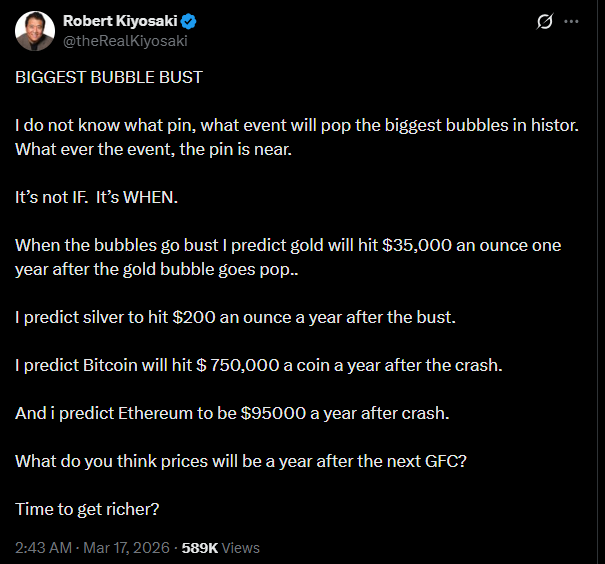
The prediction is wild? Well, a sudden correction in traditional markets, often referred to as TradFi, could push investors toward alternative assets. For Kiyosaki, Bitcoin sits at the center of that shift. He suggests that if the crash happens, the move to $750,000 could take place within a year. That short timeframe is what makes the statement viral. It reflects not just optimism about Bitcoin, but concern about how fast conditions could change if markets begin to break.
$750K Bitcoin Sounds Big - But There's a Catch
At first glance, a $750,000 Bitcoin price sounds extreme. But Kiyosaki's view becomes more nuanced when placed in a broader economic context. The key question is not just how high Bitcoin goes, but what that number actually means in real terms. If the cost of everyday life rises at the same pace, then a higher Bitcoin price may not translate into increased purchasing power. Housing, food, and energy costs could all move higher in a similar way, especially during periods of economic instability. That's the part many people overlook and Kiyosaki's prediction indirectly points to a situation where currency value weakens. In that environment, assets priced in those currencies tend to rise, because the currency itself is losing strength.
There's also a comparison to gold hidden in the numbers. A $750,000 Bitcoin price would still represent a discount compared to gold's total market value, even if it appears high on the surface. That framing suggests Kiyosaki is thinking in terms of relative value. So the headline number grabs attention, but the deeper message is about economic conditions.
Why Inflation and Money Supply Matter
To understand where Kiyosaki is coming from, it helps to look at how markets have behaved in recent years. Periods of rapid money supply expansion often lead to rising asset prices. When more money enters the system, it tends to flow into stocks, real estate, and other limited assets. This pattern was visible between 2020 and 2021, when global stimulus measures increased liquidity across markets. During that time, the S&P 500 rose by around 52%, while average home prices in major US cities climbed roughly 38% over two years. These moves were not isolated. They reflected a broader shift driven by increased money supply and demand for scarce assets.
Bitcoin often reacts strongly in these environments because of its fixed supply. There will only ever be 21 million BTC, making it fundamentally different from traditional currencies that can be expanded. Kiyosaki has consistently argued that this scarcity is what makes Bitcoin attractive during times of economic uncertainty. From that perspective, his prediction is less about speculation and more about how assets behave when confidence in traditional systems begins to weaken. But there's also a risk embedded in this view. If asset prices rise because of inflation rather than genuine economic growth, then gains may feel less meaningful. People might see higher numbers in their portfolios, but still struggle with rising costs in daily life.
READ MORE: Former UK PM Boris Johnson Says Bitcoin Is a Ponzi Scheme
A Familiar Warning With New Urgency
Kiyosaki has made similar warnings in the past, often pointing to debt levels, central bank policies, and currency devaluation as long-term risks. The idea that the "pin is near" suggests he believes the system is approaching a breaking point. At the same time, reactions to his prediction remain mixed. Supporters see it as a realistic view of how markets behave during periods of stress. They argue that Bitcoin has already proven its ability to recover and reach new highs after major downturns. Critics, on the other hand, point out that such forecasts depend on multiple assumptions. Timing a global financial collapse is extremely difficult, and price targets tied to those events are even harder to validate.
Still, predictions like this tend to resonate because they tap into broader concerns about the global economy. Rising debt levels, ongoing inflation pressures, and uncertainty around monetary policy continue to shape how investors think about the future. Whether Bitcoin reaches $750,000 or not, Kiyosaki's message centers on something bigger. It's about how value is measured in a world where financial systems are constantly shifting. And if his view turns out to be even partially correct, the conversation around Bitcoin won't just be about price. It will be about what that price actually represents in real life.
READ MORE : Top 10 Mid Cap Altcoins to Invest in For 2026