

Summary:
- Former UK Prime Minister Boris Johnson described Bitcoin as a "Ponzi scheme" in a newly published opinion article.
- Johnson argued that collectibles like gold and Pokémon cards have clearer long-term value than Bitcoin.
- His comments followed a story about a friend who lost thousands of pounds in a BTC-related investment scheme.
- The remarks quickly sparked backlash from the crypto community and industry leaders.
- Strategy co-founder Michael Saylor responded publicly, arguing that Bitcoin cannot be a Ponzi because it has no central operator or guaranteed returns.
Former United Kingdom Prime Minister Boris Johnson has reignited debate around cryptocurrencies after publicly describing Bitcoin as a "Ponzi scheme." The comments appeared in an opinion article published in the Daily Mail, where Johnson expressed long-standing skepticism toward the world's largest cryptocurrency. In the article, Johnson compared Bitcoin unfavorably to traditional collectibles. According to him, assets such as gold or even Pokémon cards have a clearer historical and cultural value. While these collectibles have existed for decades and attract a broad range of buyers, Johnson argued that Bitcoin does not carry the same tangible appeal. His remarks were framed around a personal story involving a friend who fell victim to what Johnson described as a fraudulent investment scheme tied to Bitcoin.
The friend initially gave 500 British pounds, roughly $661, to someone who promised to double the money by investing it in BTC. What began as a seemingly small investment gradually escalated into a much larger financial commitment. Johnson explained that the individual continued paying additional fees to the promoter over the next three and a half years. Despite the promises, the friend was never able to recover the funds. By the time the situation ended, the victim had reportedly lost 20,000 British pounds, or about $26,474, a sum that Johnson said caused serious financial hardship. Johnson used this example to highlight what he believes are the dangers surrounding cryptocurrency speculation. In his view, the story demonstrates how people can be drawn into schemes that exploit Bitcoin's popularity. Shortly after the article was published, Johnson shared it with his followers on X, reinforcing his skepticism toward the digital asset. In the post, he wrote:
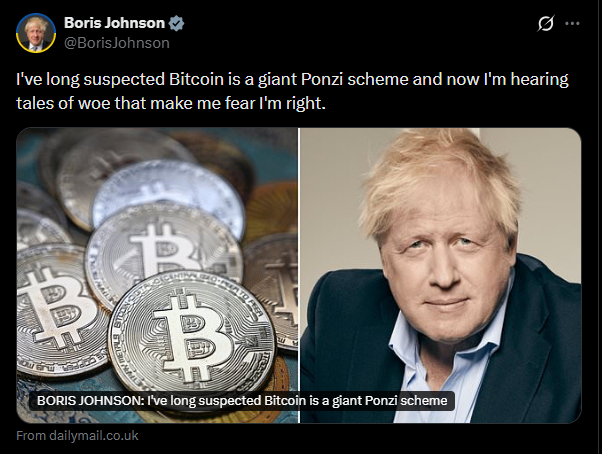
The comment quickly spread across social media, drawing thousands of responses from both supporters and critics.
Crypto Industry Responds: "Bitcoin Is Not a Ponzi"
Johnson's remarks triggered a swift reaction from the cryptocurrency community, with many industry figures pushing back against the characterization of Bitcoin as a Ponzi scheme. Among the most prominent responses came from Michael Saylor, co-founder of Strategy and a well-known advocate for Bitcoin. Saylor publicly challenged Johnson's claim, arguing that the fundamental structure of Bitcoin makes such a label inaccurate. In his response, Saylor explained that a Ponzi scheme requires a central operator who promises returns to investors and pays early participants with money collected from later ones. According to him, Bitcoin does not function in this way. Saylor wrote:
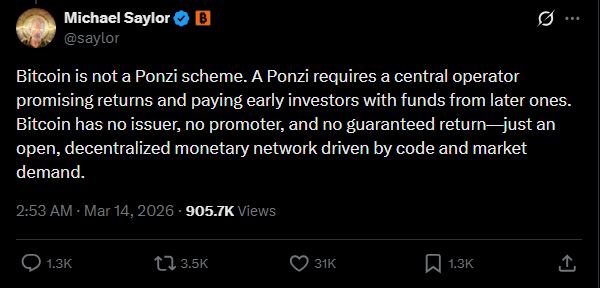
Many others in the crypto community, figures echoed this argument, pointing out that Bitcoin operates through a decentralized network structure. Unlike traditional scams, there is no company or individual guaranteeing profits to investors. Some commentators also argued that the type of fraud Johnson described in his article is not unique to cryptocurrency. Investment scams have existed for decades across many financial markets, including stocks, real estate, and commodities. In their view, the issue lies not with Bitcoin itself but with fraudulent actors who use its name to lure victims into schemes.
A Long-Running Debate Around Bitcoin
Johnson's comments highlight a broader debate that has surrounded Bitcoin since its creation in 2009. Critics have frequently questioned the digital currency's intrinsic value, while supporters argue that its decentralized design represents a new form of money. Supporters often compare Bitcoin to digital gold because of its fixed supply. The network is designed so that only 21 million bitcoins will ever exist, a feature intended to protect it from inflation. This scarcity, combined with growing adoption, has led many investors to view Bitcoin as a long-term store of value.
Over the past decade, Bitcoin has gradually moved from a niche technology experiment into a mainstream financial asset. Large institutional investors, publicly traded companies, and even some governments have begun holding Bitcoin as part of their financial strategies. At the same time, critics remain cautious. They often point to price volatility, speculative trading, and the presence of scams in the wider crypto ecosystem as reasons for concern. Johnson's comparison between Bitcoin and collectibles like Pokémon cards reflects this skepticism. While the collectible market has decades of history and established demand, cryptocurrencies are still relatively new in comparison.
However, Bitcoin supporters argue that the network's transparency and decentralized design make it fundamentally different from fraudulent schemes. Every transaction is recorded on a public blockchain, and the system operates without a central authority controlling the supply. This difference, according to advocates, is what separates Bitcoin from traditional financial fraud.
The Conversation Continues
The debate sparked by Johnson's comments illustrates how cryptocurrency remains a polarizing topic even among global political figures. While some policymakers have embraced digital assets as part of financial innovation, others continue to view them with skepticism. For the crypto community, the exchange serves as another example of the ongoing effort to explain Bitcoin's underlying principles to a broader audience. Industry leaders frequently emphasize education, transparency, and responsible investment practices as key tools for addressing misconceptions.
At the same time, stories like the one Johnson described highlight a real challenge within the digital asset space. Fraudulent investment schemes often attempt to exploit Bitcoin's popularity, making it important for investors to carefully verify any opportunity that promises guaranteed returns. As Bitcoin continues to gain attention from governments, financial institutions, and the public, discussions like this are likely to remain part of the conversation. Whether viewed as a revolutionary monetary system or a speculative asset, Bitcoin's role in the global financial landscape continues to evolve.
READ MORE: SEC Drops Case Against Justin Sun After $10M Settlement, Closing Three-Year Crypto Lawsuit