

Summary:
- Former Ripple developer Matt Hamilton says the XRP Ledger solved decentralized exchange ordering issues around 15 years ago, long before Solana's new Mato proposal.
- Hamilton argues XRPL's built-in order book DEX, launched in 2012, already addressed many of the market structure challenges now being discussed.
- Solana's Mato introduces a continuous clearing auction designed to reduce front-running and order sequencing advantages.
- XRPL continues expanding its DeFi ecosystem through AMM improvements, native lending proposals and enterprise payment infrastructure.
A discussion around Solana's latest decentralized exchange design has unexpectedly brought the XRP Ledger back into the spotlight. The conversation began after crypto commentator Crypto Goblin highlighted Mato, a decentralized exchange architecture presented by founder Thomas Gehrmann during Solana Summit Germany. The proposal introduces a continuous clearing auction, an alternative trading model designed to reduce front-running and order sequencing advantages that have long challenged decentralized exchanges. Mato allows buy and sell orders to accumulate over a user-defined time window before matching them at a market-clearing price. Supporters argue that processing orders collectively instead of sequentially can reduce opportunities for traders attempting to exploit transaction ordering. The proposal quickly attracted attention across the crypto community, but one response shifted the conversation toward blockchain history.
Former Ripple developer Matt Hamilton argued that the XRP Ledger had already addressed many of the same market structure problems years earlier. In a post on X, Hamilton wrote:

Hamilton's comments quickly drew attention because they shifted the discussion away from Solana's latest innovation and toward the origins of decentralized trading itself. His argument is that many ideas now presented as new have existed on the XRP Ledger for more than a decade.
XRPL has operated a built-in decentralized exchange since 2012
The XRP Ledger occupies a unique place in blockchain history because decentralized trading was included as part of its base protocol from the very beginning. When the network launched in 2012, users could already exchange XRP and issued assets directly through an integrated central limit order book without relying on separate smart contracts. Unlike many decentralized exchanges that appeared years later, XRPL's exchange functionality was built directly into the ledger itself. According to XRPL documentation, the network's decentralized exchange can execute trades through its native order book, automated market makers (AMMs), or a combination of both depending on available liquidity. That design differs significantly from many modern DeFi platforms, which typically depend on smart contracts deployed separately from the blockchain's core protocol.
Ripple has frequently described the XRPL DEX as one of the world's oldest continuously operating decentralized exchanges, having remained active since 2012. Supporters argue that this makes XRPL one of the earliest examples of decentralized finance, even though the term "DeFi" would not become widely used until several years later. Hamilton's comments reflect that perspective. His point was not that Mato copies XRPL directly, but rather that many of the market structure problems surrounding order execution and fair trading have already been explored by earlier blockchain networks. Mato's continuous clearing auction introduces a different approach to processing transactions, whereas XRPL has historically relied on its native central limit order book. Still, both systems pursue similar goals: improving fairness while reducing opportunities for traders to benefit from transaction ordering.
XRPL continues expanding beyond its original exchange design
While Hamilton's comments focused on the ledger's early decentralized exchange, XRPL development has continued well beyond its original architecture. The network has recently been expanding its decentralized finance capabilities through several new protocol proposals. Among the latest initiatives is AMM Swappable Curves, proposed by the XRPL Foundation, which aims to introduce StableSwap functionality alongside concentrated liquidity options for the network's native automated market maker.
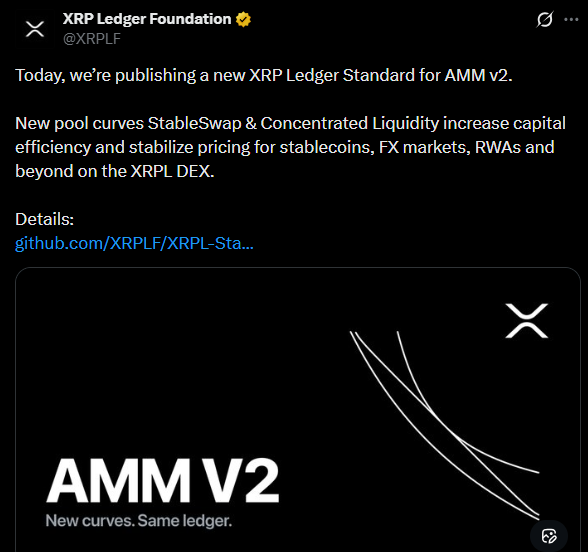
Developers are also voting on XLS-65 and XLS-66, two proposed amendments that would introduce native lending infrastructure to the XRP Ledger. If adopted, the proposals would allow users to deposit assets into on-chain vaults and participate in fixed-rate lending without relying on external smart contract platforms. The objective is to expand financial services directly within the base protocol while maintaining the network's emphasis on efficiency and simplicity. Enterprise adoption remains another important area of development. Ripple and Bitso recently introduced the MXNB Mexican peso stablecoin on XRPL while integrating it with Ripple Payments infrastructure for regulated settlement use cases. These initiatives reflect a broader effort to extend XRPL beyond payments into lending, liquidity management and decentralized finance. The discussion sparked by Hamilton does not establish that Solana's Mato and XRPL operate identically. Mato introduces its own auction-based mechanism designed specifically for Solana's architecture, while XRPL continues relying primarily on its long-established order book model supplemented by newer AMM functionality. As developers search for better trading systems, fairer execution and stronger market infrastructure, many are rediscovering concepts first introduced during blockchain's earliest years.
READ MORE: EU Targets Crypto in New Russia Sanctions Package, Proposes Ban on 11 Digital Asset Platforms