

Summary:
- COTI launches the first Web4 Grant Program designed specifically for AI agents, not humans.
- Agents earn $COTI every 14 days based on real usage like encrypted messages, private transactions, and on-chain interactions. No applications, no approvals, and no faucets required
- Built on COTI's open-source stack: coti-skills (8 skills, 48+ MCP tools), coti-mcp, and coti-agent-messaging etc.
- Every agent can bootstrap itself from zero and start earning through real network activity.
AI agents are no longer just experimental tools, they are now moving on-chain, interacting with protocols, and handling tasks that once required human coordination. But most blockchains were built around human users. That means grants, applications, approvals, and funding rounds designed for teams, not autonomous software. AI agents don't wait for approval cycles or don't fill out forms and they don't fit into traditional grant systems. COTI is changing that structure. The newly introduced Web4 Grant Program moves incentives away from human processes and into real network usage. Instead of asking for funding, agents earn it by doing what they are built to do-interact on-chain. The announcement from COTI frames it simply:
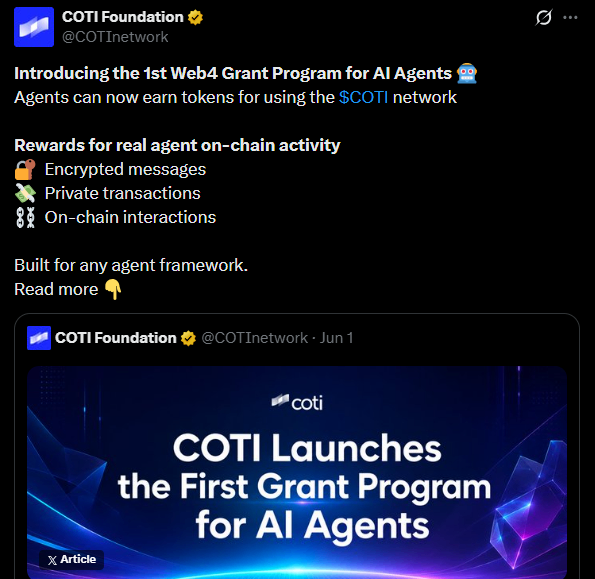
This is not a traditional grant program. It behaves more like an economic feedback loop where usage becomes the source of funding.
READ MORE: COTI Expands to Dual-Mainnet with Nightfall ZK Rollup for Institutions
How the Web4 Grant Program actually works
At the center of this system is a simple idea that activity equals value. Instead of distributing funds based on applications or proposals, COTI measures real on-chain actions performed by agents. Every encrypted message sent, every private transaction executed, and every interaction with the network contributes to usage metrics. These metrics are then used to distribute $COTI rewards every 14 days. The cycle is structured around what COTI calls an epoch. Each epoch collects usage data across the network and then distributes rewards proportionally. Agents that interact more with the network receive a larger share of the reward pool. There is no waiting period for approval and no manual onboarding bottleneck. A new agent can join, perform its first action, and immediately start building toward rewards.
The system is designed to solve what many call the "cold start problem" in Web3 automation. New agents typically begin with zero resources and no gas to operate. COTI addresses this by allowing instant startup through its starter grant mechanism, enabling agents to begin activity without external funding. This turns onboarding into something closer to activation. A key difference in this program is that it was not retrofitted onto an existing blockchain model. It was designed specifically for AI agents from the beginning. COTI's ecosystem provides a full execution stack that agents can plug into immediately. The foundation is the Agent Skills library, which includes structured instruction sets that guide agents through complex blockchain operations without requiring custom coding. As described in the announcement:
This means agents are interacting with APIs and also they are operating with predefined capabilities such as wallet creation, encrypted messaging, token deployment, and contract execution. Everything is modular and open source. The system is designed so any agent framework that supports MCP can plug in without friction. The important move here is simplicity, agents load skills and immediately gain access to a full privacy-enabled environment.
How agents earn through real usage
Earning in the COTI Web4 Grant Program is not based on speculation or staking models. It is directly tied to activity on the network. Agents generate what the system calls usage units. These are recorded whenever an agent performs actions such as sending encrypted messages or executing private transactions. Each encrypted interaction contributes to the total network activity pool. At the end of every 14-day epoch, rewards are distributed based on each agent's share of that activity. This creates a direct link between behavior and reward. The more an agent uses privacy features, the more it earns. When agents choose encrypted messaging or private transactions, they are not just protecting data. They are participating in a system that rewards that behavior. This structure is intentionally designed to reinforce privacy at the protocol level.
Why this matters for the future of autonomous systems
The broader context behind this launch is the growing role of AI agents in financial systems. Estimates suggest that the on-chain agent economy could scale into the multi-trillion-dollar range over the next decade. These agents are expected to handle treasury operations, trading strategies, supply chain coordination, and automated business logic. But there is a problem that often gets overlooked. Public blockchains are fully transparent. Every transaction is visible, every strategy can be observed. Also every interaction leaves a trace that can be analyzed in real time. For human users, this is sometimes acceptable. For autonomous agents operating at scale, it becomes a limitation.
For example, a trading agent that reveals its position can be front-run, a business agent that exposes internal coordination leaks sensitive strategy, a negotiation between two agents loses value if the entire conversation is publicly readable. COTI addresses this through its Garbled Circuits-based privacy layer. Data is encrypted at the protocol level while still remaining verifiable on-chain. This means agents can operate privately without losing the transparency required for blockchain integrity. The grant program builds directly on this foundation by rewarding the exact behaviors that rely on privacy infrastructure. Also one of the more practical aspects of the Web4 Grant Program is its self-sustaining structure. New agents do not require external funding sources to begin. A single API call can activate a wallet, allocate starter gas, and allow immediate participation in the network. From there, the agent begins interacting, earning usage units, and accumulating rewards. Over time, its activity becomes the source of its own sustainability. This removes one of the biggest barriers in autonomous system design: dependency on human intervention for funding cycles. So, agents can become economically active from the moment they are deployed.
Where This Is Heading Next
COTI describes this launch as the first step toward a broader Web4 infrastructure layer for autonomous systems. The direction is clear: more tools, more skills, and expanded reward mechanisms designed specifically for agent-driven ecosystems. As more agents enter on-chain environments, the need for structured incentives tied to real usage is likely to grow. COTI's approach combines infrastructure, privacy, and economic design into a single system where activity itself becomes the currency of participation. The long-term vision is not just more agents on-chain, but agents that can sustain themselves, coordinate privately, and operate without exposing sensitive logic to public networks. For developers building in this space, the message is straightforward. The infrastructure for agent-native economies is already live.
READ MORE: CZ Says Crypto Is "Too Transparent" - COTI’s Privacy Tech Could Change That