

Summary:
- COTI is launching Nightfall, an enterprise-focused ZK Rollup for compliant privacy
- It will run alongside COTI's existing Garbled Circuits (GC) mainnet
- GC focuses on speed and low cost - Nightfall focuses on compliance and institutions
- Built on tech originally developed by EY, now upgraded into a full ZK rollup
- Same $COTI token powers both networks with 1:1 bridging and no new supply
- Marks COTI's shift into a multi-chain, all-in-one privacy protocol
Privacy in crypto isn’t a new conversation, but the way people think about it has changed a lot. Early on, most solutions were built around hiding transactions or staying anonymous. That worked for individuals, but it never really fit what institutions needed. Banks, asset managers, and regulated entities don't just want privacy - they need control, compliance, and auditability at the same time. Public blockchains are transparent by design. That's great for verification, but it creates problems when real money, sensitive data, or regulated assets are involved. You can't expect a financial institution to move billions on-chain if every transaction detail is visible to anyone watching.
At the same time, the demand has increased and stablecoin usage is climbing rapidly. Real-world assets are moving on-chain and governments and enterprises are testing blockchain systems in controlled environments. The interest is there but the infrastructure hasn't fully matched those requirements. This is the gap COTI is trying to close and solve. Until now, COTI has focused heavily on Garbled Circuits, building one of the fastest and most cost-efficient privacy layers available. That approach works well for builders, DeFi apps, and high-volume systems. But enterprise use cases come with a different set of constraints. Instead of trying to force one solution to fit everything, COTI is expanding its approach and adding a second path, designed specifically for institutions and that path is Nightfall.
What Is COTI Nightfall
COTI Nightfall is a Zero-Knowledge (ZK) Rollup designed for private and compliant transactions on Ethereum-compatible networks. It allows transactions to remain confidential while still meeting the transparency and verification standards that institutions expect. At its core, Nightfall bundles transactions together, processes them off-chain, and then settles them on-chain using zero-knowledge proofs. This keeps sensitive data hidden while still proving that everything is valid.
But the key difference is its compliance. Nightfall includes features like KYC gating and permissioning. That means access can be controlled, identities can be verified when needed, and transactions can still meet regulatory requirements. This is something most privacy solutions don't handle well and it's very important to be clear here. Nightfall is not replacing Garbled Circuits - it's expanding COTI's privacy stack. Instead of one approach trying to cover everything, COTI is now building a system where different technologies handle different needs. One for speed and flexibility and on the hand, another for compliance and institutional use.
READ MORE: What Are Garbled Circuits? Easy Explanation And Recent Advances
Why Nightfall Brings Credibility
One of the biggest concerns with new blockchain infrastructure is risk. If a system hasn't been tested, institutions won't touch it and that's why the origin of Nightfall matters. Nightfall wasn't built from scratch by COTI Network. It was originally developed by Ernst & Young (EY) in 2019, one of the largest professional services firms in the world. Over the years, it has gone through multiple upgrades, eventually evolving into a full ZK Rollup architecture in 2025. And honestly, that history changes the conversation. It's technology that has been developed with enterprise use cases in mind from the beginning. EY operates across more than 150 countries and works directly with large financial institutions, which means Nightfall was designed with real-world constraints.
The system focuses on enabling private transactions while maintaining auditability. It allows companies to keep sensitive data hidden without losing the ability to verify and report activity when needed. That balance is what institutions care about and this partnership reflects that alignment.
By integrating Nightfall, COTI isn't just adding another feature or something like that. It's bringing in a system that already fits how enterprises operate.
Nightfall Already Used in Production
Another important detail here is that Nightfall isn't limited to one ecosystem. It has already been explored and integrated in other environments, which reduces the risk of it being seen as untested infrastructure. One recent example is its connection to StarkWare's ecosystem. Nightfall-based privacy solutions have been explored within Starknet to enable confidential transactions for institutional use cases on public blockchains.
This matters because it shows a broader trend. Institutions are not just experimenting with blockchain anymore and they are actively looking for ways to use it without exposing sensitive information and multiple ecosystems are converging on the same conclusion. Privacy needs to be built into the infrastructure itself. By bringing Nightfall into its ecosystem, COTI is aligning with that direction while combining it with its own approach through Garbled Circuits.
The Dual-Mainnet Strategy
COTI Network is now operating with two mainnets, each designed for a different purpose. Garbled Circuits (GC) remains the foundation for builders. It focuses on speed, low cost, and scalability. It allows developers to run private computations directly on-chain without heavy overhead. This makes it suitable for DeFi, AI applications, identity systems, and high-frequency environments where performance matters. Nightfall, on the other hand, is designed for institutions. It focuses on compliance, structured workflows, and regulated environments. It includes built-in mechanisms for identity verification, permissioning, and regulatory alignment. This makes it suitable for tokenized assets, financial systems, and enterprise-grade applications.
GC handles flexibility and performance and on the other hand, Nightfall handles structure and compliance. But they both exist within the same ecosystem. That means developers and institutions don't need to choose between completely separate networks. They can operate within the same framework, using the same token, while selecting the privacy model that fits their needs. This separation avoids a common problem in crypto that tries to force one system to do everything. Instead, COTI is building a layered approach.
Is COTI Moving Away from Garbled Circuits
This is a question that comes up quickly whenever a new system is introduced. The short and clear answer is no.
Garbled Circuits remain central to COTI's ecosystem, especially for builders and existing projects. The focus there hasn't changed. If anything, it becomes more defined now that Nightfall exists alongside it. COTI's leadership has already addressed this clearly. COTI's CMO Amateo Kaplan said in Telegram announcement,
The message is clear that different users need different tools. Builders still rely on GC for fast, scalable applications. Nightfall is covering a different segment entirely. Institutions operate under constraints that builders don't face. They need compliance layers, identity checks, and structured environments and that's where Nightfall fits.
Why Now - The Timing Behind This Move
The broader market is already moving in this direction. Stablecoin usage alone shows how quickly things are scaling. According to Dune Analytics, stablecoin transfer volume exceeded $10.5 trillion in a single month earlier this year.
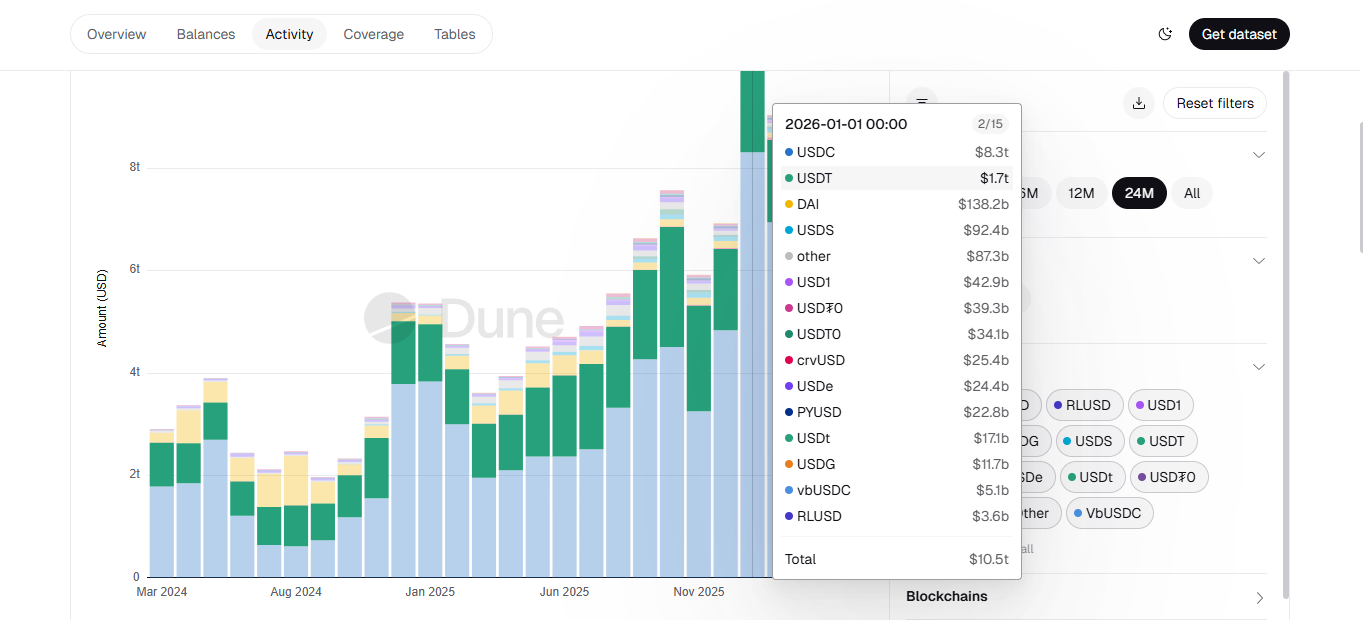
That kind of volume doesn't come from experiments stage. At the same time, tokenized real-world assets are gaining traction. Financial institutions are exploring blockchain-based systems for settlement, asset management, and cross-border transactions. But all of this runs into the same issue that transparency without privacy doesn't work for institutions. Regulators are also becoming more active and on the other hand, Compliance requirements are tightening. Any system that wants institutional adoption needs to meet those standards from the start. That's the gap Nightfall is built for.
What Nightfall Enables
Nightfall opens up a range of use cases that were difficult to support on public blockchains. Confidential transactions are one of the most obvious. Institutions can move assets without exposing amounts, counterparties, or internal structures, while still proving that transactions are valid. Private DeFi is another area. Financial strategies, positions, and execution logic can remain hidden, which reduces the risk of front-running and competitive exposure. Tokenized real-world assets become more practical as well. Assets like commodities, real estate, or financial instruments can be represented on-chain while keeping ownership and transaction details private. Regulated payments are also a key focus. Systems can enforce compliance rules while maintaining confidentiality, something traditional blockchains struggle with.
Identity and compliance layers tie everything together. Instead of exposing user data publicly, Nightfall allows selective disclosure, meaning only the necessary information is shared when required. Nightfall change how blockchain can be used in regulated environments.
One Token, Two Networks
Despite the expansion, The same $COTI token powers both networks. There's no new token being introduced or No additional supply. Instead, the existing token is used across both the GC mainnet and the Nightfall ZK mainnet. The bridge between the two operates on a 1:1 basis, meaning value moves across networks without dilution. The token is now used across a broader set of use cases, from high-speed applications on GC to compliance-driven systems on Nightfall. Fees, staking, and governance all extend across both networks. This keeps the ecosystem unified while expanding its reach. The testnet for Nightfall is expected soon(coming weeks), giving developers and partners a chance to explore the system. The full mainnet launch is planned for this year.
Final Thoughts
Garbled Circuits already gave developers a fast and cost-efficient way to work with private data. That part stays but now there's a second layer built for a different audience - one that needs structure, compliance, and control. Not every user wants the same thing from a blockchain. Builders want flexibility, on the other hand Institutions want certainty. Now there are two clear paths inside the same ecosystem. Different tools, different use cases, but still connected. So, COTI isn't just building privacy. It's starting to shape how privacy gets used, depending on who's using it.