

Summary:
- Vitalik Buterin raised concerns about governance, privacy, and secure multi-party computation in decentralized systems.
- Vitalik Buterin Highlights Garbled Circuits tech on his tweet.
- COTI is already live with a production-ready implementation of optimized Garbled Circuits through its gcEVM.
- This positions COTI ahead in delivering scalable, practical on-chain privacy for governance, finance, and beyond.
- As privacy concerns grow across the crypto industry, adoption of real cryptographic privacy solutions.
Privacy has once again become one of the most serious conversations in crypto. From CZ raising concerns about transparent on-chain payments to broader debates about AI governance and decentralization, the industry is being forced to confront a hard truth that transparency alone is not enough. Public blockchains were designed to maximize visibility and trust. But as adoption grows, payments, negotiations, voting, compensation decisions etc not everything can be fully exposed on a public ledger without consequences. While the blockchain privacy landscape has evolved with innovations like Fully Homomorphic Encryption (FHE) and Zero-Knowledge proofs (ZKPs), TEE, and another strong technology that has existed for decades - is quietly emerging as a practical and scalable solution for on-chain confidentiality.
That's Garbled Circuits. COTI's implementation of Garbled Circuits is already live in production, running through its Ethereum Layer 2 infrastructure. As the industry debates what privacy should look like, COTI is deploying it. The conversation gained new momentum when Ethereum co-founder Vitalik Buterin shared his thoughts on decentralized governance, AI, and the role privacy must play in making democratic systems work at scale.
What Vitalik Is Really Concerned About
In his recent post, Vitalik explored the risks of handing too much control to centralized AI systems while also acknowledging the limits of fully decentralized governance. He argued that while AI replacing government would be dystopian, AI used correctly could strengthen decentralized and democratic systems. Also, In decentralized governance models like including DAOs - participants are expected to evaluate and vote on countless decisions across complex. Most people simply do not have the time or expertise to meaningfully engage with every proposal. Delegation helps but it creates concentration of power. Once someone delegates their vote, influence moves toward a smaller group.
Vitalik proposed that personal AI agents could help solve this attention gap. These agents could act according to an individual's preferences, stepping in to vote or evaluate proposals when needed. But that creates a new issue and that's Privacy. For such systems to work, sensitive data must sometimes be processed. Governance often involves confidential negotiations, dispute resolutions, and compensation decisions. These situations cannot function properly if every detail is publicly exposed. He emphasized that decentralized governance struggles when private information must be considered. In traditional organizations, this problem is solved by assigning power to specific individuals who can access confidential data. But that reduces decentralization.
Vitalik suggested that multi-party computation could offer a solution, allowing multiple participants to evaluate sensitive information without revealing it publicly. He specifically wrote on X :
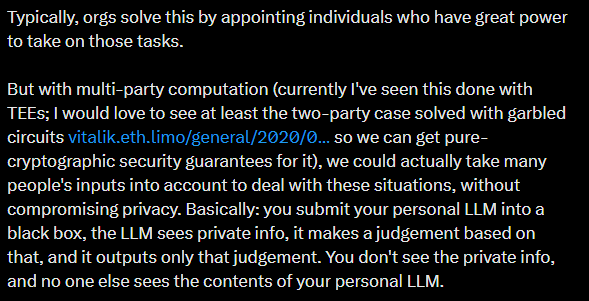
Vitalik mentions garbled circuits because while many discussions around privacy remain theoretical or hard to scale, COTI has already implemented garbled circuits at the blockchain level.
What's the Two-Party Case
To understand why Vitalik mentioned the "two-party case," we need to go back to 1982. Computer scientist Andrew Yao introduced what became known as the Millionaires' Problem. The challenge was simple: how can two millionaires determine who is richer without revealing their actual wealth? The goal was to compute a result privately. Yao's solution laid the foundation for secure multi-party computation. His method - Garbled Circuits - allowed parties to encode computations in a way that the result could be calculated without revealing the underlying inputs.
In simple terms, two participants could jointly compute an answer while keeping their individual data secret. This concept has since evolved into a broader field of privacy-preserving computation. But for decades, practical implementation remained limited due to performance constraints. COTI, in partnership with Soda Labs, claims to have engineered the first-ever blockchain implementation of optimized Garbled Circuits which is already live. Recently, COTI shared a short explanation video about the Millionaires' Problem solution on X:
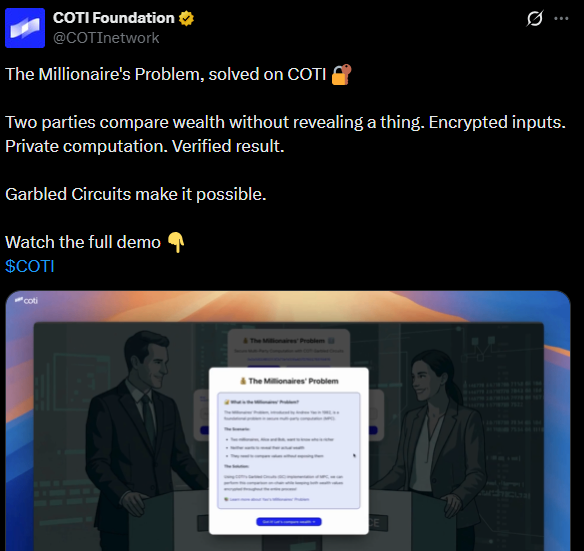 Source: Video link
What Are Garbled Circuits And Why Do They Matter Now?
At its core, Garbled Circuits allow multiple parties to compute a function together without revealing their private inputs. Think of it as running a calculation inside a sealed box where everyone gets the final answer, but no one sees the data that went inside. Historically, Garbled Circuits faced a major limitation that participants had to exchange large amounts of data to maintain synchronization. That made implementations slow and impractical for blockchain environments. But after the COTI partnership with Soda Labs, they successfully implemented the first-ever blockchain with optimized Garbled Circuits.
According to the COTI benchmark, their system achieves performance approximately 3000 times faster than FHE-based systems and 250 times lighter than alternative privacy solutions. That removes one of the biggest problems in privacy technology and the constant balance between security and usability. As an Ethereum Layer 2, COTI's gcEVM enables real-time, multi-party, private execution while remaining fully EVM-compatible. Developers can integrate confidential computation directly into smart contracts without rewriting their entire stack. Privacy infrastructure becomes programmable and importantly, it runs on Ethereum's security foundation.
Why This Matters for Governance and Real-World Applications
Vitalik's concerns are totally valid and badly needed solution for the industry. Governance systems break down when sensitive decisions must be made publicly. Because if everything is transparent, strategic information leaks. If everything is centralized, decentralization fails and that shouldn’t be. Garbled Circuits offer a third path. Participants can submit inputs privately. Computation happens securely. Only the final decision is revealed.
No single authority holds the data and on the other hand, no participant sees more than they should. This approach extends far beyond governance. Finance, healthcare, identity systems, and enterprise applications all require private computation. Traditional institutions will not adopt blockchain infrastructure if confidentiality cannot be preserved. COTI positions itself as the programmable privacy layer for Web3, enabling confidential transactions and multi-party computation without sacrificing performance.
In a landscape where privacy discussions often remain conceptual, COTI is already running these computations in production.
COTI's Role in the Emerging Privacy Standard
COTI stands as the first blockchain to implement Garbled Circuits in a live production environment. By combining decades of cryptographic research with modern engineering optimization, COTI is attempting to bridge a long-standing gap between theory and real-world deployment. As Ethereum scales and institutional adoption grows, privacy demands will increase. ZK proofs address anonymity. But content privacy - the confidentiality of the data being processed - requires more advanced multi-party computation tools. Vitalik's reference to garbled circuits suggests that even Ethereum's leadership recognizes this need.
COTI's gcEVM positions the network ahead of all competitors in this category. It allows developers to build applications where sensitive business logic executes privately, multi-party negotiations occur on-chain, Financial transactions remain confidential and governance decisions incorporate secret inputs. All without abandoning decentralization.
Adoption May Be Closer Than It Appears
Privacy in crypto has often been reactive - responding to regulatory pressure or user demand after problems emerge. But the conversation is moving. When figures like Vitalik Buterin openly discuss garbled circuits as a desired solution for secure multi-party computation, it signals recognition at the highest levels of blockchain development.
The industry is asking how to implement it without sacrificing scalability. COTI appears to have chosen its direction early. While others experiment with research-stage solutions, COTI is deploying optimized Garbled Circuits today. COTI's implementation suggests that practical, scalable, programmable privacy is fully operational. As adoption discussions continue and privacy becomes non-negotiable, the projects already delivering cryptographic guarantees may define the next chapter of Web3. The path to widespread adoption is already started and happening now, and COTI is at the forefront.
Final Thoughts
Crypto's next phase will not be defined only by speed or fees. It will be defined by whether blockchains can handle real-world complexity. Governance requires discretion, Finance requires confidentiality and Institutions require compliance without exposure. Vitalik's remarks highlight a gap in decentralized systems: the need for secure, private computation that does not rely on centralized trust.
COTI is already delivering it at scale. While other projects are still exploring the possibilities of secure computation, COTI has live implementations, proven technology, and performance that’s hundreds to thousands of times faster than alternatives or competitors. This combination of real-world experience and cutting-edge cryptography positions COTI as a leader in programmable privacy, giving developers and institutions the tools to build secure, confidential, and practical blockchain applications today.
READ MORE: Launch Your Idea on COTI and Earn Up to 50,000+ COTI