

Summary:
- Arthur Hayes said he sold his entire Zcash position following the disclosure of a critical Orchard Pool vulnerability.
- The bug, which reportedly existed since 2022, raised concerns about ZEC's supply integrity despite no evidence of exploitation.
- Hayes said the incident broke his investment thesis around privacy-focused assets and forced him to reassess his position.
- ZEC fell sharply after the disclosure, while major holders saw tens of millions of dollars wiped from their portfolios.
- Hayes left the door open to buying back into Zcash if future analysis proves his concerns unfounded.
Privacy coins have spent years positioning themselves as a response to increasing surveillance in the digital age. For many supporters, that narrative depends on absolute confidence in the integrity of the underlying network. That confidence was shaken this week after a critical vulnerability affecting Zcash's Orchard Pool became public, prompting one of the sector's best-known investors to completely exit his position. Arthur Hayes, chief investment officer of Maelstrom and co-founder of BitMEX, announced that he had sold all of his Zcash holdings following the disclosure of the vulnerability. In a post on X, Hayes explained that the issue fundamentally changed how he viewed the investment.
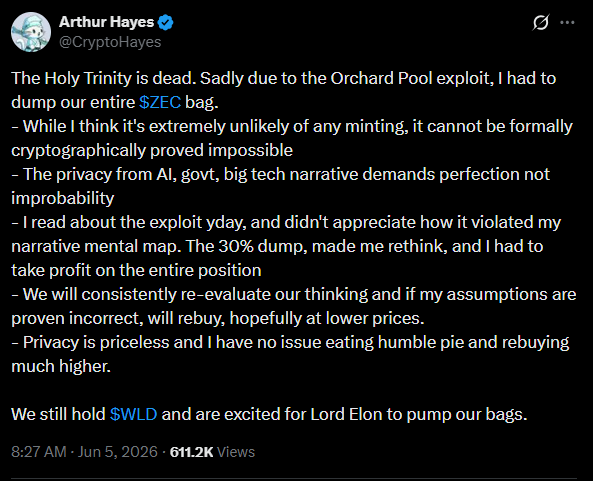
The decision marks a notable shift for Hayes, who has previously been among the more vocal supporters of privacy-focused cryptocurrencies. While he stopped short of claiming the network had been exploited, he argued that the possibility alone was enough to challenge the assumptions behind his investment thesis. The vulnerability was discovered on May 29 and fixed on June 1, according to Shielded Labs. Developers have stated there is no evidence that the flaw was ever exploited and no unauthorized creation of ZEC has been detected. Still, for Hayes, the issue appears to be about what might have been possible. He explained that although he considers it highly unlikely that any illicit minting occurred, the fact that it could not be mathematically ruled out created uncertainty around the network's supply guarantees. The investor later expanded on his reasoning, saying the incident forced him to rethink the framework through which he evaluated privacy-focused assets. Hayes argued that privacy networks compete on trust and security standards that leave little room for ambiguity. In his view, users seeking protection from governments, large technology companies, and increasingly sophisticated AI systems expect a level of certainty that goes beyond probabilities. According to his comments, reading more details about the vulnerability and witnessing the subsequent market reaction convinced him that taking profits and exiting the position was the prudent move.
Why the Orchard Pool Vulnerability Matters
The Orchard Pool is one of Zcash's modern shielded transaction systems and forms a central part of the network's privacy infrastructure. The disclosed bug reportedly had the potential to allow unlimited ZEC creation under specific circumstances. While developers moved quickly to patch the issue and emphasized that no exploit had been observed, the nature of the vulnerability triggered broader concerns among investors.
READ MORE: US Seized Nearly $1 Billion in Iranian Crypto, Treasury Secretary Says
In cryptocurrency networks, supply integrity is one of the most important assumptions underpinning value. If investors begin questioning whether a token's supply could theoretically be manipulated, confidence can deteriorate rapidly regardless of whether any actual exploit occurred. This helps explain why the market reaction was so severe. Following the disclosure, ZEC experienced one of its sharpest declines in recent years. The token lost more than 40% of its value as traders rushed to reassess risk. The selloff extended beyond retail investors. Blockchain intelligence platform Arkham highlighted the impact on a major ZEC holder whose portfolio value fell dramatically during the downturn.
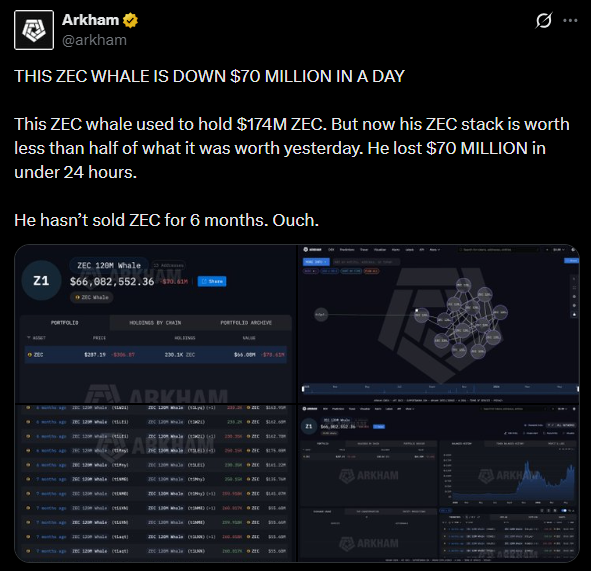
The scale of the decline illustrates how quickly sentiment can shift when questions emerge around a network's core security assumptions. The incident also arrives at a time when privacy coins face increasing scrutiny from regulators around the world. Many exchanges have already restricted or delisted privacy-focused assets in certain jurisdictions, making investor confidence even more important for the sector's long-term growth. Against that backdrop, any event that raises doubts about security can carry consequences beyond short-term price action.
Hayes Says He Could Return if Confidence Is Restored
Despite his decision to exit, Hayes did not completely close the door on Zcash. In his comments, he made clear that his current position is based on his understanding of the situation today, not necessarily a permanent rejection of the project. He suggested that ongoing analysis and additional technical clarification could change his view. If future evidence demonstrates that his concerns about supply integrity are misplaced, he said he would be willing to re-enter the market. Notably, Hayes indicated that he would even be comfortable buying back at higher prices if doing so meant regaining confidence in the network's long-term security. That distinction highlights an important reality for crypto markets. Security incidents often create immediate price volatility, but long-term outcomes depend heavily on transparency, communication, and how effectively development teams respond.
For Zcash, the focus now shifts from emergency remediation to rebuilding trust. Developers have already addressed the vulnerability, and there is currently no indication that any unauthorized minting took place. However, investors will likely continue examining the details of the incident, looking for reassurance that similar risks cannot emerge again. The broader debate may ultimately extend beyond Zcash itself. As blockchain networks increasingly compete on privacy, security, and institutional credibility, the standard investors apply is becoming stricter. Hayes' reaction reflects that reality. His decision was not based on confirmed losses or evidence of exploitation, but on the possibility that a critical assumption underlying the network could no longer be accepted without question. Whether that concern proves justified remains to be seen. For now, the incident serves as a reminder that in crypto markets, perception of security can be almost as important as security itself.
READ MORE: Zcash Restores Orchard After Emergency Upgrade Fixes Critical Vulnerability