

Summary:
- Blockchain speed, measured in transactions per second (TPS), plays a major role in user experience and scalability.
- Faster networks reduce congestion, lower transaction costs, and support complex Web3 applications.
- Several modern blockchains now process hundreds of transactions per second in real-world conditions.
- According to data from Chainspect, networks like Internet Computer, Solana, and BNB Chain rank among the fastest blockchains currently operating.
Blockchain speed directly affects transaction costs, usability, and overall user experience. Slow networks can lead to congestion, rising fees, and delayed transactions-issues that often frustrate users and developers alike. Traditional blockchain networks were not originally designed to support global-scale activity. As a result, when demand increases, these systems may struggle to process transactions efficiently. Many users have experienced delays, higher fees, or failed transactions when network demand spikes, particularly during periods of intense activity in decentralized finance (DeFi).
A blockchain's speed is typically measured in transactions per second (TPS), which indicates how many transactions a network can process within one second. Higher TPS generally means a network can handle larger workloads and more users simultaneously. The popularity of Ethereum has highlighted the importance of scalability. As usage grew, congestion and higher fees pushed developers to explore faster alternatives capable of supporting large-scale applications. Several factors influence blockchain performance. These include the consensus mechanism (such as Proof-of-Stake or Delegated Proof-of-Stake), block size, block time, and technical upgrades like sharding or Layer-2 scaling solutions. Improvements in these areas allow modern blockchains to handle significantly higher throughput than earlier generations.
As the Web3 ecosystem grows, networks with higher real-world TPS are becoming increasingly important for supporting decentralized applications at scale.
10 Fastest Blockchains by TPS in 2026
The following list highlights the fastest blockchain networks based on real-world transaction throughput. The information below reflects last 30 days performance data from Chainspect.
2. Solana - 1,385 TPS
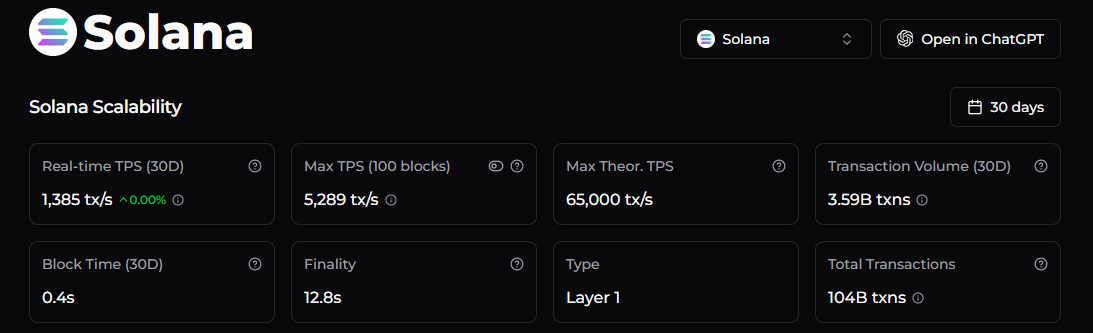
Solana remains one of the fastest widely used blockchains. In real-world conditions, the network processes around 1,385 transactions per second, even though its theoretical maximum is much higher. Since launching in 2020, Solana has built its reputation on speed and efficiency. Its performance largely comes from a unique system called Proof-of-History (PoH), which improves how transactions are ordered and verified across the network.
The ecosystem supports decentralized finance platforms, NFT marketplaces, and a wide range of Web3 applications. The SOL token powers transactions and incentivizes validators to maintain network security.
2. Internet Computer - 1,177 TPS
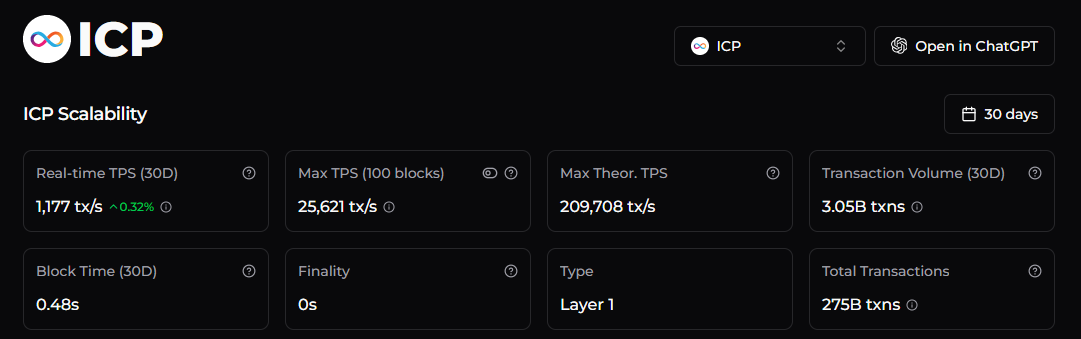
With an actual TPS of around 1,177, Internet Computer Protocol stands out for its goal of changing how internet services are hosted. ICP, Introduced in 2021, the network uses Chain Key cryptography to enable rapid transaction finality and scalable decentralized web services. Also, The ICP token plays a key role in governance and smart contract execution across the network. Its architecture is designed to support enterprise-level applications, helping bridge the gap between traditional internet services and decentralized systems.
In theory, the network's infrastructure can scale far beyond its current throughput, with projections suggesting potential capacity exceeding 209,708 TPS.
3. COTI Network – 1,000 TPS
With stress testing showing up to 1,000 TPS for native transactions and around 40 TPS for encrypted transactions, COTI is designed to deliver high performance while adding privacy directly to blockchain activity. The network focuses on Privacy-on-Demand, allowing users and developers to choose when transaction data should remain private while still staying compliant with regulatory requirements. Built as a lightweight and efficient blockchain, COTI aims to support real-world Web3 applications that require both speed and confidentiality. Its architecture is optimized for fast settlement and scalable decentralized services without sacrificing privacy. According to internal stress tests, encrypted transactions on COTI run roughly twice as fast as comparable privacy-focused solutions, highlighting the network’s focus on balancing performance with secure data handling.
By combining high throughput, selective privacy, and compliance-ready infrastructure, COTI is positioning itself as a practical foundation for decentralized finance, payments, and enterprise applications that need both transparency and confidentiality.
READ MORE : COTI vs. Mind Network: Why Garbled Circuits May Outrun FHE in the Privacy Race
4. Fogo - 700.3 TPS
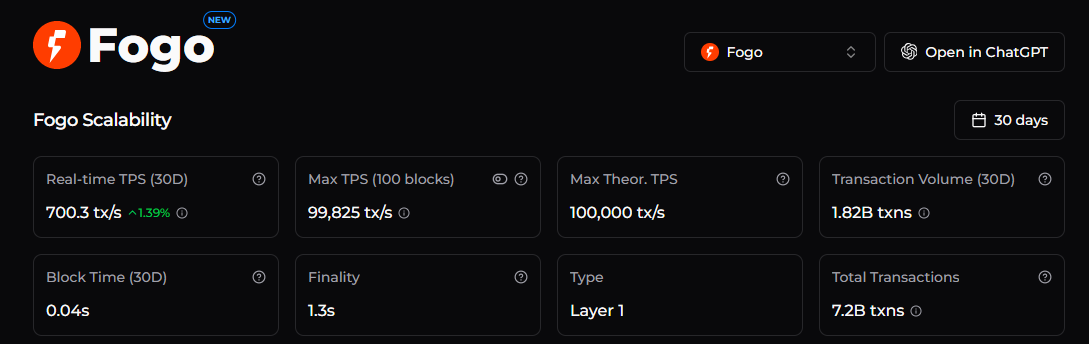
Fogo is a newer Layer-1 blockchain designed with high-performance applications . With a theoretical capacity reaching 100,000 TPS and real time TPS 700.3, the network focuses on solving the blockchain trilemma-balancing scalability, decentralization, and security. Its architecture allows transactions to be processed in parallel rather than sequentially. This reduces delays and improves responsiveness compared with traditional blockchain designs.
Fogo targets demanding applications such as DePIN networks, gaming platforms, and high-frequency transactions, where real-time performance is essential.
5. BNB Chain - 167.8 TPS
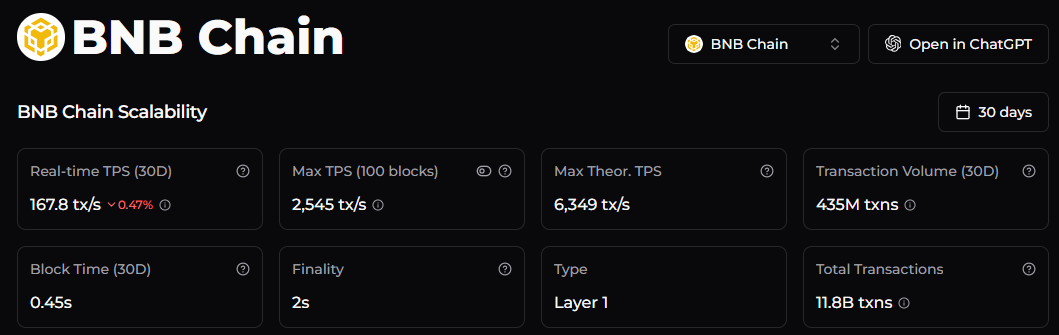
BNB Chain processes roughly 167.8 transactions per second and supports a large ecosystem of decentralized applications. Originally launched as Binance Smart Chain, the network later expanded its scope and branding to support a broader Web3 ecosystem. Today it hosts DeFi platforms, token exchanges, gaming applications, and NFT projects.
The BNB token powers the network by covering transaction fees and rewarding validators who secure the blockchain.
6. Tron - 123.4 TPS
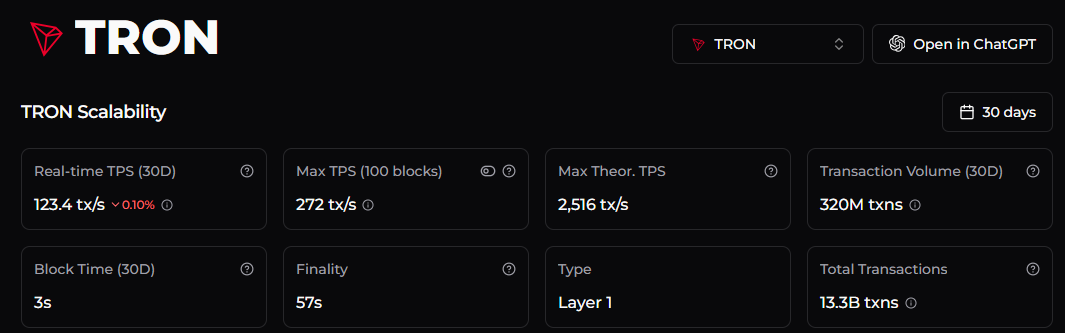
Tron uses a Delegated Proof-of-Stake (DPoS) system to enable quick block production and low transaction fees. Since launching in 2018, the network has focused on digital content distribution and financial services. The TRX token powers smart contracts and governance mechanisms within the ecosystem. Tron Chain processes roughly 123.4 transactions per second , While its TPS is lower than some newer blockchains, Tron remains widely used for stablecoin transfers and payment applications due to its efficiency.
READ MORE: SEC Drops Case Against Justin Sun After $10M Settlement, Closing Three-Year Crypto Lawsuit
7. Base - 122.1 TPS
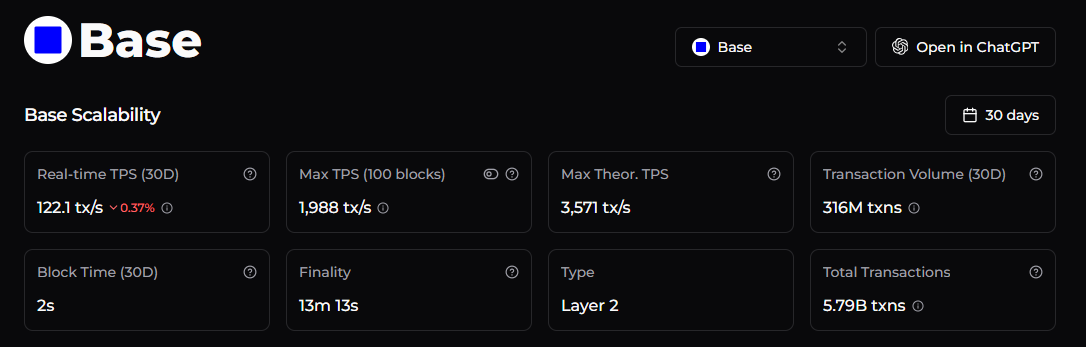
Base is an Ethereum Layer-2 network developed by Coinbase. Instead of processing every transaction directly on Ethereum, it handles transactions off-chain and later bundles them for settlement on the main network. This approach significantly reduces costs and increases throughput while still benefiting from Ethereum's security model. Base processes roughly 122.1 transactions per second, Base is particularly attractive for developers looking for faster and cheaper blockchain infrastructure while remaining connected to the Ethereum ecosystem.
8. Stellar - 113.3 TPS
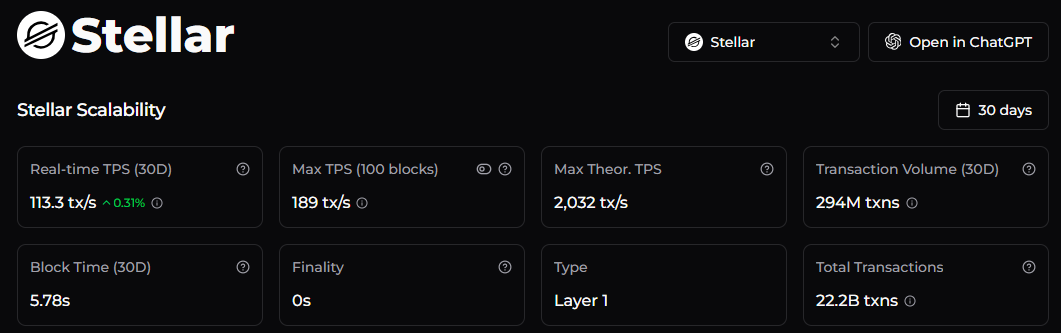
Stellar specializes in cross-border payments and remittance systems. Launched in 2014, the network uses a lightweight consensus model to enable quick, low-cost transfers between different currencies. The native token, XLM, facilitates transactions and liquidity between asset pairs. Stellar processes roughly 113.3 transactions per second Partnerships with traditional financial companies have also helped expand the network's real-world adoption.
9. Polygon - 100 TPS
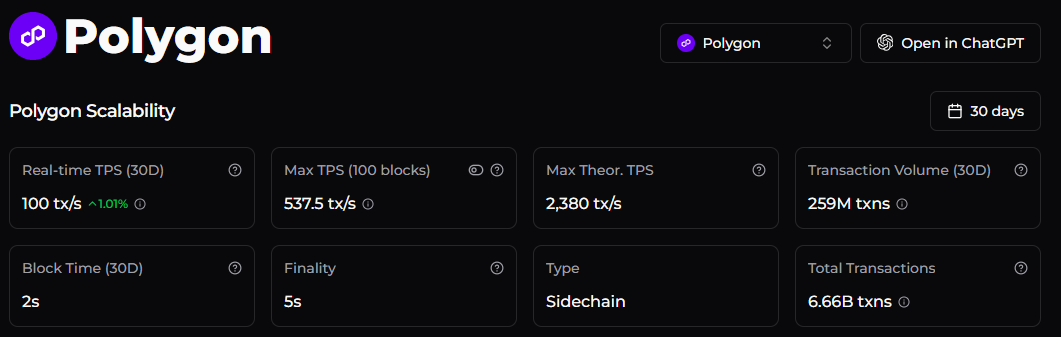
Polygon focuses on providing faster and cheaper transactions compared with the Ethereum mainnet. Polygon processes roughly 100 transactions per second, It achieves this through a modified Proof-of-Stake system that improves block confirmation efficiency. The network hosts a large ecosystem of DeFi protocols, gaming projects, and enterprise applications powered by the POL token. Polygon is also developing its AggLayer, a system designed to connect multiple chains and aggregate liquidity across the ecosystem.
10. Aptos - 47.81 TPS
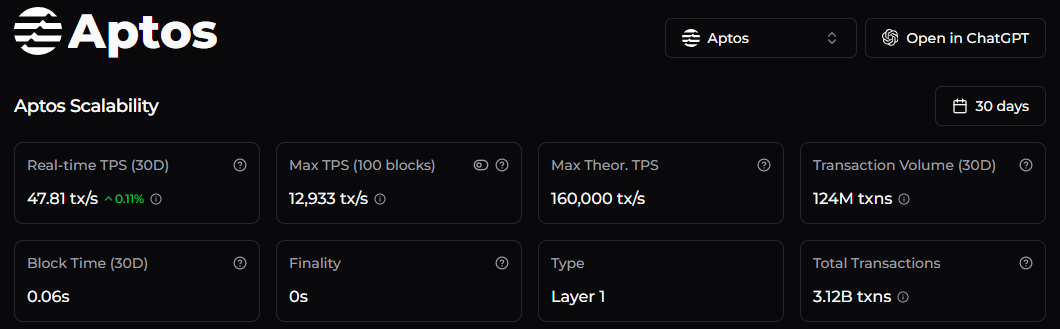
Aptos is designed for high-performance decentralized applications, particularly within DeFi ecosystems. The network uses the Move programming language and supports parallel transaction execution. Aptos processes roughly 47.81 transactions per second. This architecture allows it to scale efficiently as more users join the network. The APT token supports governance and transaction processing across the platform.
Real-World Use Cases of High-TPS Blockchains
High-throughput blockchains are especially valuable in environments where speed and efficiency are essential. In decentralized finance, faster networks help reduce trading delays and keep prices accurate across markets. High throughput also enables complex financial transactions to execute smoothly without overwhelming the network. Gaming and NFT ecosystems also benefit from faster blockchains. Interactive games require rapid updates to asset ownership and player actions. Networks capable of processing transactions quickly allow developers to build more responsive digital environments.
Micropayments represent another important use case. Low fees and fast confirmations make small payments practical, which is why networks such as Stellar and Tron are frequently used for payment systems. Enterprise systems also depend on reliable transaction processing. Supply chains, logistics tracking, and auditing platforms all benefit from networks capable of handling large volumes of transactions consistently.
Ultimately, the most successful blockchains are not simply those with high theoretical numbers but those that deliver reliable throughput under real-world conditions.
Closing Thoughts
Blockchain scalability continues to improve as new technologies emerge. Modern networks are exploring solutions such as parallel processing, Layer-2 scaling, and sharding to increase throughput without sacrificing decentralization. As Web3 applications expand-from financial platforms to gaming and digital identity systems-fast transaction speeds will become even more important. While theoretical TPS numbers often attract headlines, real-world performance remains the most meaningful metric. Networks that consistently process transactions efficiently while maintaining security and decentralization are likely to play the biggest role in the next stage of blockchain adoption. For developers and users alike, the fastest blockchains are helping push the industry closer to truly global, scalable decentralized infrastructure.
READ MORE: Hong Kong and Shanghai Launch Blockchain Trade Data Pilot Under Project Ensemble