

Summary:
- The U.S. Securities and Exchange Commission (SEC) has ended its lawsuit against crypto entrepreneur Justin Sun after a $10 million settlement paid by his company Rainberry.
- The case, filed in March 2023, accused Sun and related organizations of selling unregistered securities and conducting wash trading involving TRX and BTT tokens.
- Sun and his companies did not admit or deny the allegations as part of the settlement.
- The resolution comes amid broader shifts in U.S. crypto enforcement, with the SEC also backing away from several other high-profile cases.
- The case drew political attention due to Sun's $30 million investment in the Trump-linked crypto project World Liberty Financial.
The U.S. Securities and Exchange Commission has officially closed its long-running lawsuit against crypto entrepreneur Justin Sun, marking the end of a legal dispute that stretched for more than three years. According to a letter submitted to a Manhattan federal court, one of Sun's companies, Rainberry, agreed to pay a $10 million fine to resolve the case. In exchange, the SEC said it would drop its claims against Sun and his related organizations, including the Tron Foundation and the BitTorrent Foundation. The regulator confirmed the settlement in its filing, stating that Rainberry would pay the financial penalty while the agency would withdraw its allegations against the defendants. Importantly, the resolution does not include an admission of wrongdoing. As outlined in the court filing, Sun and the associated companies "did not admit or deny the SEC's allegations.
The case originally began in March 2023, when the SEC accused Sun and several affiliated entities of violating U.S. securities laws. Regulators claimed that the companies conducted the sale of unregistered securities through tokens linked to the Tron ecosystem, specifically Tronix (TRX) and BitTorrent (BTT). Beyond the securities allegations, the agency also argued that Sun and his companies engaged in manipulative wash trading related to TRX tokens. Wash trading refers to a practice where the same asset is repeatedly bought and sold to create the appearance of higher market activity or demand.
At the time the case was filed, the SEC said these activities had the potential to mislead investors about the true level of trading interest in the tokens. The lawsuit quickly became one of the most closely watched enforcement actions in the crypto industry, partly because of Sun's global reputation as a high-profile blockchain entrepreneur. The settlement now closes the chapter on a case that had remained unresolved while the regulatory climate around digital assets in the United States continued to shift.
A Changing Regulatory Climate for Crypto
The end of the Sun case arrives during a period of noticeable changes in how U.S. regulators are approaching cryptocurrency enforcement. Over the past year, several lawsuits that were initially launched under former SEC Chair Gary Gensler have either been dropped or resolved through settlements. Industry observers have noted that the agency has stepped back from a number of aggressive legal actions targeting major crypto companies. Among the cases that have seen similar outcomes are enforcement actions against large crypto platforms such as Kraken and Coinbase. These developments suggest that the regulatory environment surrounding digital assets may be entering a new phase, one where negotiations and settlements are becoming more common than lengthy courtroom battles. For the SEC, the Sun case had represented one of the more prominent attempts to address alleged securities violations involving token sales and trading activity. But with the settlement finalized, the regulator appears to have chosen closure rather than continuing a prolonged legal fight. These changes matter because regulatory clarity has long been one of the industry's biggest challenges. Many blockchain companies have argued that existing securities laws were written long before digital assets existed and therefore do not easily apply to modern token ecosystems.
That tension has played out repeatedly in courtrooms across the United States. Projects that issue tokens often claim they are building decentralized networks rather than offering traditional investment products, while regulators argue that many token sales resemble securities offerings. In the case involving Justin Sun, the dispute centered on whether TRX and BTT were sold in ways that should have been registered with regulators. The SEC maintained that the tokens qualified as securities under U.S. law, while Sun's side pushed back against that interpretation. With the settlement now completed, the legal debate surrounding those specific claims will likely fade. But the larger question of how digital assets should be regulated in the United States remains unresolved and continues to shape discussions across the crypto sector.
Political Attention and the Trump-Linked Crypto Project
The case involving Justin Sun attracted additional review because of its political connections. In November 2024, the same month that Donald Trump was elected president, Sun became the largest investor in the Trump family's crypto initiative known as World Liberty Financial. Reports indicated that Sun purchased $30 million worth of the project's tokens, making him a major supporter of the venture. That investment drew attention from lawmakers who were already watching the SEC case closely.
Earlier this year, three House Democrats raised concerns about the situation and urged regulators to carefully consider the implications of dropping the case. Representatives Maxine Waters, Brad Sherman, and Sean Casten warned that leaving the lawsuit unresolved could "undermine investors' confidence" in the SEC. The lawmakers also expressed concern about what they described as the possibility of a "pay-to-play scheme," referencing Sun's investment in the Trump-linked crypto project. Despite those concerns, the SEC ultimately moved forward with the settlement that closes the case. Following the announcement, Sun publicly addressed the outcome on social media. In a post on X, he wrote:
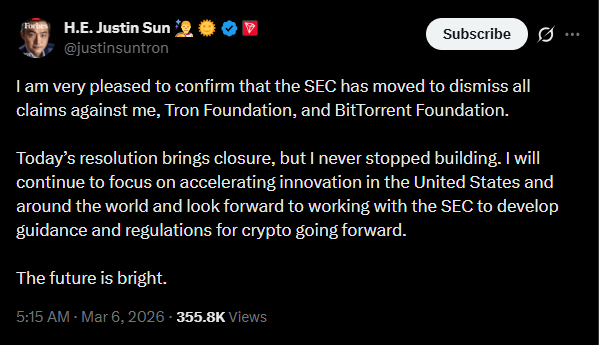
Sun also commented on the broader meaning of the settlement and what it represents for his future plans.
The statement reflects a tone of relief while also pointing to the ongoing conversation between blockchain developers and regulators about how digital assets should be governed.
What the Settlement Means for Tron and the Crypto Industry
For Justin Sun and the broader Tron ecosystem, the end of the SEC lawsuit removes a significant legal cloud that has hovered over the project for years. Tron remains one of the most widely used blockchain networks for stablecoin activity and decentralized applications, particularly in emerging markets where low transaction costs and fast settlement speeds are important. The network has built a strong presence in global crypto markets, and TRX continues to rank among the most actively traded digital assets.
Legal battles with regulators can create uncertainty for projects, especially when they involve allegations related to securities law. Even when cases take years to resolve, they often influence how exchanges, investors, and partners interact with a blockchain ecosystem. With the settlement finalized, Tron and its associated organizations can move forward without the immediate pressure of ongoing litigation from the SEC. At the same time, the outcome highlights a broader trend in the crypto sector. Regulators and companies are increasingly resolving disputes through settlements or negotiated agreements.
For the industry, Still, the Sun case serves as a reminder that the regulatory landscape for cryptocurrency remains fluid. Enforcement priorities can move depending on political leadership, market developments, and evolving interpretations of financial law. For now, however, the SEC's case against Justin Sun has officially reached its end - closing a three-year legal chapter that once stood at the center of the U.S. government's crackdown on crypto projects.
READ MORE: SpaceX Bitcoin Holdings Drop to $562M Ahead of Expected IPO Filing