

Summary:
- Ireland has classified crypto assets as a "very significant" money laundering and terrorism financing risk in its latest National Risk Assessment.
- Authorities plan to introduce new industry standards governing crypto-related sources of funds by the second half of 2027.
- Officials said crypto presents challenges beyond money laundering, including sanctions evasion, tax enforcement, and corruption risks.
- Around 10% of Ireland's population had invested in crypto assets as of December, according to data cited from the Central Bank of Ireland.
- The report comes as regulators around the world continue tightening compliance requirements for digital asset businesses.
Ireland has identified crypto assets as one of the country's most significant financial crime risks, marking an important shift in how policymakers view the rapidly growing digital asset sector. In its latest National Risk Assessment, published by the Department of Finance, the government classified cryptocurrencies as a "very significant" money laundering and terrorism financing risk while outlining plans to strengthen oversight over the coming years. The report represents Ireland's first comprehensive government assessment in seven years to specifically evaluate risks associated with digital assets.
According to the assessment, the increasing number of crypto-related fraud cases, money laundering prosecutions, and broader financial crime investigations has placed additional pressure on regulators to improve supervision across the industry. While acknowledging that blockchain technology and digital assets continue gaining wider adoption, Irish authorities argue that the sector also introduces unique compliance challenges that require stronger regulatory frameworks. The report highlights that cryptocurrencies are not viewed solely as a money laundering concern. Officials also warned that digital assets may facilitate sanctions evasion, complicate tax enforcement efforts, and create opportunities for corruption involving individuals responsible for supervising or regulating financial activity. Another concern raised throughout the assessment is the uneven pace of global regulation. Although Ireland operates within the broader European Union framework, policymakers noted that differences between jurisdictions continue creating opportunities for regulatory arbitrage, where financial activity shifts toward countries with weaker oversight. The report also points to decentralized finance (DeFi) as an area presenting additional supervisory challenges. Unlike traditional financial institutions, many decentralized protocols operate without centralized intermediaries, making compliance monitoring and enforcement significantly more complex. Irish authorities concluded that continued growth across these less-regulated areas reinforces the need for stronger domestic standards alongside international cooperation.
READ MORE: XRP Ledger Solved DEX Trading Years Before Solana, Says Former Ripple Developer
New compliance standards are expected before 2027
Alongside the risk assessment, the government released an implementation plan setting out several measures intended to strengthen anti-money laundering (AML) and counter-terrorism financing (CTF) controls. One of the most significant proposals involves creating industry standards governing the acceptance of crypto-related wealth and digital assets as legitimate sources of funds. Authorities expect those standards to be introduced during the second half of 2027. The initiative forms part of a broader modernization of Ireland's financial crime framework, with regulators seeking greater consistency across both traditional financial institutions and digital asset businesses. While detailed requirements have not yet been published, the proposal suggests that crypto firms, financial institutions, and other regulated businesses may eventually face more standardized procedures when verifying the origin of digital asset holdings.
The government's increased attention also reflects crypto's growing presence within Ireland itself. Data cited in the report from the Central Bank of Ireland indicates that approximately 10% of Ireland's population had invested in cryptocurrencies as of December.
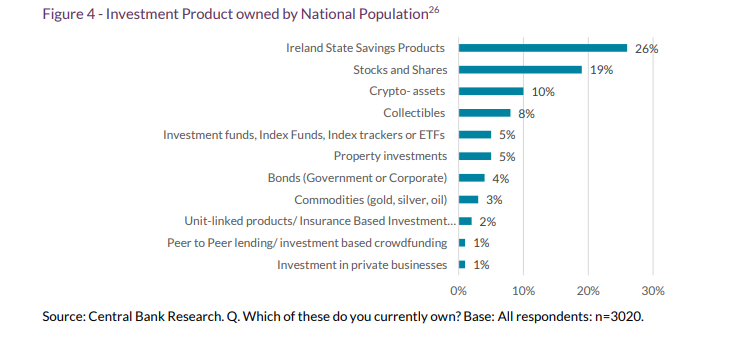
That level of adoption places digital assets firmly within Ireland's mainstream financial landscape rather than remaining a niche investment category. As participation grows, regulators argue that compliance standards must evolve alongside the market. The report also references recent enforcement activity that has highlighted weaknesses in existing oversight. In November 2025, the Central Bank of Ireland imposed a fine of approximately $24 million on Coinbase Europe Limited for breaches relating to Anti-Money Laundering and Countering the Financing of Terrorism requirements. According to the regulator, the company failed to promptly report deficiencies within its transaction monitoring systems. Although the enforcement action focused on compliance processes, it reinforced the regulator's expectation that licensed crypto firms maintain effective monitoring systems capable of identifying suspicious financial activity.
Ireland joins a broader global push toward stronger crypto oversight
Ireland's latest assessment arrives during a period of growing international focus on digital asset regulation. Across major financial jurisdictions, policymakers are increasingly attempting to balance innovation with stronger consumer protection and financial crime controls. Regulators are steadily integrating digital assets into existing anti-money laundering frameworks. Ireland's report reflects that broader direction. Beyond financial crime, the assessment also notes concerns surrounding the use of cryptocurrencies in corruption-related payments and political financing. In fact, Ireland had already moved to limit that risk several years earlier. In 2022, policymakers proposed legislation preventing political parties from accepting cryptocurrency donations, including Bitcoin, Ether, and privacy-focused digital assets. Those restrictions formed part of wider efforts to improve transparency around political funding.
The latest National Risk Assessment expands that focus by examining how digital assets interact with the broader financial system. Importantly, the report does not argue against cryptocurrency adoption itself. Instead, it emphasizes that stronger oversight, consistent compliance standards, and clearer regulatory expectations will become increasingly important as participation continues growing. For crypto businesses operating in Ireland, the planned source-of-funds standards represent another indication that regulatory expectations will likely become more detailed over the next several years. For investors, the assessment reflects a wider global trend in which governments are moving beyond debating whether digital assets should be regulated and are instead focusing on how existing financial crime rules should apply to an increasingly mature crypto market. As digital assets become more integrated into traditional finance, policymakers appear increasingly focused on ensuring that innovation develops alongside robust compliance frameworks capable of addressing evolving financial risks.
READ MORE: EU Targets Crypto in New Russia Sanctions Package, Proposes Ban on 11 Digital Asset Platforms