

Summary:
- A crypto user lost nearly their entire $50.4 million USDT during a large token swap involving Aave tokens.
- The trade, executed through CoW Protocol and SushiSwap, returned only 327 AAVE tokens worth about $36,000.
- A MEV bot launched a sandwich attack, profiting roughly $9.9 million from the transaction.
- Stani Kulechov said the user confirmed a warning about "extraordinary slippage" before proceeding.
- The Aave team said it will attempt to contact the user and return about $600,000 in fees collected from the swap.
A single cryptocurrency trade worth more than $50 million has turned into one of the most talked-about incidents in decentralized finance this year after a user lost nearly the entire amount during a token swap. The transaction involved converting $50.4 million worth of Tether USD (USDT) into the governance token of Aave through the decentralized exchange aggregator CoW Protocol and the decentralized exchange SushiSwap. According to blockchain data from Etherscan, the wallet executing the trade had recently been funded from Binance before initiating the swap. The intention appeared straightforward: convert the entire USDT balance into AAVE tokens. However, the final outcome was dramatically different from what the user likely expected. Instead of receiving tens of millions of dollars worth of AAVE tokens, the wallet received only 327 AAVE tokens, valued at roughly $36,000 at the time.
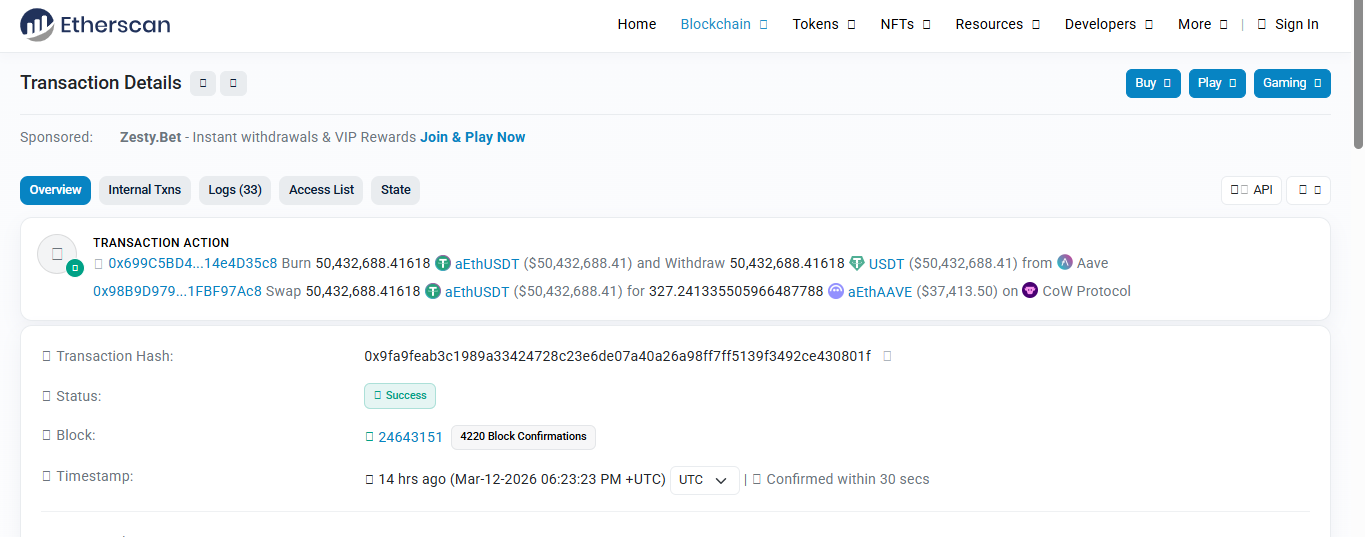
That result meant the user effectively paid around $154,000 per AAVE token, while the token's market price was closer to $114. The enormous gap between the expected and actual price came from a slippage, combined with aggressive activity from automated trading bots that monitor blockchain transactions in real time. Large decentralized trades can move prices inside liquidity pools, particularly when the trade size far exceeds the available liquidity. In this case, the transaction size appears to have been so large that it pushed the price of AAVE higher during the swap itself. But the situation became even more costly because a specialized trading bot identified the opportunity before the transaction was finalized.
MEV Bot Executes Sandwich Attack for $9.9M Profit
While the swap was waiting to be confirmed on the blockchain, a Maximal Extractable Value (MEV) bot detected the unusually large order. MEV refers to profits that automated traders can extract by observing pending transactions in a blockchain's public mempool and strategically inserting their own transactions around them. In this case, the bot launched a sandwich attack. This strategy involves placing one trade before a large transaction and another immediately after it. The bot first front-ran the transaction, meaning it executed a trade just before the user's swap was processed. According to the transaction analysis, the bot flash-borrowed about $29 million worth of Ether (wrapped ETH) from the DeFi protocol Morpho.
With that borrowed capital, the bot purchased AAVE tokens through the decentralized exchange Bancor. This purchase increases the token's price higher inside liquidity pools. Once the user's massive order was executed at the inflated price, the bot quickly sold the tokens on SushiSwap. Because the price had been artificially pushed upward just moments earlier, the bot captured a substantial profit. The strategy worked exactly as designed. By the time the sequence ended, the automated trader had secured approximately $9.9 million in profit, while the user's trade suffered catastrophic slippage. Such attacks are possible because blockchain networks process transactions publicly. Bots continuously scan pending transactions and compete to exploit profitable opportunities.
While these strategies are technically allowed by the rules of decentralized networks, they often generate controversy when they lead to massive losses for individual users.
Aave Founder Says User Ignored Slippage Warning
Following the incident, Stani Kulechov, founder of Aave, addressed the situation in a post on X, explaining that the platform's interface had warned the user about the risk before the transaction was executed. He wrote:
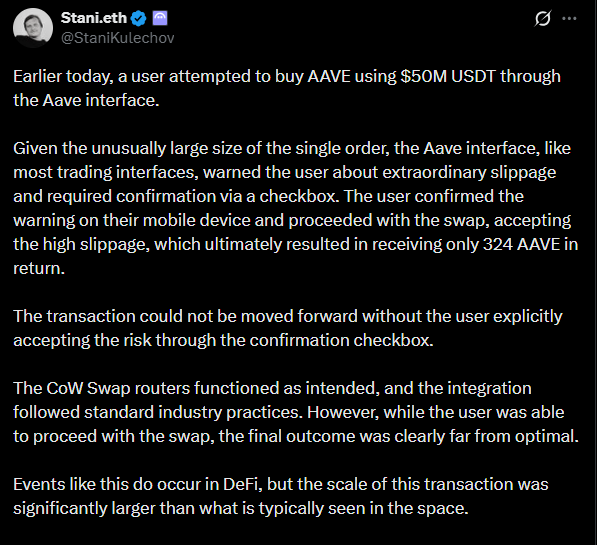
Automated market makers like SushiSwap rely on mathematical formulas to determine token prices inside liquidity pools. When a trade is extremely large relative to the pool size, the formula increases the price significantly as the trade progresses. This mechanism is designed to maintain balance between assets in the pool, but it also means that large trades can quickly produce huge price swings. In this case, the platform apparently flagged the issue ahead of time. According to Kulechov, the user saw a warning describing the "extraordinary slippage" that could occur due to the size of the transaction. Despite the warning, the trade was confirmed and executed. Kulechov also added that the Aave team intends to reach out to the user and return the platform fees collected during the transaction.
The gesture drew attention across the crypto community. Sandeep Nailwal, CEO of Polygon Labs, responded to the post and praised the move, writing:
In the same discussion, Nailwal also speculated about possible explanations behind the unusually large and risky trade. In paraphrased remarks, he described the situation as an extremely unusual transaction and wondered whether it might have involved funds changing hands for reasons unrelated to normal trading activity, though he emphasized that he had no evidence and was simply speculating.
A Reminder of Risks in DeFi Trading
The incident highlights the complex mechanics behind decentralized finance trading. Unlike traditional exchanges where trades occur within centralized systems, DeFi platforms operate through automated liquidity pools. Prices are determined algorithmically based on the balance of assets inside these pools. When traders execute extremely large transactions, the algorithm can produce dramatic price shifts. Combined with the presence of MEV bots that actively monitor transactions, such conditions can create significant risks.
For many observers, the event serves as a reminder of how transaction size, liquidity levels, and automated trading strategies interact in decentralized markets. While the open nature of blockchain networks allows anyone to participate, it also means that large transactions can attract opportunistic strategies from automated traders seeking profit. As decentralized finance continues evolving, developers and users alike are exploring new tools - such as private transaction relays and advanced order routing systems to help reduce exposure to MEV attacks. For now, the $50 million trade gone wrong stands as one of the most dramatic examples of how quickly things can go wrong when liquidity, automation, and massive transactions collide in the DeFi ecosystem.
READ MORE: DeFi’s Most Advanced DEX That Makes You a Smarter Trader