

Summary:
- Ripple has acquired an equity stake in African fintech giant Flutterwave as part of the company's Series E funding round.
- Flutterwave CEO Olugbenga Agboola said the investment values the company at $3.3 billion.
- Ripple plans to integrate RLUSD, Ripple Payments, and the XRP Ledger (XRPL) into Flutterwave's payments ecosystem.
- Africa remains one of the fastest-growing regions for crypto adoption, driven largely by cross-border payments and remittances.
- Stablecoins are increasingly becoming a lower-cost alternative to traditional money transfer services across the continent.
Ripple has expanded its presence in Africa by acquiring an equity stake in Flutterwave, one of the continent's largest financial technology companies. The investment gives Ripple a stronger foothold in a region where demand for faster and more affordable international payments continues to rise. The financial terms of the investment were not disclosed. However, Flutterwave Chief Executive Officer Olugbenga Agboola told Bloomberg that the Series E fundraising round values the company at $3.3 billion, making it one of Africa's most valuable fintech firms. Ripple confirmed the partnership on X, saying the investment will go beyond capital by bringing its blockchain payment infrastructure directly into Flutterwave's ecosystem. The company wrote:
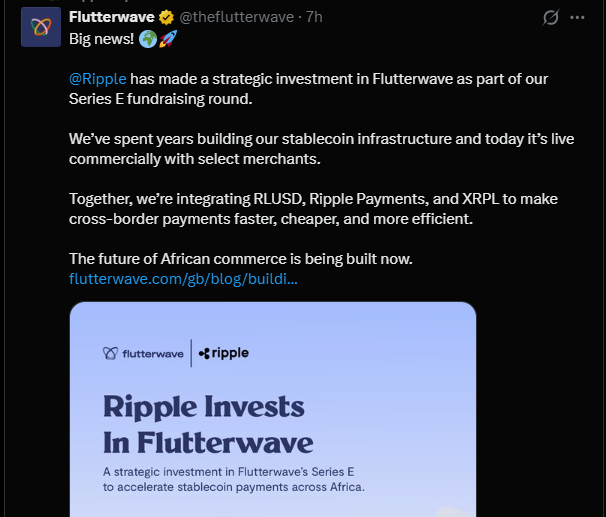
The partnership represents another step in Ripple's long-term strategy of building payment infrastructure rather than simply expanding its digital asset offerings. Flutterwave operates across dozens of African markets, providing payment services for businesses, merchants, and consumers. By combining Ripple's blockchain technology with Flutterwave's established regional network, both companies hope to improve how money moves across borders. Cross-border payments remain one of the biggest financial challenges in Africa. Transfers often pass through multiple intermediaries before reaching recipients, increasing both costs and settlement times. Ripple believes blockchain-based payment rails can simplify that process by reducing the number of intermediaries involved while allowing transactions to settle much faster. The investment also follows Ripple's broader expansion across the continent. In October last year, the company partnered with South Africa's Absa Bank to provide digital asset custody services for institutional clients, signaling that Africa has become an increasingly important market for Ripple's enterprise strategy.
READ MORE: EU Targets Crypto in New Russia Sanctions Package, Proposes Ban on 11 Digital Asset Platforms
Stablecoins are reshaping Africa's remittance market
Africa has become one of the world's fastest-growing regions for cryptocurrency adoption, with cross-border payments serving as one of the strongest drivers. Millions of people working abroad regularly send money home to family members, creating one of the largest remittance markets globally. Traditional international transfers, however, remain expensive for many households. According to a September 2025 report by Chainalysis, cryptocurrency adoption across Sub-Saharan Africa grew by 52% over a twelve-month period. During that time, the region processed more than $205 billion in on-chain transaction volume, making it the world's third-fastest-growing crypto market.
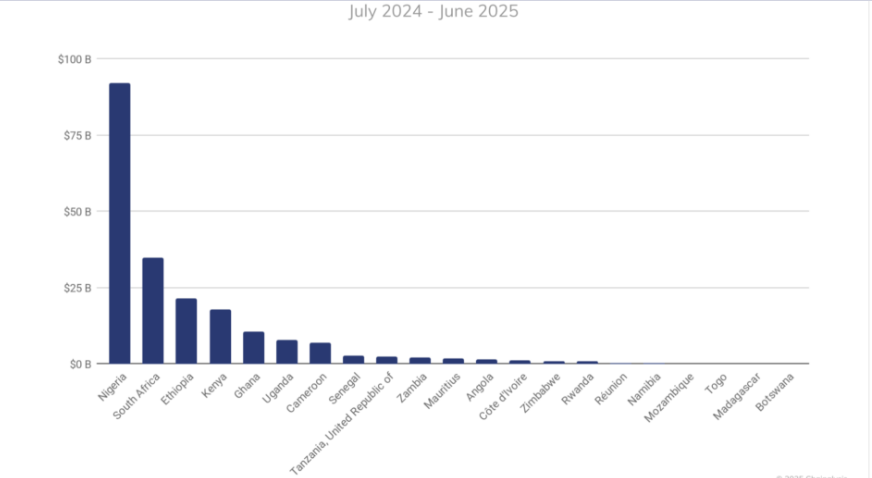
Stablecoins have become a major contributor to that growth because they offer users access to digital dollars without exposing them to the price volatility commonly associated with cryptocurrencies. Stablecoin transfers can often be completed within minutes while reducing transaction costs. The opportunity has attracted growing competition among payment companies. USDC issuer Circle recently partnered with African fintech Sasai to expand stablecoin-powered payment services throughout the region, focusing primarily on remittances and business payments. Cost savings remain one of the strongest arguments for blockchain-based payment systems. According to World Bank estimates cited in industry research, sending a typical $200 remittance to Sub-Saharan Africa through traditional channels often costs recipients between $13 and $17 in fees. By comparison, transfers using USDt (USDT) on the Tron network can cost as little as $0.50, while transfers using USDC on Ethereum may cost around $2, depending on network conditions.
Although transaction costs vary depending on the platform and blockchain used, the difference illustrates why many fintech companies are exploring stablecoin infrastructure for international payments.
Ripple expands beyond payments with blockchain infrastructure
The Flutterwave investment reflects Ripple's broader strategy of building blockchain infrastructure for financial institutions rather than focusing solely on cryptocurrency transactions. One important part of the partnership will be the integration of RLUSD, Ripple's U.S. dollar-backed stablecoin. Combined with Ripple Payments and the XRP Ledger, the companies aim to build payment services capable of supporting faster settlement, lower transaction costs, and improved liquidity for businesses moving funds across multiple countries. Ripple has increasingly positioned its technology as infrastructure that financial companies can integrate into their existing services.
Flutterwave already provides payment solutions to businesses across numerous African markets, making it a natural partner for expanding blockchain-powered settlement. The agreement also reflects a broader trend developing across the payments industry. Stablecoins are gradually moving beyond crypto trading and becoming part of real-world financial infrastructure. Payment companies, banks, and fintech providers are increasingly exploring blockchain networks as tools for international settlement, treasury management, and remittance services. Africa's rapidly growing digital economy makes it one of the most active testing grounds for these technologies. With high remittance volumes, increasing smartphone adoption, and continued demand for lower-cost financial services, the region has become an attractive market for companies building blockchain-based payment solutions. Ripple's investment in Flutterwave positions the company at the center of that growth. If the planned integration of RLUSD, Ripple Payments, and XRPL delivers the expected efficiency improvements, the partnership could strengthen Ripple's role in one of the world's most important emerging payments markets while giving Flutterwave additional tools to expand its cross-border financial services.
READ MORE: XRP Ledger Solved DEX Trading Years Before Solana, Says Former Ripple Developer