

Summary:
- Ripple Labs is reportedly launching a $750 million share buyback program through April.
- The tender offer could value the company at $50 billion, about 25% higher than its valuation after a $500 million funding round in November 2025.
- Ripple continues expanding beyond crypto, including a $1.2 billion acquisition of Hidden Road and the purchase of GTreasury.
- The company also plans to pursue a financial services license in Australia through a local payments firm acquisition.
- Ripple says it has processed over $100 billion in transactions, while its stablecoin RLUSD has surpassed a $1 billion market cap since launching in December 2024.
Ripple Labs is preparing to buy back as much as $750 million worth of company shares, according to a report from Bloomberg, a move that could place the company's valuation at roughly $50 billion. The reported buyback would take place through a tender offer, allowing existing shareholders and employees to sell their shares back to the company. The program is expected to run through April, giving participants a limited window to participate in the offer. According to the Bloomberg report, the valuation implied by the buyback represents a 25% increase from the company's last major funding round. In November 2025, Ripple raised $500 million, which set the company's valuation significantly lower than the figure being discussed in the new share repurchase program.
Share buybacks are not uncommon among privately held technology companies, especially those that have accumulated significant capital reserves. These programs often serve multiple purposes. They can provide liquidity to early investors or employees who hold equity, while also allowing the company to consolidate ownership or adjust its capital structure. For Ripple, the buyback comes at an interesting moment. Despite a decline in the price of XRP over the past year, the company itself appears to be strengthening its financial position and expanding its global footprint. The move may also signal confidence in Ripple's long-term strategy, particularly as the firm continues evolving from a crypto payments startup into a broader financial infrastructure company.
Expansion Beyond Crypto Services
Ripple has been steadily broadening its reach beyond the traditional boundaries of the cryptocurrency industry. Over the past year, the company has pursued several major acquisitions and partnerships aimed at strengthening its role within the global financial system. One of the most significant developments was Ripple's $1.2 billion acquisition of Hidden Road, a non-bank prime brokerage firm. Prime brokers typically provide institutional investors with trading infrastructure, financing, and clearing services across multiple asset classes. By acquiring Hidden Road, Ripple signaled its interest in expanding into institutional financial markets.
The company also acquired GTreasury, a treasury management software provider. Treasury systems are used by corporations to manage liquidity, payments, and financial risk. Integrating such technology could allow Ripple to build deeper connections with enterprise financial operations. Together, these acquisitions suggest a broader strategy that goes well beyond cryptocurrency payments alone. Ripple has also been expanding internationally. Earlier this week, the company confirmed that it plans to pursue a financial services license in Australia. The license effort reportedly involves acquiring a local payments firm, which could allow Ripple to offer regulated financial services in the country. Such expansion is part of a longer trend in the crypto industry, where companies increasingly seek regulatory approvals and traditional financial licenses in order to operate globally.
For Ripple, these steps appear aimed at positioning the company as a bridge between blockchain technology and conventional financial infrastructure.
Ripple Payments Growth and RLUSD Stablecoin Adoption
While Ripple continues expanding its corporate footprint, the company's core payment network also appears to be gaining momentum. In a recent update shared through its official X account, Ripple said its platform has now processed more than $100 billion in transactions. The milestone reflects growing activity across the company's global payment network.
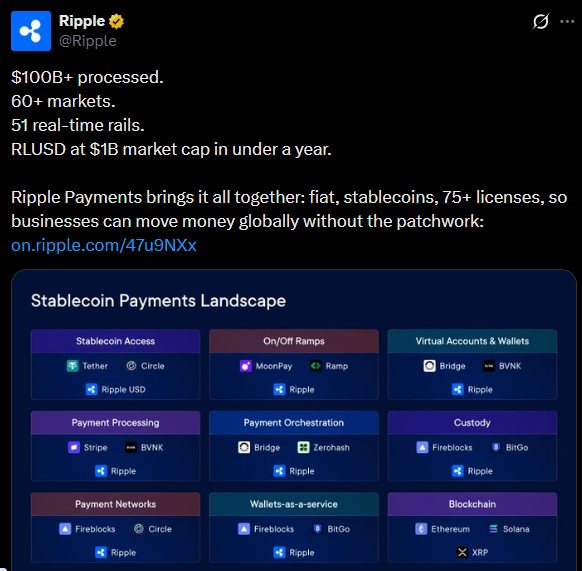
Ripple also highlighted the progress of its stablecoin initiative. The company's stablecoin, Ripple USD (RLUSD), has reportedly exceeded a $1 billion market capitalization since launching in December 2024. Stablecoins are digital assets designed to maintain a stable value, often pegged to traditional currencies like the US dollar. They are increasingly used in cross-border payments, decentralized finance platforms, and digital asset trading. Ripple's stablecoin strategy could help the company compete in a rapidly growing segment of the crypto market. Stablecoins have become an essential part of blockchain-based financial infrastructure, supporting everything from remittances to decentralized trading systems.
READ MORE: Ripple Expands Stablecoin Payments Stack for Banks and Fintechs to Boost Cross-Border Speed
At the same time, stablecoins are drawing increased attention from regulators around the world. Companies operating in this space are therefore under pressure to demonstrate transparency, compliance, and robust financial backing. Ripple's approach appears focused on integrating its stablecoin into existing payment rails while also expanding its institutional partnerships.
A Private Giant in the Crypto Industry
Despite its growing valuation and global presence, Ripple has repeatedly indicated that it does not currently plan to become a publicly traded company. Following the company's November 2025 funding round, Ripple president Monica Long stated that the firm had no immediate plans to pursue an initial public offering (IPO). That decision means Ripple remains one of the largest privately held companies in the blockchain sector. A $50 billion valuation would place the company among the most valuable firms operating in the digital asset ecosystem. The figure also highlights the contrast between the performance of Ripple's corporate operations and the price fluctuations of XRP, which has experienced volatility over the past year.
Still, Ripple's leadership appears focused on long-term infrastructure growth. The planned share buyback may therefore serve as both a financial strategy and a signal to investors that the company remains confident about its direction. As Ripple continues expanding into institutional finance, payment infrastructure, and stablecoin markets, its influence across the broader blockchain ecosystem could continue to grow in the years ahead.
READ MORE: XRP Holds $1.30 Support as Traders Watch Key Resistance Levels for the Next Move