

Summary:
- The U.S. Securities and Exchange Commission has formally dismissed its lawsuit against Gemini Trust Company with prejudice.
- The decision follows the full, in-kind recovery of all Gemini Earn customer assets through the Genesis bankruptcy process.
- The case had accused Gemini Earn of operating an unregistered securities offering before freezing withdrawals in late 2022.
- With the dismissal, the SEC cannot refile the same claims, closing a three-year legal chapter tied to the crypto lending fallout.
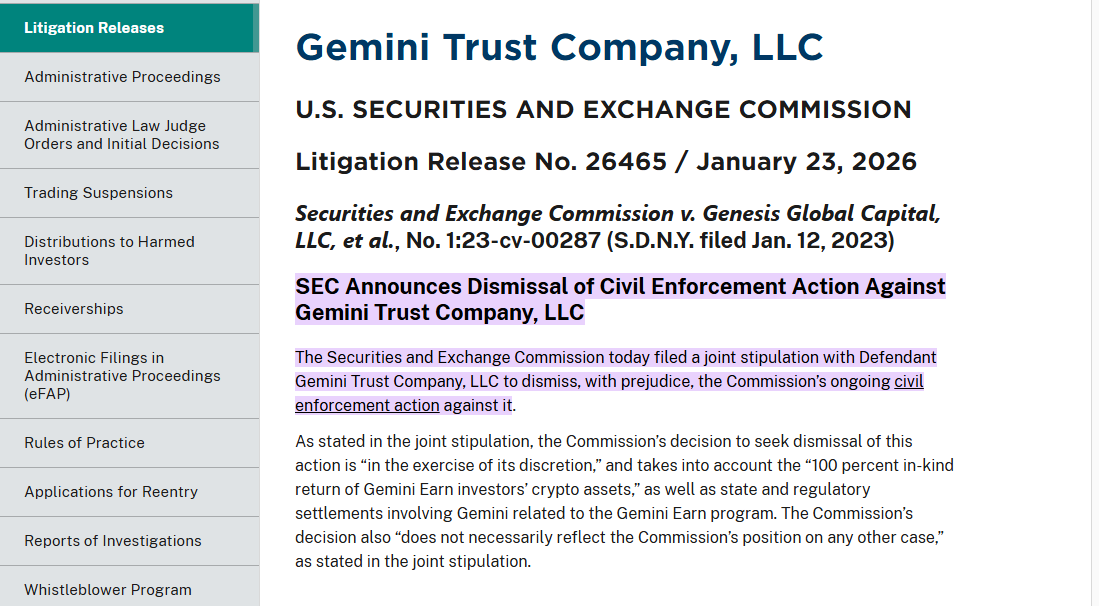
The U.S. Securities and Exchange Commission has officially closed its enforcement action against Gemini Trust Company, ending one of the most closely watched crypto lending cases to emerge from the 2022 market collapse. On Friday, the agency filed a joint stipulation for dismissal with prejudice in the U.S. District Court for the Southern District of New York, formally terminating its lawsuit over the Gemini Earn program.
The dismissal with prejudice is significant. It means the SEC cannot bring the same claims against Gemini again, effectively closing the door on a case that had loomed over the company for three years. According to the regulator, the decision was driven primarily by the fact that Gemini Earn investors have now recovered 100% of their crypto assets. Those recoveries were achieved through the bankruptcy proceedings of Genesis Global Capital, the lending partner behind Gemini Earn. Between May and June 2024, customers received a full return of their assets in kind, rather than cash equivalents, a point the SEC emphasized in its litigation release.
In the joint stipulation, the Commission said its decision to seek dismissal was made “in the exercise of its discretion” and explicitly cited the “100 percent in-kind return of Gemini Earn investors’ crypto assets.” The filing also noted that state and regulatory settlements involving Gemini related to the program factored into the outcome. At the same time, the SEC added a caveat, stating that the decision “does not necessarily reflect the Commission’s position on any other case.”
For Gemini, the dismissal removes a major legal overhang. For the broader crypto industry, it marks another example of how enforcement actions tied to customer harm are being reassessed once restitution is complete.
How Gemini Earn unraveled and how it came back together
The Gemini Earn program launched in February 2021, offering users the ability to lend crypto assets in exchange for yields that reached as high as 7.4% APY. Gemini partnered with Genesis Global Capital, which handled the lending and borrowing activity behind the scenes. At its peak, the program attracted hundreds of thousands of users. That structure came under intense strain in November 2022. As the fallout from the FTX collapse rippled across the market, Genesis halted withdrawals, freezing access to funds for roughly 340,000 Gemini Earn users. Around $940 million in customer assets were locked at the time, turning Gemini Earn into one of the most visible casualties of the broader credit crisis.
In January 2023, the SEC charged both Genesis and Gemini, alleging that the Gemini Earn program constituted an unregistered securities offering. The lawsuit argued that the way the program was structured and marketed required registration under U.S. securities laws. The case moved forward despite pushback from both companies. In March 2024, a federal judge denied motions to dismiss, ruling that the SEC had “plausibly alleged” securities violations. At that point, the lawsuit appeared likely to proceed toward trial. Genesis ultimately agreed to pay $21 million to the SEC as part of its settlement, while Gemini reached a $37 million settlement with the New York Department of Financial Services. Gemini also contributed $40 million into the bankruptcy estate to help ensure customers were fully repaid.
Those combined actions allowed Genesis to return 100% of customer assets, a rare outcome in the aftermath of the 2022 lending collapse. Once investors were made whole, the SEC’s posture shifted. By Friday, the agency formally acknowledged that recovery, paving the way for the dismissal. The result is a rare ending in crypto litigation: one where customers exit without losses and a regulator steps back from continued enforcement.
A wider signal from the SEC’s changing enforcement stance
The end of the Gemini Earn case does not stand alone. It arrives amid a broader pullback in crypto enforcement actions under SEC Chairman Paul Atkins, who assumed the role in April 2025. Over the past year, the agency has dropped or narrowed cases involving several major industry players, including Coinbase, Kraken, and Ripple. While each case carries its own facts, the Gemini dismissal reinforces a pattern. Where investor harm has been fully addressed through restitution or settlement, the SEC has shown a willingness to close the file rather than press forward with punitive litigation.
That does not mean the agency is abandoning oversight. The SEC was careful to note that its decision in the Gemini matter “does not necessarily reflect the Commission’s position on any other case.” Still, the practical message is hard to miss. Enforcement tied to past market failures is being reassessed in light of outcomes, not just allegations. For crypto firms, the case underscores the importance of customer recovery. Gemini spent years under scrutiny, but the final chapter was written not by courtroom arguments, but by repayment. The fact that customers received their crypto back in kind rather than a discounted cash settlement & played a central role in the SEC’s calculus.
For users, the conclusion brings a measure of closure. The Gemini Earn freeze became a symbol of broken trust during the market downturn. Its resolution, while slow and complex, shows that bankruptcy processes can still produce full recoveries when assets remain traceable and parties cooperate. And for regulators, the dismissal highlights a delicate balance. Enforcement remains a tool, but restitution appears to be carrying more weight in determining when a case has served its purpose.
Closing Thoughts
With the lawsuit now dismissed with prejudice, one of the longest-running crypto lending battles of the post-2022 era is officially over. The outcome may not rewrite securities law, but it does mark a shift in how unfinished business from the last cycle is being wrapped up.
READ MORE: COTI Earn Season 3 Explained: Rewards, TPS, Missions, and How It Works