

Summary:
- Bank Negara Malaysia (BNM) unveiled three pilot sandbox programs focused on stablecoins, tokenized bank deposits and real-world asset tokenization.
- The initiatives use ringgit-pegged digital tokens and aim to explore cross-border settlement and institutional applications.
- Tests may inform future wholesale central bank digital currency (CBDC) development and broader policy direction.
- BNM will also consider Shariah-related financial principles, reflecting Malaysia's unique regulatory landscape.
- Earlier, Malaysia published a three-year roadmap to expand digital asset use cases across supply chains, finance and 24/7 settlement.
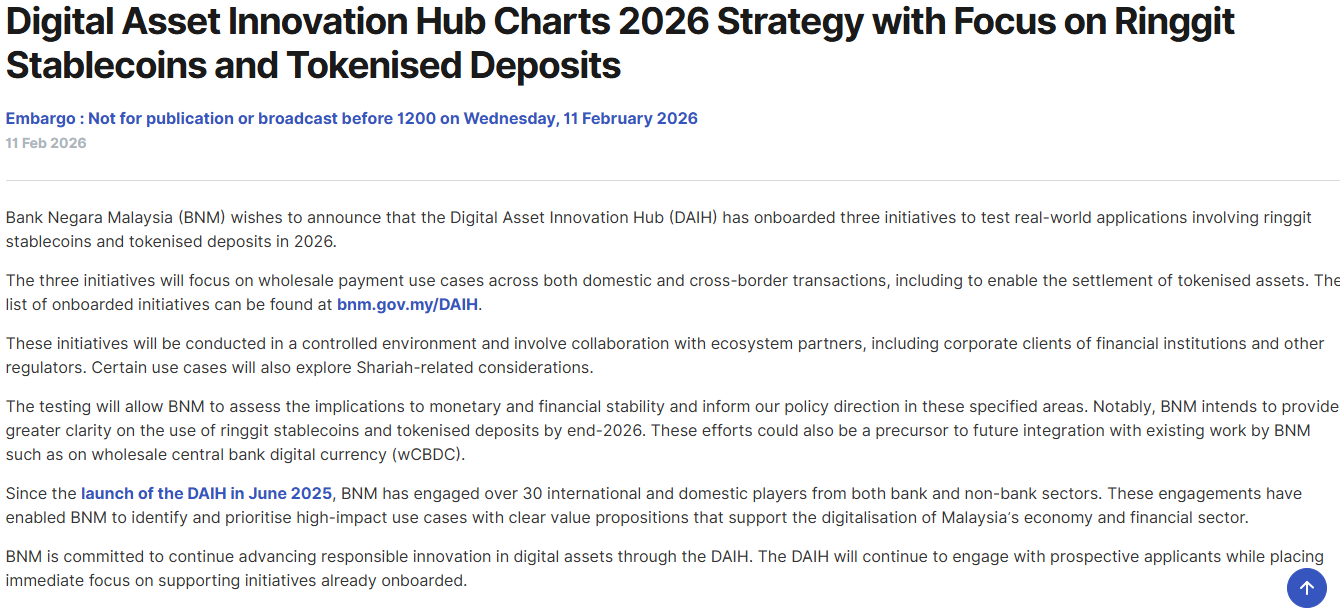
Malaysia's central bank, Bank Negara Malaysia (BNM), has taken a forward-looking approach to digital assets with the launch of three pilot programs at its Digital Asset Innovation Hub (DAIH). On Wednesday, the bank announced a series of regulatory sandbox initiatives designed to research the practical and policy implications of stablecoins and tokenized financial instruments.
At the heart of the sandbox is the use of ringgit-denominated stablecoins, digital tokens pegged to Malaysia's fiat currency for settlement and financial activity. These stablecoins are being tested as tools for cross-border settlement between institutions, a use case that has drawn global attention as countries consider how digital money can complement existing banking systems. Alongside stablecoins, the pilots will explore tokenized bank deposits. These are digital representations of traditional deposit balances issued by banks, allowing funds to move on a blockchain rather than through conventional banking rails. By tokenizing deposits, BNM hopes to learn how banks and other financial institutions might integrate digital tokens into their operations without disrupting liquidity or monetary policy.
BNM has made clear that the research conducted through these pilots will "inform our policy direction in these specified areas." That phrasing suggests that while the work is exploratory, it could shape future regulations or even lead to the issuance of a wholesale central bank digital currency (CBDC) - a digital form of fiat currency designed for interbank and institutional use. The sandbox also will examine Shariah-related considerations, reflecting Malaysia's position as a major center for Islamic finance. Shariah compliance adds another layer to digital currency design, as it requires that financial products adhere to Islamic legal principles, which can affect contract structure, risk sharing and asset backing.
Stablecoins, tokenization and the future of money
The focus on ringgit stablecoins positions Malaysia among a growing list of nations actively considering the real-world utility of digital money. Stablecoins, by design, combine the price stability of fiat currencies with the programmability and settlement efficiency of blockchain technology. In cross-border contexts, they can reduce friction, lower costs and speed up settlement compared with traditional correspondent banking.
Cross-border settlement is a particularly challenging problem in conventional finance. Even in today's digital age, transferring funds between countries often involves multiple intermediaries, foreign exchange conversions and time delays. Tokenized ringgit stablecoins could, in theory, allow institutional participants - banks, clearing houses, payment providers - to settle directly across borders on chain, potentially in near real time. BNM's pilots also include tokenized bank deposits. Instead of moving traditional deposit balances through messaging systems like SWIFT, a bank could issue a deposit token that moves on a blockchain. This experiment will help assess not just the technology, but also legal, operational and risk considerations around using private-sector tokenized products in broad financial activity.
Central banks around the world are watching similar experiments. Some, like those in the European Union and the United States, are focused on retail CBDCs digital cash for everyday use. Malaysia's pilots, by contrast, are oriented toward wholesale financial and institutional use cases. BNM's statement noted that learnings from the sandbox could feed into future frameworks for tokenized real-world assets (RWAs). RWAs are traditional financial assets like such as bonds, equities or even physical goods - represented digitally on a blockchain. Tokenization promises easier trading, fractional ownership and improved transparency, but it also raises questions about custody, settlement finality and legal rights.
A broader digital asset roadmap
Malaysia's recent sandbox announcement builds on earlier steps taken by authorities. In November 2025, officials in Kuala Lumpur published a three-year roadmap outlining plans to test asset tokenization across several sectors. According to a BNM discussion paper, use cases include supply chain management, Shariah-compliant financial products, access to credit, programmable finance and round-the-clock settlement. These themes point to a comprehensive strategy to understand how digital assets might integrate into everyday economic functions. Supply chain tokenization, for example, could allow physical goods to be tracked and financed in real time through digital tokens representing ownership or receipts. Programmable finance - financial contracts coded directly on blockchains - could automate actions such as payments, dividends or compliance checks, reducing manual processes and settlement risk.
Shariah-compliant finance remains an important consideration in Malaysia's work. Islamic finance principles emphasize risk sharing, asset backing and ethical participation, all of which intersect with the technical design of digital tokens. By explicitly exploring these aspects in its pilots, BNM is signaling that it intends to develop frameworks that are inclusive of Malaysia's diverse financial ecosystem. The emphasis on research and policy reflection rather than immediate deployment also suggests a thoughtful approach to risk. Stablecoins and tokenized assets have huge potential but also for episodes of volatility and misuse in unregulated markets. BNM's pilots will allow regulators and participants to identify potential pitfalls - on security, compliance, interoperability and market conduct - before scaling up any live systems.
As the global landscape evolves, more central banks are weighing the trade-offs between innovation and stability. Malaysia's sandbox does not leap straight into full digital currency issuance, but it does place the country firmly among policymakers willing to experiment with modern financial infrastructure.
What comes next
The pilots underway at Bank Negara Malaysia's Digital Asset Innovation Hub will unfold over time, with findings expected to influence future regulatory thinking. By pairing stablecoin research with tokenized deposits and RWA exploration, BNM is capturing a wide set of emerging trends in digital finance. Whether these experiments eventually lead to a wholesale CBDC or broader tokenized financial market remains to be seen. But by laying this groundwork now - and explicitly considering practical issues like cross-border use and Shariah compliance - Malaysia is positioning itself as a thoughtful player in the global digital currency conversation