

Summary :
- CoinShares argues only around 10,000 BTC are in wallets realistically worth targeting with quantum attacks.
- Most Bitcoin remains protected by address formats that keep public keys hidden.
- Quantum algorithms threaten signature schemes more than Bitcoin's core supply or mining rules.
- Debate continues over whether developers are moving fast enough on quantum-resistant upgrades.
Quantum computing and Bitcoin is one of those hot topics that are heavily concerning. But once you move past headlines and into the structure of how Bitcoin actually works, the picture becomes more measured. Bitcoin's security relies on two core building blocks. The first is digital signatures, currently based on elliptic curve cryptography such as ECDSA and Schnorr, which are used to prove ownership when someone spends coins. The second is hashing, like SHA-256, which secures mining and helps shield addresses. Under normal computers, deriving a private key from a public key is practically impossible, and reversing hashes is just as unrealistic.
Quantum computers introduce new math into that equation. Shor's algorithm, in theory, could break the elliptic curve math behind signatures if powerful enough machines ever become available. That is the part researchers focus on most. Grover's algorithm, meanwhile, reduces the strength of hash functions like SHA-256, but not to a level that suddenly makes brute-force attacks easy. Even halved in effective strength, the numbers involved are still enormous.The key detail is exposure. Most Bitcoin addresses do not publicly reveal their public keys until coins are spent. That extra layer, where only a hash of the public key is visible, keeps many coins out of reach even in a quantum scenario. The main vulnerability lies in older address types, such as Pay-to-Public-Key outputs, where the public key is already visible on-chain.
Those legacy outputs hold around 1.6 million BTC, close to 8% of supply. That number sounds big. But CoinShares' analysis narrows the focus much further. According to the firm , only about 10,200-10,230 BTC sit in UTXOs that are both exposed and large enough to matter from a market perspective if stolen. The rest are spread across tens of thousands of small outputs, often around 50 BTC each, where attacking them one by one would be slow and economically questionable even with optimistic assumptions about future quantum hardware.
What quantum can and cannot do to Bitcoin
There is a common idea floating around that quantum computers could just "break Bitcoin." The reality is more specific because the main pressure point is signatures. If Shor's algorithm runs at the scale required, a revealed public key could allow someone to compute the corresponding private key and sign a transaction. But other parts of the system stay intact as hashing is weakened in theory but not collapsed. Mining could become faster for whoever controls a large quantum computer, yet Bitcoin's difficulty adjustment would respond, keeping block times stable. The supply cap of 21 million coins does not change. Proof-of-work rules for block validation do not vanish.
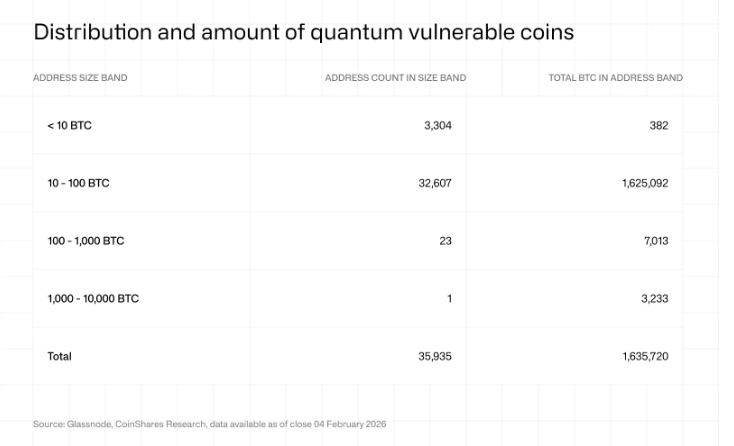
Christopher Bendiksen, Bitcoin research lead at CoinShares, framed the situation as a limited, targeted issue rather than a system-wide failure. His view is that the coins at meaningful risk are a small slice of the total. He noted that a little over 7,000 BTC sit in wallets with between 100 and 1,000 BTC, while roughly 3,230 BTC are in wallets with 1,000 to 10,000 BTC. At current prices, that group of coins adds up to hundreds of millions of dollars. In traditional market terms, that size could resemble a large but not catastrophic trade. This does not mean there is no risk. It means the risk has boundaries. It is concentrated in specific address types and wallet structures.
The other side of the argument
Not everyone is fully comfortable with the timeline. Some voices in the ecosystem worry less about today's machines and more about preparation. EasyA co-founder Dom put it on X :
That view points the focus from cryptography to governance and coordination. Even if quantum threats are years away, upgrading Bitcoin's signature schemes to quantum-resistant alternatives would be a complex process. It would require broad agreement, technical testing, and a smooth migration path for users. Bitcoin has handled major upgrades before, but slowly and carefully. That caution is part of its design, yet it can also look like inertia when facing long-term technological change.
Closing Thoughts
For now, CoinShares' stance lands in the middle ground. Quantum computing is a real research field, and Shor's and Grover's algorithms are not science fiction. But the idea that tomorrow's machines will suddenly unlock most Bitcoin does not match how addresses, keys, and UTXOs are actually structured. The vulnerable slice appears small, visible, and, importantly, measurable. It seems the numbers suggest the threat is narrower than the loudest headlines imply.
READ MORE: The One Thing Ethereum Still Can't Do - That COTI Already Solved