

Summary:
- Tether and Dubai Multi Commodities Centre (DMCC) signed an MoU to explore tokenization, blockchain adoption, and digital asset education.
- The partnership will focus on digital payments, advisory services, pilot programs, and infrastructure for tokenized assets.
- DMCC's network includes more than 26,000 companies, making it one of Dubai's largest business ecosystems.
- The collaboration adds to Tether's growing push beyond stablecoins into tokenized gold, payments, and broader tech investments.
- Education initiatives, hackathons, and advisory programs will be part of the rollout inside DMCC's Crypto Centre.
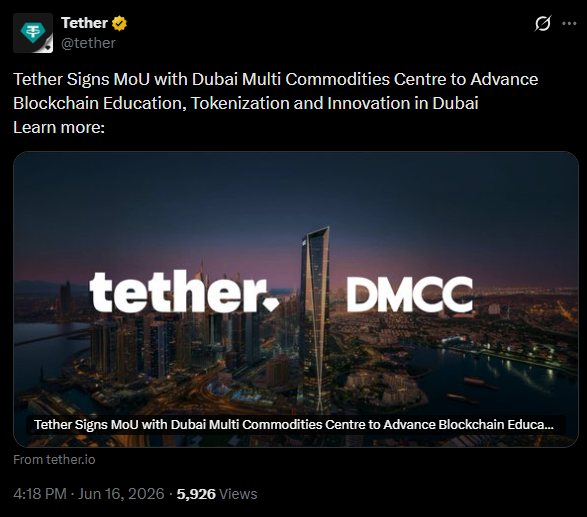
Tether has signed a memorandum of understanding with the Dubai Multi Commodities Centre (DMCC), marking another step in its effort to expand beyond stablecoins into broader blockchain infrastructure and real-world applications. The agreement brings Tether into one of Dubai's most active business ecosystems, which includes more than 26,000 companies operating across commodities, trade, finance, and technology sectors. According to a June 16 announcement shared on X, the partnership will explore tokenization initiatives, blockchain adoption strategies, digital payment systems, and advisory services designed for businesses within the DMCC network.
Beyond technical exploration, the agreement also includes plans for pilot programs and educational efforts. These will involve workshops, hackathons, and industry-focused events aimed at increasing understanding of digital assets and blockchain systems among companies operating in DMCC. The partnership signals a practical shift in focus, moving from theoretical blockchain adoption toward structured experimentation inside a real commercial ecosystem.
READ MORE: Zcash Restores Orchard After Emergency Upgrade Fixes Critical Vulnerability
Tokenization, Payments, and Digital Infrastructure
At the core of the agreement is the exploration of how blockchain can support everyday business activity. Both Tether and DMCC will assess how tokenized assets can be integrated into trade, payments, and financial workflows across participating companies. The scope includes peer-to-peer communication systems, digital payment infrastructure, and advisory frameworks that could help businesses transition into blockchain-based operations. DMCC, which contributes roughly 15% of Dubai's foreign direct investment, plays a significant role in connecting international businesses to regional markets. Its leadership sees digital infrastructure as increasingly tied to real-world commerce. Ahmed Bin Sulayem, Executive Chairman and CEO of DMCC, described how financial systems are gradually shifting toward digital networks. He highlighted that stablecoins already handle large transaction volumes globally and said tokenization is starting to reshape how assets are financed and transferred across borders. He also pointed to Dubai's regulatory framework as a foundation for supporting these developments.
From Tether's side, CEO Paolo Ardoino emphasized the UAE's role in shaping global digital asset infrastructure.
The emphasis on "real-world applications" reflects a broader shift in how blockchain firms are positioning themselves, moving away from isolated crypto ecosystems and toward integration with traditional business environments. Inside DMCC's Crypto Centre, Tether also plans to provide advisory support for member companies. This includes knowledge sharing initiatives and participation in joint programs designed to encourage experimentation with blockchain tools.
READ MORE: EU Targets Crypto in New Russia Sanctions Package, Proposes Ban on 11 Digital Asset Platforms
Tether's expansion beyond stablecoins continue
The DMCC partnership is part of a wider pattern of expansion from Tether, which has been steadily moving into areas beyond its core stablecoin business. Earlier this month, the company partnered with Fasset to launch a Visa-linked payment card that allows users to spend tokenized gold in everyday transactions. The product is tied to Tether Gold (XAU₮), with rewards designed to encourage real-world usage of tokenized assets. Tether also committed up to $1 million in XAU₮ to support the rewards program, positioning digital gold as more than just a store of value. In parallel, Tether has been increasing its exposure to technology and infrastructure investments outside the financial sector. On June 10, the company participated in a major funding round for German robotics firm Neura Robotics, alongside global technology and financial players including Amazon, Nvidia, Qualcomm, Bosch, Schaeffler, and the European Investment Bank.
According to Neura Robotics, the Series C round could reach up to $1.4 billion and will help develop AI-powered humanoid and cognitive robotics systems. These moves show a broader shift in strategy. Instead of focusing only on issuing stablecoins, Tether is positioning itself closer to infrastructure, payments, tokenization, and emerging technologies that intersect with both finance and industry. The DMCC deal fits into that trajectory, linking blockchain tools directly with business ecosystems that already operate at scale. For Dubai, the partnership adds another layer to its growing digital asset strategy, reinforcing its position as a regional hub for blockchain experimentation and tokenized finance. For Tether, it opens access to a large and diverse business network where blockchain use cases can be tested in practical settings. As tokenization, digital payments, and blockchain infrastructure continue to evolve, the collaboration between Tether and DMCC represents one of the more structured attempts to connect these systems with everyday commercial activity.
READ MORE: Are Bitcoin Holders Selling for SpaceX? Onchain Data Suggests a Different Story