

Summary:
- Bittensor (TAO) has fallen nearly 20% since June 15 as governance concerns and liquidations weigh on market sentiment.
- The proposed Root Reborn upgrade has divided the community, with critics warning about validator power, liquidity risks, and possible regulatory challenges.
- More than $1.6 million in long positions were liquidated as traders reduced exposure to TAO.
- Technical indicators suggest sellers remain in control, with the $220 level becoming an important support area in the short term.
Bittensor (TAO) has come under renewed selling pressure after a heated governance debate raised fresh concerns about the network's future direction. The AI-focused cryptocurrency has fallen nearly 20% from its June 15 high of around $283, slipping to roughly $224 as investors reacted to both internal governance discussions and broader market weakness. While crypto markets have remained cautious following expectations of higher U.S. interest rates, much of TAO's recent decline has been linked to controversy surrounding Root Reborn, a proposal that would significantly change how validators allocate capital across the Bittensor ecosystem. Supporters believe the proposal could strengthen the network over time by addressing tokenomics issues. Critics, however, argue it could shift too much influence toward validators while introducing new liquidity and regulatory concerns.

The combination of uncertainty, reduced trader confidence, and leveraged liquidations has placed TAO among the weaker-performing AI-related cryptocurrencies over the past several days.
Root Reborn proposal divides the Bittensor community
The recent decline began shortly after debate intensified around the proposed Root Reborn governance overhaul. According to supporters, the proposal aims to solve an ongoing issue within the Bittensor ecosystem by changing how validators distribute capital across network subnets. The objective is to reduce continuous selling pressure from subnet tokens while creating stronger long-term incentives across the network. Not everyone agrees with that approach. One of the strongest public responses came from validator group Yuma, which argued that the proposal fundamentally changes the role validators play within Bittensor. Instead of acting as neutral network participants responsible for securing the protocol, validators could become active capital allocators, giving them greater influence over which subnet projects receive support. Yuma warned that this could create incentives that do not currently exist within the network.

The group also suggested that validators with greater influence over capital allocation could unintentionally encourage preferential treatment, collusion, or front-running, while subnet teams might spend more time building relationships with validators than focusing on developing AI products. Beyond governance, Yuma also highlighted liquidity concerns. According to its analysis, if staking rewards become tied to baskets of subnet tokens, redeeming those assets during periods of market stress could become increasingly difficult. In a large-scale unstaking event, later participants could receive less favorable execution than earlier redeemers. The group also raised the possibility that validators making capital allocation decisions could attract additional regulatory scrutiny, particularly if those responsibilities begin to resemble investment management activities. Such concerns, if realized, could complicate participation for institutional operators, exchanges, and custodians. The discussion remains ongoing, and no final decision has been reached. Even so, the debate has introduced uncertainty at a time when crypto investors have become increasingly sensitive to governance-related risks.
READ MORE: XRP Ledger Solved DEX Trading Years Before Solana, Says Former Ripple Developer
Liquidations add pressure
Governance concerns were quickly reflected across derivatives markets. According to CoinGlass, open interest in TAO futures fell by more than 8% over a 24-hour period, dropping to roughly $252 million-$260 million as traders reduced leveraged exposure. During the same period, more than $1.66 million in bullish positions were liquidated, accelerating downside momentum as forced selling entered the market. Spot market activity also cooled noticeably. Daily trading volume declined by roughly 14% to around $624 million, suggesting many traders are waiting for greater clarity before rebuilding positions. Technical data now shows several important price levels that traders are watching.
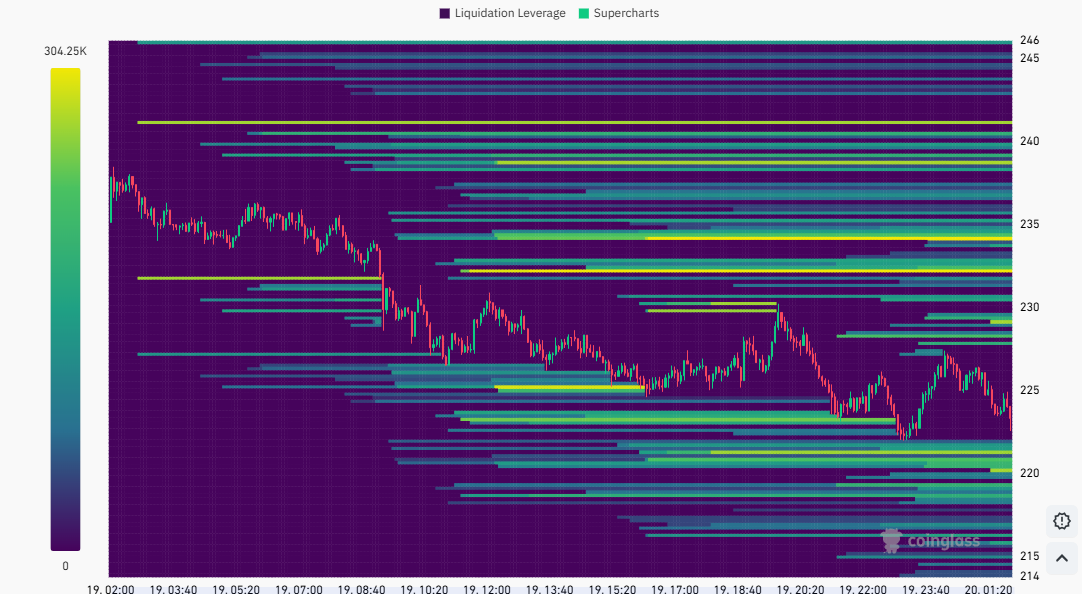
CoinGlass liquidation heatmaps indicate dense liquidity clusters between $239 and $241, with additional concentrations near $244-$245. If buyers regain momentum, these levels could become natural targets as short positions begin to unwind. On the downside, however, attention remains focused on the $220 support zone. A decisive move below that level could expose TAO to another decline toward June's swing low near $190, while the broader support range between $180 and $200 may become increasingly important if selling pressure continues. The macroeconomic backdrop has also offered little relief. Broader crypto markets weakened after expectations grew that U.S. interest rates may remain elevated for longer than previously anticipated. Higher interest rates generally reduce demand for higher-risk assets, including cryptocurrencies and AI-related tokens like TAO. The stronger U.S. dollar has further contributed to cautious market sentiment, encouraging investors to reduce exposure to more speculative sectors while waiting for clearer economic signals. For now, TAO would likely need to reclaim the $237-$250 range before buyers can begin rebuilding confidence in the current trend.
READ MORE: US Seized Nearly $1 Billion in Iranian Crypto, Treasury Secretary Says