

Summary:
- World Liberty Financial (WLFI) investors have approved a governance proposal requiring tokens to be locked for 180 days to retain voting rights.
- The vote passed with 99.12% support from 1,800 voters, though more than 76% of the tokens came from just ten wallets.
- The rule aims to ensure that only holders with "long-term alignment to the protocol" influence governance decisions.
- Stakers can earn 2% annual percentage yield (APY) if they participate in at least two governance votes during the lock-up period.
- Large investors locking $5 million worth of tokens can qualify as "Super Nodes" with additional access to the project's business development team.
World Liberty Financial (WLFI), the crypto venture backed by members of the Trump family, has approved a new governance rule that significantly changes how token holders participate in decision-making. Under the proposal, investors who want to retain voting rights must lock their tokens for 180 days, or roughly six months. The proposal was put to a governance vote on the project's Snapshot platform and closed with overwhelming support. According to the official voting page, 99.12% of the 1,800 votes cast supported the proposal, signaling strong approval among participants.
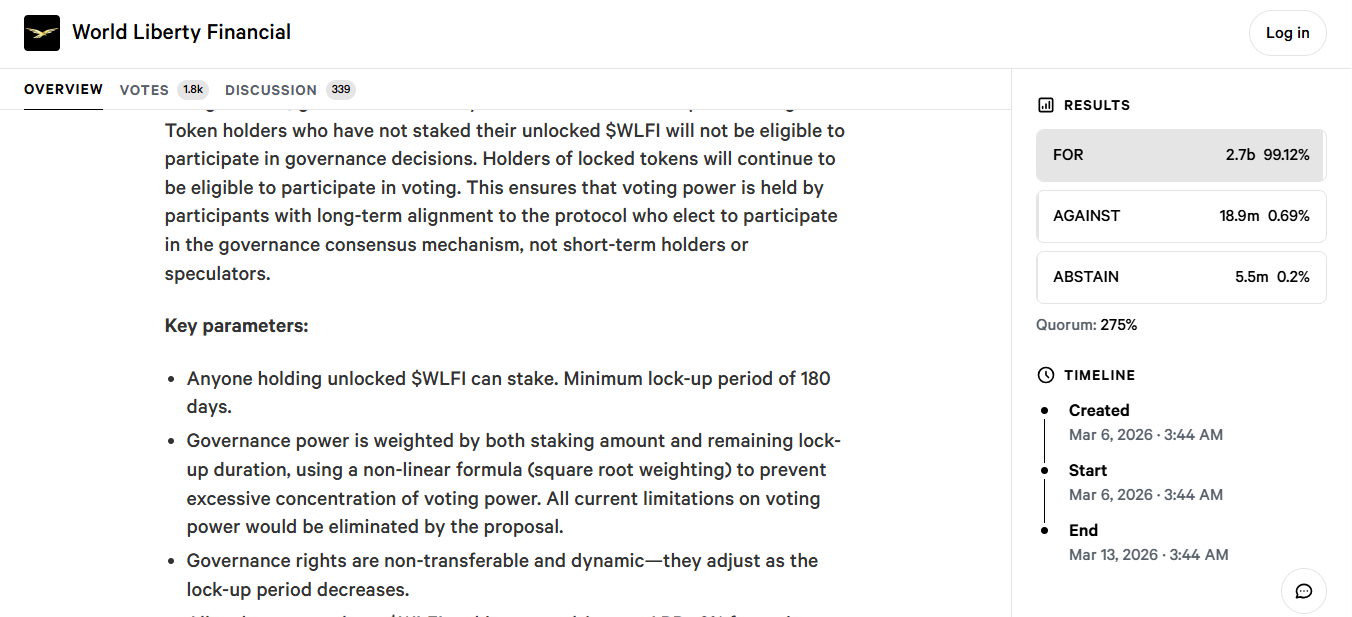
However, the voting data also revealed a concentration of influence among a small group of holders. More than 76% of the total tokens used in the vote came from just ten users, highlighting how governance power within decentralized projects can often rest with a limited number of large stakeholders. The new rule is designed to ensure that those participating in governance decisions have a long-term interest in the protocol. According to the proposal's explanation, the requirement was introduced to ensure that only users with "long-term alignment to the protocol" are able to help steer its future. Token holders who already had their assets locked before the proposal was passed will not be affected. They will continue to participate in governance votes under the existing structure until their current lock-up periods expire. To encourage participation, the proposal also introduces a modest financial incentive. Users who stake their tokens for the required period can earn 2% annual percentage yield on their holdings, provided they participate in at least two governance votes during the lock-up period.
The structure is intended to encourage more active involvement in decision-making while discouraging short-term traders from influencing governance outcomes.
Large Investors and the Rise of "Super Nodes"
Another aspect of the governance structure centers on large investors who commit significant capital to the project. World Liberty Financial has introduced a category referred to as "Super Nodes," which applies to investors who lock $5 million worth of WLFI tokens for the required six-month period. These high-value participants receive additional privileges within the ecosystem. According to documents and statements referenced in Reuters reporting, Super Nodes gain enhanced access to the project's internal teams for strategic discussions. The project's spokesman, David Wachsman, described one of the main benefits tied to the designation:
The proposal originally described the benefit as a form of "guaranteed direct access" to the team for partnership discussions, though the company later clarified that the access does not extend directly to the founders themselves. World Liberty Financial lists several prominent figures on its "Supporting Team," including members of the Trump family such as Eric Trump, Donald Trump Jr., and Barron Trump. However, according to the company, Trump and other family members will not be part of the direct access arrangement offered to Super Node investors. The introduction of the Super Node category highlights the increasing role that large investors can play in shaping governance structures within emerging crypto platforms. While decentralized projects often emphasize community control, major token holders frequently carry significant influence due to the voting power tied to their holdings. For WLFI, the system attempts to balance these dynamics by encouraging longer holding periods while rewarding investors who demonstrate substantial commitment to the ecosystem.
READ MORE : Top 10 Mid Cap Altcoins to Invest in For 2026
Addressing Governance Challenges in Decentralized Projects
The new lock-up rule comes at a time when decentralized organizations across the crypto industry are grappling with a common problem: low voter participation. Decentralized autonomous organizations, commonly known as DAOs, are designed to allow token holders to vote on proposals that shape the development of a project. In practice, however, participation rates are often much lower than expected. Some studies estimate that only 15% to 25% of eligible token holders typically take part in governance votes. This gap between theoretical decentralization and real-world participation has led many projects to experiment with new governance models. The approach adopted by World Liberty Financial is one attempt to address the issue by tying voting rights to a longer commitment of capital. The idea is that investors who lock their tokens for several months are more likely to remain engaged in the protocol's future.
But Earlier this year, Ethereum co-founder Vitalik Buterin proposed that AI-powered personal assistants could help DAO members evaluate proposals and cast votes more easily. The concept involves using automated tools to analyze governance proposals and summarize them for users, potentially increasing participation rates. At the same time, some leaders have argued for reducing the role of token voting altogether. Stani Kulechov, founder of the decentralized lending platform Aave, has suggested that governance could benefit from greater involvement by core leadership teams rather than relying entirely on token holder votes. The WLFI proposal represents a different direction, the new rule attempts to strengthen governance by requiring a deeper commitment from participants.
Closing Thoughts
For supporters, the six-month lock-up requirement signals stability and long-term thinking within the protocol. For critics, however, the concentration of voting power among a small group of large investors remains a key concern. Whether the new lock-up rule leads to stronger participation and more balanced governance will likely become clearer over time as WLFI's community continues to grow and new proposals emerge.
READ MORE: SEC Drops Case Against Justin Sun After $10M Settlement, Closing Three-Year Crypto Lawsuit