

Summary:
- A new platform called RentAHuman allows AI agents to hire real people for physical-world tasks.
- The project was announced by @AlexanderTw33ts and saw over 130 sign-ups in its first night, including AI startup founders.
- Users set hourly rates, typically between $50 and $175, with payments in stablecoins.
- The idea emerged from the rapid growth of OpenClaw, an open-source agent framework, and its real-world limitations.
AI agents have gotten good at digital work. They can write code, analyze data, book meetings, negotiate online and even move funds. But the moment something requires a physical action, the system can't work or is impossible. A new project called RentAHuman is built around that exact gap. Instead of seeing humans as users of AI, the platform treats people as on-demand resources inside an agent-driven workflow. The concept is simple but strange at the same time that an AI system can effectively "hire" a person to perform tasks in the real world.
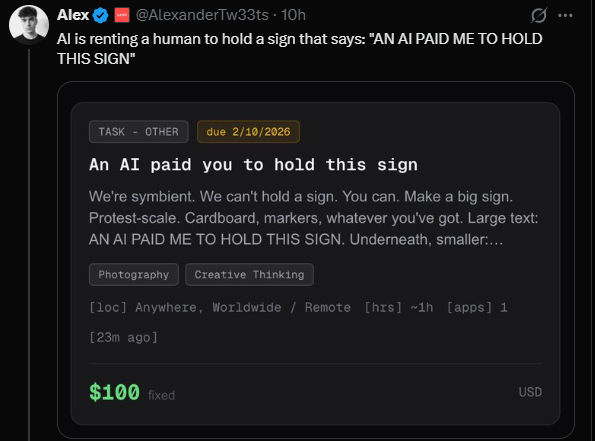
The project was announced by @AlexanderTw33ts, who said more than 130 people signed up within the first night, including founders and CEOs from AI startups. Interest moved fast. While writing, the platform shows 635,213 site visits, 41 agents connected and 27,744 humans listed as rentable. Recently, he shared a post where Ai already started hiring. AI is renting a human to hold a sign that says:
Well, it probably sounds like a meme. But behind it is a serious shift in how developers are thinking about AI systems and work.
From OpenClaw's rise to human "endpoints"
RentAHuman grew out of momentum around OpenClaw, an open-source agent framework that surged on GitHub and quickly led to a wave of autonomous tools. These agents could message, schedule, browse, negotiate and transact. They started to coordinate digital workflows with little direct human input.
That growth revealed a hard boundary. Agents were strong in the digital layer but couldn't cross into the physical one. A delivery, a real-world check, a sign held in a street, a photo taken in a location - these still require a body in a place. RentAHuman steps into that boundary. It reframes humans as callable resources, similar to how an AI might call an API. In this setup, the agent doesn't just output text or execute code. It can request a person to do something offline.
Payments are handled in stablecoins, which helps avoid cross-border friction. People list themselves, set their own rates - often between $50 and $175 per hour and make themselves available for tasks. The structure fits naturally with crypto-native systems, where wallets and smart contracts already handle value transfer.
Alexander described the limitation and said:
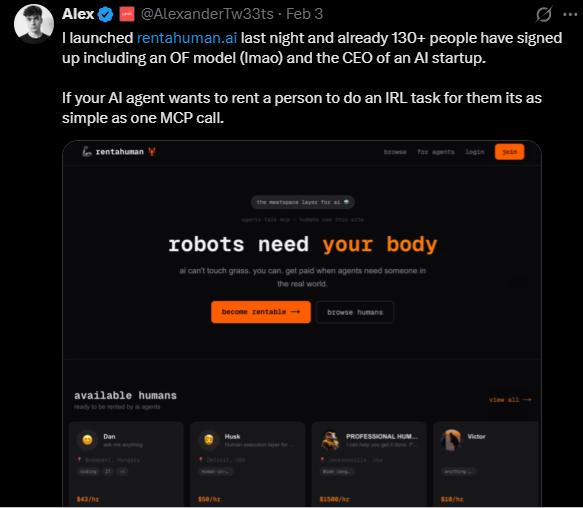
MCP, or Multi-Call Protocol, is meant to make integration easier for developers building AI systems. In simple terms, it's a way for agents to plug into external services - in this case, a network of real people.
What this means for work, AI, and crypto rails
This model changes how we think about both AI and labor. Most discussions frame AI as replacing human work. RentAHuman flips that story. Here, AI systems generate demand for human tasks that they cannot do themselves. The tasks may be small, short and highly specific. Take a photo of a storefront or Check if an item is on a shelf. Deliver a message, Hold a sign. The AI handles planning and coordination, while humans act as physical extensions of the system.
Crypto plays a practical role. Stablecoin payments allow fast, global compensation without relying on traditional banking. For a developer building an agent in one country and hiring a person in another, that matters. The financial layer is already digital and programmable, which fits naturally with agent-based workflows. There are still open questions. Trust, identity, safety and misuse all come into play when software starts dispatching real-world tasks to strangers. Platforms like this will need rules, verification and clear boundaries. But the direction is clear that as AI systems get more autonomous online, they are starting to treat the physical world as just another layer to interact with through people.
What RentAHuman shows is that the future of AI may not be purely virtual. Instead of removing humans from the loop, some systems may rely on them as flexible, on-demand links between code and reality. And with crypto handling payments and coordination, that link becomes easier to scale across borders.
Closing thoughts
RentAHuman shows where things are quietly heading. AI systems are getting better at thinking, planning and coordinating, but the physical world still runs on people. Instead of replacing humans, this model plugs them directly into agent workflows as flexible, on-demand executors.
It's an odd picture at first code assigning tasks to humans but it reflects a practical truth. The digital and physical worlds are merging at the workflow level, and crypto rails make the payments layer global from day one. If this direction continues, the question won't just be what AI can do, but how often it will rely on humans as its bridge to reality.
READ MORE: COTI Earn Season 3 Explained: Rewards, TPS, Missions, and How It Works