

Summary:
- The US Treasury has sanctioned two UK-registered crypto exchanges linked to Iran's financial networks.
- This marks the first time Washington has directly targeted digital asset platforms under its Iran sanctions program.
- Officials say the exchanges were connected to entities tied to the Islamic Revolutionary Guard Corps (IRGC).
- The move is part of a broader package aimed at Iranian officials and financial facilitators.
- Blockchain analytics firms have previously flagged large-scale Iranian use of crypto to bypass sanctions.
The United States Treasury has sanctioned two cryptocurrency exchanges linked to Iran's financial system, marking the first time Washington has directly targeted digital asset platforms as part of its Iran sanctions program. The action came through the Treasury Department's Office of Foreign Assets Control (OFAC), which said the designations are part of a broader campaign focused on Iranian officials and financial networks.
According to the Treasury, these networks are accused of suppressing people domestically while relying on alternative financial channels to move funds and work around international restrictions. That framing is important. Crypto is not being treated here as a side issue. It is being described as part of the financial plumbing that can help sanctioned actors stay connected to global value flows. Among those sanctioned was Eskandar Momeni Kalagari, Iran's minister of the interior, who oversees the country's Law Enforcement Forces. The announcement tied the measures to internal repression as well as financial activity.
OFAC also designated Babak Morteza Zanjani, a prominent Iranian businessman previously convicted of embezzling billions of dollars in oil revenue from Iran's national oil company. According to the Treasury, Zanjani was later released and used by the Iranian state to help move and launder funds, providing financial support to projects connected to the Islamic Revolutionary Guard Corps.
This context matters because it places the crypto exchange sanctions inside a larger financial and political story, not just a tech enforcement case.
UK-registered exchanges named
The part that breaks new ground is the inclusion of two UK-registered crypto exchanges: Zedcex Exchange Ltd. and Zedxion Exchange Ltd. US officials say both are linked to Zanjani and processed large volumes of transactions associated with IRGC-linked entities. OFAC said Zedcex alone has handled more than $94 billion in transactions since its registration in 2022. That figure, if accurate, shows the scale at which digital asset platforms can operate even outside the biggest global brand names.
By sanctioning these exchanges, the US is signaling that digital asset businesses can be treated like any other financial institution in the sanctions system. Being registered outside Iran did not shield them from US measures. What mattered was the alleged flow of funds and the connection to sanctioned networks. Bessent accused Tehran of channeling oil revenues toward weapons programs and militant proxies rather than supporting its population. He said Washington would continue targeting networks that use digital assets to bypass restrictions and finance illicit activity. The message is direct. Crypto rails are now clearly within scope for enforcement when linked to sanctioned actors.
Beyond the exchanges, OFAC also sanctioned senior IRGC commanders and security officials in multiple provinces. The designations cited evidence of live-fire attacks on protesters, forced burials without funerals and widespread intimidation aimed at suppressing dissent. The crypto element is therefore tied into a wider human rights and security narrative.
Blockchain tracing and the Iran crypto trail
Blockchain analytics firms have been tracking state-linked crypto flows for years, and recent research has added more fuel to the discussion. About ten days before the Treasury action, Elliptic published research saying it had identified wallets used by Iran's Central Bank to acquire at least $507 million worth of cryptoassets. The firm said the activity suggested the regime used digital assets to evade sanctions and help support the falling value of the national currency.
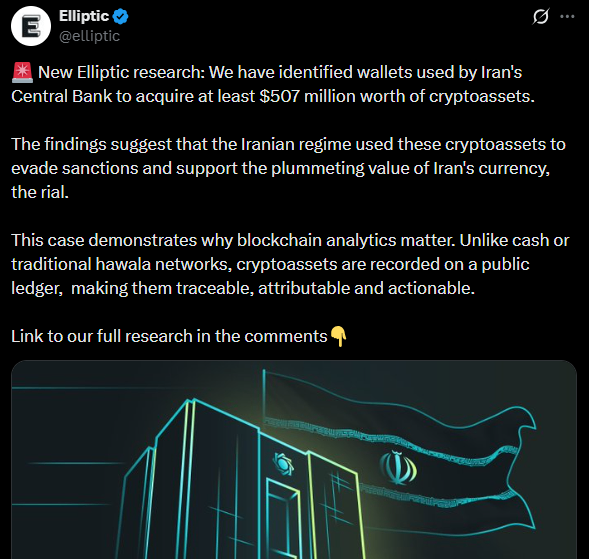
The researchers framed it as a case study in why blockchain tracing matters. Unlike physical cash or informal money transfer systems, crypto transactions leave records on public ledgers. That makes them visible to investigators who know how to follow the trails.
This broader context helps explain why regulators and enforcement agencies are paying closer attention to digital assets in sanctions policy. Crypto does not erase financial footprints. It changes how they look. For governments, that means both new risks and new investigative tools. The latest OFAC action shows how that thinking is translating into policy. Exchanges, not just individuals or wallets, are now in focus when they are seen as key nodes in sanctioned networks.
Closing Thoughts
For the crypto industry, the signal is hard to miss. Operating across borders, dealing with high-risk jurisdictions or failing to screen flows properly can pull a platform into geopolitical disputes that go far beyond market cycles. Compliance is no longer just about financial regulation. It now sits directly alongside foreign policy and national security. For policymakers, this step sets a precedent. Digital asset infrastructure is no longer treated as peripheral to sanctions enforcement. It is part of the financial system's frontline, and it will be policed that way.