

Summary:
- CrossCurve's cross-chain bridge was compromised in a smart contract vulnerability, with roughly $3 million reportedly exploited across multiple networks.
- The protocol urged users to pause interactions while the issue is investigated.
- Security analysts described how a spoofing weakness allowed unauthorized token unlocking.
- Curve Finance, which partners with CrossCurve, warned users to review related votes and tread carefully with third-party protocols.
- CrossCurve's CEO offered a 10% bounty for the return of stolen funds under a white-hat framework.
CrossCurve, a crypto protocol that enables cross-chain liquidity movement, confirmed late Sunday that one of its bridge contracts has been attacked, leading to a multi-network exploitation with around $3 million taken, according to independent security monitoring. Bridges mean a mechanism that allows assets to move between different blockchain networks are widely seen as among the riskiest components in decentralized finance because they connect otherwise separate ecosystems. CrossCurve first alerted users through a post on X, urging caution. The message read in part:
The tone of the message was clear that activity on the protocol should stop for now to prevent further losses. Security observers quickly shared a few details. Defimon Alerts, an X account tied to blockchain security firm Decurity, reported that the exploit stemmed from a weakness in a CrossCurve smart contract allowing attackers to bypass message validation. In essence, cross-chain mechanics rely on messages being securely passed from one network to another. If those messages can be spoofed, attackers can trick the system into believing a legitimate transfer occurred, unlocking assets without proper authorization. According to Defimon Alerts:
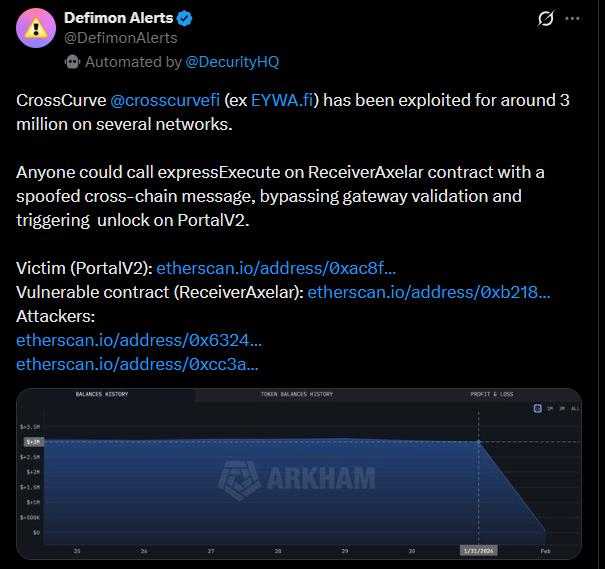
That description points to a structural weakness in how the contract validated cross-chain instructions. The exploit allowed a crafted request to be accepted and processed, effectively tricking the system into releasing assets. This type of failure underlines ongoing risks many protocols face when building infrastructure that spans multiple blockchains. Complexity increases with each additional network involved, and so do opportunities for unexpected interactions or unchecked paths through which assets can leak.
Curve Finance respond and users urged to revisit positions
CrossCurve evolved from EYWA.fi and has partnered with Curve Finance, one of decentralized finance's largest liquidity protocols. In response to the security incident, Curve Finance posted a notice on X urging caution among its community. In its message, Curve noted the issue involved the protocol formerly known as EYWA, now operating as CrossCurve, and advised users with votes allocated to related pools to review their positions. It also underscored the importance of caution when interacting with third-party projects.
That reminder reflects a broader conversation in decentralized finance. Liquidity and composability - the ability for one protocol to work with or build on another are core strengths of the ecosystem. But they also mean users must weigh risks beyond the flagship protocols they know. A vulnerability in a partner project can ripple outward, affecting dependent systems and user funds.
In this case, CrossCurve's bridge integrates liquidity across networks, and any exploit there can have far-reaching effects. Whether users have funds directly on the bridge or indirect exposure through pool votes or positions, the incident is a reminder that cross-chain activity carries layered risks.
A bounty offer and hopes for recovery
Amid the fallout, CrossCurve's leadership moved quickly to try to recover funds. CEO Boris Povar identified a set of addresses that had received tokens traced back to the exploit and reached out publicly. Instead of assuming malicious intent, he framed the event as a smart contract failure and extended a conditional offer to recover assets.
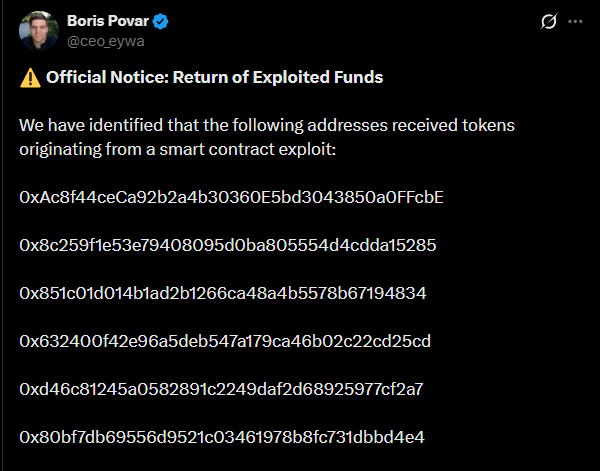
To encourage a return, the protocol offered a bounty of up to 10% under its SafeHarbor WhiteHat policy, valid if the rest of the exploited funds were returned within 72 hours of the attack. The idea behind such programs is to give benevolent actors or intermediaries a clear incentive to return funds rather than face sanctions or reputational consequences. In practical terms, that means if someone who received exploited tokens hands them back, they can retain up to 10% of the recovered amount as a reward. These kinds of white-hat initiatives have become more common when exploits are detected quickly and there is a belief that the community can be mobilized to resolve the situation without litigation or punitive outcomes.
Whether the bounty yields results remains to be seen. In past incidents, white-hat offers have sometimes led to partial returns, especially when wallets are well-tracked on public ledgers and intermediaries or custodians can identify flows and nudge cooperation. In other cases, funds have remained on chains or been mixed through secondary paths that make recovery difficult. For CrossCurve users and broader DeFi participants, the incident will likely reinforce two ongoing themes. First, bridges and cross-chain systems remain technical frontiers with higher risk profiles than single-chain smart contracts. Second, transparency and quick community engagement - including bounty programs - are now standard elements of how teams respond when things go wrong.
Final Thoughts
As the investigation continues, users are watching closely to see whether the exploited balances move back into protocol control, whether any legal or technical follow-ups emerge, and what lessons this episode will yield for future bridge design. In the meantime, the CrossCurve community has been reminded how deeply interconnected and delicately balanced modern decentralized finance infrastructure can be.
READ MORE: COTI Earn Season 3 Explained: Rewards, TPS, Missions, and How It Works