

Summary:
- Anthropic has launched Claude Fable 5, its most capable public AI model, with stronger reasoning and coding abilities.
- The company says safety filters are designed to block dangerous cybersecurity requests, though it acknowledges determined attackers may still search for ways around them.
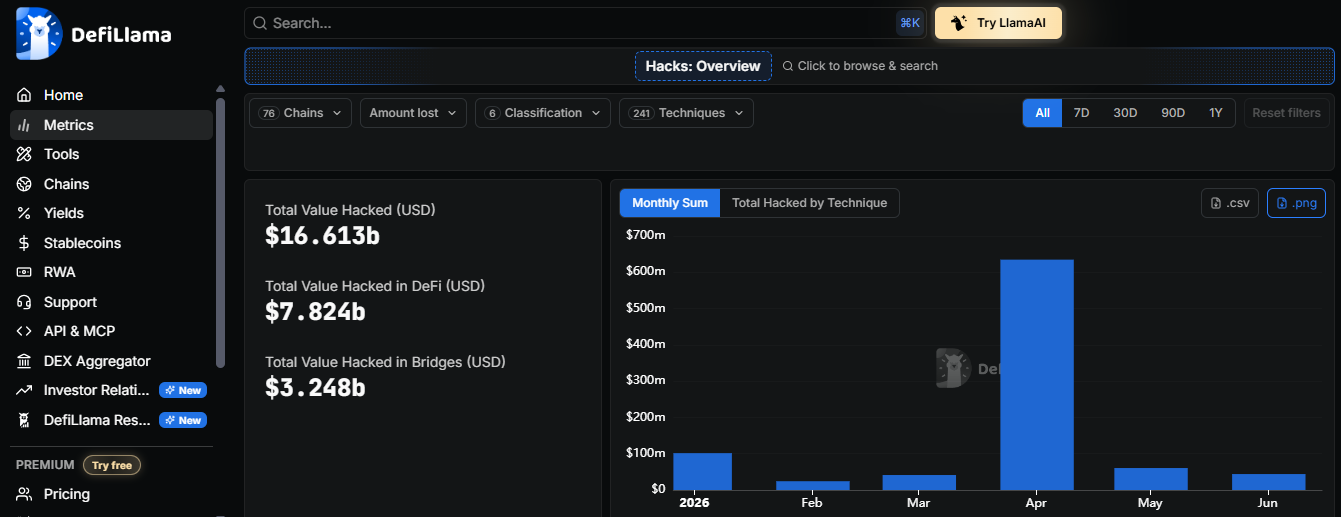
- DeFi has already lost more than $840 million to hacks in the first five months of 2026, making crypto one of the industries most exposed to AI-assisted attacks.
- Security experts say AI's biggest advantage may not be creating entirely new exploits, but dramatically accelerating vulnerability discovery, phishing campaigns and attack execution.
- Anthropic says fewer than 5% of user sessions trigger its cybersecurity safeguards, while a more powerful Mythos version remains restricted to vetted researchers.
AI is reaching a point where it can review complex software much faster than humans. It can analyze codebases, compare updates, explain technical reports and highlight potential vulnerabilities within minutes instead of days. For decentralized finance and blockchain applications, where code often controls billions of dollars in assets, that increased speed is both an opportunity and a challenge. Better tools can strengthen security, but they also raise the stakes if sophisticated attackers gain access to the same capabilities. That discussion intensified this week after Anthropic introduced Claude Fable 5, describing it as its most capable public AI model to date. The release brings significantly stronger reasoning and coding abilities while introducing new safety systems intended to prevent misuse in sensitive areas such as cybersecurity.
Anthropic divided the launch into two versions. Claude Fable 5 is available to the public with built-in safety controls, while Claude Mythos 5, which offers even stronger cybersecurity capabilities, is limited to vetted organizations working in areas such as critical infrastructure and professional security research. According to Anthropic, experts found Mythos capable of identifying and chaining together previously unknown software vulnerabilities, commonly known as zero-day bugs. Those are flaws developers have not yet discovered or patched, making them particularly valuable to attackers. Recognizing those risks, Anthropic says requests involving high-risk cybersecurity topics are automatically redirected to its less capable Claude Opus 4.8 model instead. The company explained its reasoning clearly:
Anthropic also noted that internal security teams and external researchers spent more than 1,000 hours attempting to bypass these protections without finding a universal method. Even so, the company acknowledged that determined and well-funded attackers will likely continue testing the system because of the potential value such capabilities could provide. For the crypto industry, where a single vulnerability can lead to millions of dollars disappearing within minutes, that warning carries particular weight.
READ MORE: US Seized Nearly $1 Billion in Iranian Crypto, Treasury Secretary Says
Speed may become AI's biggest weapon against DeFi
The biggest concern surrounding advanced AI models is not necessarily that they invent completely new attack techniques. Instead, researchers argue that AI dramatically reduces the time required to carry out tasks that previously demanded days or even weeks of manual work. A model like Claude Fable 5 can quickly analyze open-source code repositories, compare software updates, summarize lengthy security audits and identify patterns that human analysts might overlook. It can also generate highly convincing phishing messages or help organize complex research across thousands of documents within minutes. That speed changes the economics of cybercrime. Rather than requiring large teams of experienced researchers, future attackers could automate much of the early reconnaissance process, allowing them to identify more potential targets while spending far less time on each one.
Crypto is especially vulnerable because software errors often translate directly into financial losses. According to DefiLlama, decentralized finance protocols have already suffered more than $840 million in hacks during the first five months of 2026. April alone accounted for more than $600 million, making it the worst month on record for the sector.
Still, recent incidents also show that smart contract bugs are only one part of the threat landscape. One of the year's largest attacks reportedly involved a North Korea-linked group that spent roughly six months conducting social engineering before gaining administrative access to Drift Protocol, resulting in losses estimated at around $285 million. Another major exploit targeted Kelp DAO through a single-verifier vulnerability that reportedly enabled attackers to steal approximately $292 million. More recently, Humanity Protocol disclosed that private keys belonging to a member of its foundation had been compromised, leading to losses exceeding $30 million. Human mistakes, operational weaknesses and compromised credentials continue to account for some of crypto's largest security failures. AI could make those attacks significantly more efficient. By rapidly reviewing public documentation, identifying outdated code, organizing research and generating believable communications, advanced models may lower both the cost and time required to launch sophisticated campaigns.
Crypto security may become an AI race of its own
The arrival of increasingly capable AI systems presents both an opportunity and challenge for blockchain security. Developers already use AI tools to review code, identify vulnerabilities and improve software quality before products reach production. Security firms are also experimenting with AI-assisted auditing to detect issues earlier in the development process. At the same time, the same advances can benefit attackers if safeguards are bypassed or if future models become even more capable. Anthropic's own messaging reflects that balance. The company believes its current protections meaningfully reduce risk but openly acknowledges that no security system is perfect and that future models will require even stronger safeguards.
For crypto projects, the discussion goes well beyond one AI release. As decentralized finance continues to manage billions of dollars in digital assets, the speed of security research will increasingly matter. Defensive teams will likely need to adopt AI as aggressively as attackers do, creating an ongoing technological race rather than a one-time solution. The industry's challenge is ensuring they are discovered and fixed before increasingly capable AI tools can help malicious actors find them first.
READ MORE: Fake Google Ads Targeting Uniswap Users Steal $400K, Analysts Warn