

Summary:
- Drift confirms a $280M exploit tied to a planned admin takeover using pre-approved multisig transactions
- Attackers used durable nonce accounts to delay execution and gain control, No smart contract bug or seed phrase leak involved
- ZachXBT says Circle failed to freeze over $230M in USDC linked to the attack
- Funds were bridged from Solana to Ethereum through CCTP over several hours.
Drift Protocol has shared new details about the $280 million exploit that hit its Solana-based trading platform, placing it among the largest DeFi incidents to date. This incident is heavily highlighted in the crypto community because of the attack style. According to the team, this wasn't a quick breach or something like that, It was planned, staged, and executed with precision. Drift protocol team said in X,
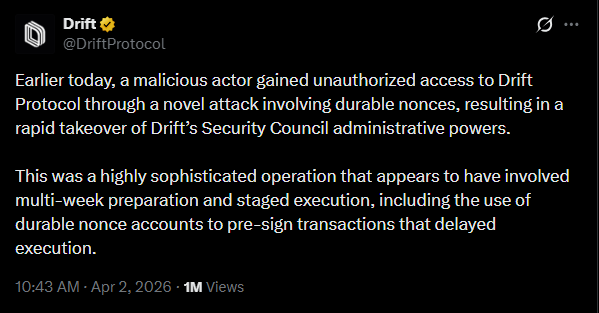
Instead of breaking into the system through a code flaw, the attacker worked around the edges. Drift says the exploit likely involved social engineering or misleading transaction approvals. In simple terms, approvals were collected in advance, possibly without raising suspicion at the time. Those approvals were then paired with durable nonce accounts - a feature that lets transactions be signed early and executed later. That delay created the opening. Once control was secured, the attacker moved fast. They introduced a malicious asset, removed withdrawal limits, and drained funds across multiple pools. Drift confirmed that borrow-lend deposits, vaults, and trading balances were all affected. The stolen assets include JLP, SOL, USDC, cbBTC, and wBTC. Importantly, the team ruled out two common causes, firstly there was no smart contract bug and another there's no compromised seed phrase. That narrows the issue down to access control and how approvals were handled. One user summed up the similar incident :

While Drift hasn't confirmed oracle manipulation as the root cause, the comparison shows how familiar patterns can resurface in new ways. Drift is now working with security firms, exchanges, and law enforcement to trace the funds and limit further movement.
ZachXBT Questions Circle's Response
While Drift focuses on tracking funds, attention has shifted to how stablecoin flows were handled during the attack. Onchain investigator ZachXBT publicly criticized Circle, pointing to a delay in freezing funds linked to the exploit. According to his findings, more than $230 million in USDC was bridged from Solana to Ethereum using Circle's Cross-Chain Transfer Protocol (CCTP). This didn't happen instantly and it unfolded over multiple transactions and several hours. He wrote:
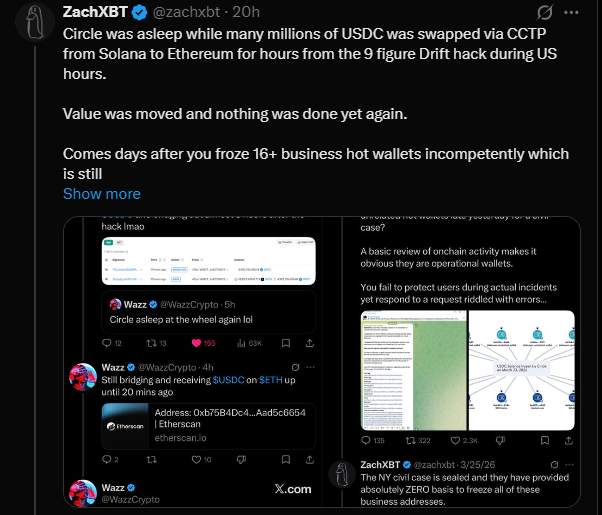
He added more context around this incident : " $230M+ USDC bridged via CCTP from Solana to Ethereum across 100+ txns. 6 hours is how long Circle had to freeze stolen funds from the $280M+ Drift hack." The criticism is direct to circle and the claim is that there was enough time to act, but no intervention came during that window. Especially when a centralized issuer like Circle has the ability to freeze assets. So far, Circle hasn't publicly responded to these claims.
READ MORE : MEV Bot Nets $9.9M After $50M AAVE Swap Goes Wrong, User Receives Only $36K
What This Means for Solana DeFi
Drift has been a key part of the Solana trading ecosystem, especially in perpetuals. With over $550 million in total value locked before the incident, according to DefiLlama. However, Multisig approvals are meant to add security. But if those approvals are collected under false assumptions, they can become the weak point. The use of delayed execution through durable nonces adds another layer. It shows the standard features can be used in ways that aren't immediately obvious. At the same time, the movement of funds across chains shows fast liquidity can shift once control is lost. Even a few hours can make a difference. Drift is still in the middle of its investigation, and more details will likely come out.
READ MORE: Bitrefill Hack Linked to Lazarus Group: 18,500 Records Exposed and Hot Wallets Drained