

Summary:
- COTI's Garbled Circuits (GC) privacy tech is now integrated into Bancor's Arb Fast Lane arbitrage system
- The system now encrypts the minimum acceptable outcome of arbitrage trades
- This prevents bots from copying or front-running profitable trades just by reading mempool data
- It proves COTI's privacy stack works in high-frequency, real economic environments
- Gas optimization work is underway to make protected execution cheaper and scalable
DeFi talks a lot about open systems. But arbitrage is one of those areas where full visibility can actually punish the people contributing the most effort. The moment a trade becomes readable, it can turn into a signal for someone else to extract value from it. Every serious arbitrage system invests heavily in research, infrastructure, monitoring tools, and routing logic. The moment a transaction is broadcast, though, much of that work becomes visible. On transparent blockchains, parts of a transaction can reveal how profitable a trade might be before it’s executed. So instead of competing on who discovered the opportunity, others can just watch pending transactions and react. They don’t need to understand the full strategy and they just need to see that it looks profitable. This is the core issue Bancor's Arb Fast Lane is addressing with COTI's Garbled Circuits integration.
Tiago, from Bancor's research team explained it clearly:
That quote sums up the imbalance perfectly. On transparent infrastructure, exposure becomes a liability. This is the uncomfortable part DeFi doesn’t talk about much. Transparency is great for verification. But in some cases, it also creates an easy way to extract value from other people’s research.
That’s exactly the gap COTI’s privacy model was built to solve by stopping sensitive execution details from being exposed at the worst possible moment.
What Actually Changed Technically And Why It's Important
This isn't about making arbitrage secret or something like that. COTI's Garbled Circuits allow selective encryption of transaction inputs. Instead of hiding everything, only sensitive values are protected. In this case, the Arb Fast Lane now encrypts the minimum acceptable outcome for an arbitrage route. It tells observers how profitable the trade is expected to be. It's effectively a signal for copy-trading bots. With GC integration:
- The value is encrypted before broadcast
- The smart contract expects the encrypted input
- Decryption happens only during execution
- The condition is still enforced
- The value is never visible in plaintext to the network
This is targeted privacy. Tiago described the environment like this:
Privacy isn't being used to hide outcomes or bypass transparency. It's being used to protect process integrity. Execution remains public and results remain verifiable. Only the exploitable signal is shielded. That's exactly how COTI positions programmable privacy - applied where transparency becomes a liability.
Why This Is a Big Moment for COTI and Bancor
This integration is a proof point COTI has been working toward for years: privacy as infrastructure. COTI didn't build Garbled Circuits to create hidden chains or black-box finance or something like that. The goal has always been selective confidentiality that keeps sensitive inputs private while preserving public verification.
Arbitrage is one of the hardest environments to test that in. Margins are thin and on the other hand competition is ruthless. Also Execution speed matters because if privacy tech slows things down too much or costs too much gas, it simply won't be used. But Bancor's Arb Fast Lane is live infrastructure. It monitors markets continuously and it executes real trades. Plus, It operates in adversarial conditions and now it's using COTI's GC layer in production.
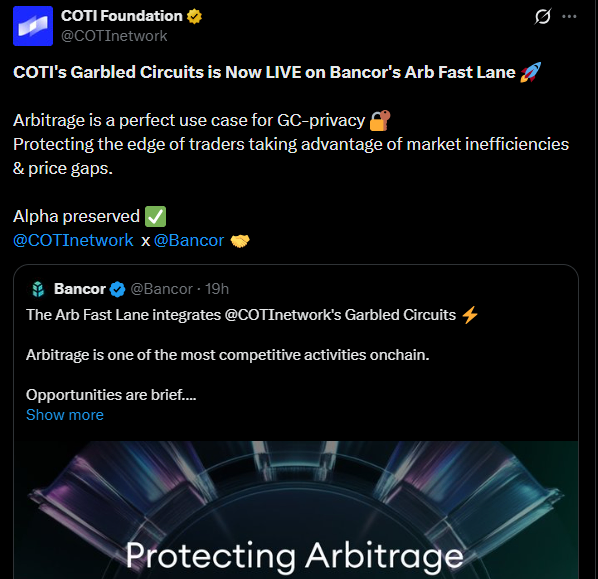
COTI commented on bancor’s X post and called it a "killer use case" and emphasizing that privacy-powered arbitrage trading is now live. In another post, the network noted that arbitrage is a perfect use case for GC privacy because it protects the trader's edge when exploiting market inefficiencies. COTInetwork said,
This is DeFi infrastructure choosing COTI privacy because the economic incentives make sense. That's kind of a big milestone.
What This Means for COTI Users and the Ecosystem
For regular users, Arbitrage keeps prices aligned across DEXs and better arbitrage efficiency means tighter spreads, less mispricing, and more consistent market conditions. When execution is protected and discovery is rewarded, arbitrage systems can operate more reliably instead of constantly being undermined by copy-trading.
There's another angle too. Gas cost and performance are now part of the roadmap. Bancor noted that encryption and decryption add overhead, and COTI is actively working on optimization including gas improvements and moving parts of the process into precompiles. Lower costs make existing trades cheaper and expand the range of viable trades, also market efficiency improves. That can be simply called liquidity quality.
For COTI, this positions its privacy layer as something that enhances core DeFi mechanics. It shows that GC privacy can live inside trading systems, routing engines, and execution infrastructure. That simply expands where COTI can be integrated next.
Privacy as Market Infrastructure
Privacy making DeFi more fairer and safe for everyone. Competition should be about who finds the opportunity, who builds better routing logic, who manages risk better. It shouldn't be about who can scrape the mempool fastest.
By encrypting just the critical signal, Bancor and COTI are shifting arbitrage back toward discovery and execution quality. Few things remain the same like transparency, auditability. But the easy extraction layer is removed. That model applies far beyond arbitrage. Any system where certain inputs reveal strategy, intent, or vulnerability can use selective encryption. This is exactly the type of real-world, adversarial environment where privacy tech either proves itself or fails. Here, it's proving itself.
And that's why this matters for COTI's privacy chain with potential use cases. It's becoming a provider of execution-layer privacy for live DeFi infrastructure.
Closing Thoughts
COTI quietly laying down infrastructure pieces that connect to each other over time. First it was confidential smart contract logic. Then privacy for RWAs, DeFi, wallets, and now even trading infrastructure like arbitrage systems. Each step covers a different part of how value actually moves onchain payments, trading, assets, governance, execution. That's kind of ecosystem layering.
COTI is positioning itself as the environment where privacy works in real financial activity. Builders can run logic privately, traders can protect execution and Institutions can process sensitive data without exposing it. Users don't have to choose between usability and confidentiality. That's a different direction from most privacy blockchain. COTI is embedding privacy into the core rails of how applications operate. Step by step, this is how an ecosystem forms and on the other hand foundation where privacy-native systems can actually function at scale.
READ MORE: The One Thing Ethereum Still Can't Do - That COTI Already Solved