

TL;DR
- Solana Mobile will airdrop nearly 2 billion SKR tokens to users and developers on January 21
- 1.8 billion SKR will go to more than 100,000 Solana Seeker users, with 141 million SKR allocated to developers
- The airdrop represents 20% of SKR's total supply
- SKR is designed to govern and shape Solana Mobile's growing onchain mobile ecosystem
- The Seeker phone has already processed 9 million transactions and $2.6 billion in volume
Solana Mobile is preparing one of the largest ecosystem-focused airdrops seen in the Solana world to date. Next week, more than 100,000 users and mobile app developers will receive allocations from the first Seeker (SKR) token airdrop, distributing close to 2 billion tokens directly to the community. The airdrop marks a major milestone for Solana Mobile's second-generation phone, the Solana Seeker, and signals a shift toward a more user- and developer-governed mobile platform built onchain.
In a post shared on X on Wednesday, Solana Mobile confirmed that its allocation tracker is now live and that eligible participants can check their "seed vault wallets" ahead of the January 21 distribution.
A community-first token launch
The SKR airdrop represents 20% of the token's total supply, making it clear that Solana Mobile is prioritizing users and builders from day one. Rather than reserving the bulk of tokens for insiders or future incentives, the company is anchoring SKR ownership in the people who actually used the platform.
The distribution is tied directly to participation in what Solana Mobile calls the first "Seeker Season," a period that measured real activity across apps, transactions, and onchain volume. Seeker officialy tweeted and shared the excitement,
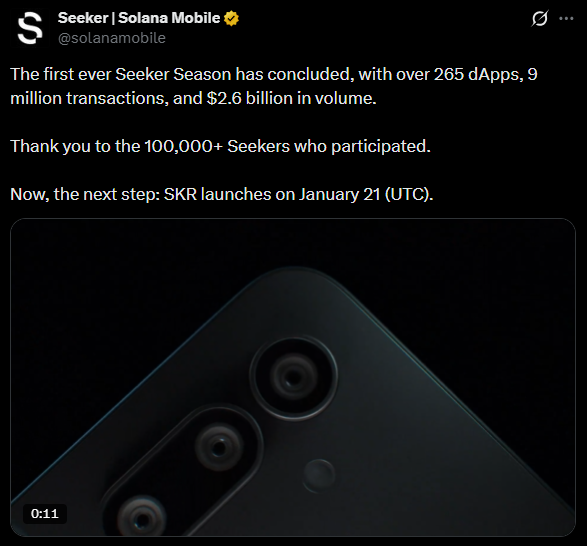
That usage data matters. It suggests the airdrop isn't just a marketing event, but a reward tied to measurable engagement. For Solana Mobile, it also serves as proof that a blockchain-native phone can support meaningful economic activity with experiments.
What SKR is meant to do
Unlike many tokens that launch with vague utility, SKR is positioned as a governance and coordination layer for Solana Mobile's platform. "SKR will give all of the people who have gotten us to this point the opportunity to influence the success of this platform: who can participate, what rules they follow, and what economic flows keep it going," said Solana Mobile general manager Emmett Hollyer. Also added
The language here is deliberate. SKR is framed less as a speculative asset and more as a way for users and developers to influence access, incentives, and platform rules. That reflects a broader shift in how consumer crypto products are being designed, especially those that sit at the intersection of hardware and software. The SKR airdrop is inseparable from the Solana Seeker itself. Launched in August 2025 at a price of around $500, the Seeker is Solana Mobile's second blockchain-powered phone, built to integrate decentralized apps, payments, and token ownership directly into the user experience.
It followed the original Solana Saga, which helped prove early demand but struggled with long-term traction. Solana Mobile officially ended software and security support for the Saga in October, focusing fully on the Seeker as its flagship device. So far, the Seeker appears to be gaining stronger adoption. More than 100,000 users have interacted with decentralized applications on the device, spanning 265 dApps and generating billions in volume. Those figures give Solana Mobile a real dataset to work from as it moves into its next phase.
Token supply and unlock structure
SKR has a total supply of 10 billion tokens. Of that, nearly 2 billion are being distributed in this first airdrop. According to Solana Mobile's website, 30% of airdropped tokens will be unlocked at launch, with two-thirds of that portion allocated to Seeker users and developers.
In addition, 2.7 billion SKR, or 27% of the total supply, will be unlocked during the token generation event. While large unlocks often raise concerns, Solana Mobile has emphasized transparency around its distribution schedule, giving participants a clear view of how supply will enter circulation. You can check the official website to see the full structure and tokenomics.
For users, the immediate unlock offers some flexibility, while the remaining vesting keeps incentives aligned over time.
Closing Thoughts
For years, blockchains focused on infrastructure while leaving distribution to traditional app stores and devices. The Seeker takes a different approach, embedding crypto-native features at the operating system level. The numbers from Seeker Season suggest that approach is resonating with a specific audience. Whether it can scale beyond early adopters remains an open question, but SKR gives Solana Mobile a tool to coordinate that growth more openly.
As Hollyer hinted, Solana Mobile is also exploring ways to make its software available beyond Seeker and Saga. If that happens, SKR could become the connective tissue across multiple devices and platforms. For now, the focus is on January 21. For more than 100,000 users and builders, it's the moment when participation turns into ownership - and when Solana Mobile's experiment in onchain mobile takes its next step.