

Summary:
- Visa and Stripe-owned Bridge are expanding stablecoin-linked Visa cards to 18 countries, with plans to reach over 100 by year-end.
- The rollout builds on the program's 2025 launch across Latin America.
- The companies are testing stablecoin settlement through Visa's pilot, with support from Lead Bank.
- Bridge has received conditional approval from the Office of the Comptroller of the Currency to form a federally chartered national trust bank.
Global payments giant Visa is deepening its partnership with Stripe-owned Bridge, expanding the rollout of stablecoin-linked Visa cards while moving closer to direct onchain settlement. According to a Tuesday announcement, the companies are expanding their joint card program to 18 countries. The plan is to reach more than 100 countries across Europe, Asia-Pacific, Africa and the Middle East by the end of the year. The expansion follows the program's initial launch in April 2025, when it first supported several Latin American markets, including Argentina, Colombia, Ecuador, Mexico, Peru and Chile. That early rollout allowed users to spend stablecoins through Visa cards while merchants continued receiving payments in their local currency.
Under the original structure, Bridge processed transactions by deducting funds from the customer's stablecoin balance and converting them into fiat currency before final settlement. From the merchant's perspective, the payment worked like any other card transaction. The new phase goes further. In addition to geographic expansion, Visa and Bridge are now testing stablecoin settlement through Visa's pilot program. This allows issuers and acquirers to settle transactions using stablecoins instead of traditional fiat rails.
The statement underscores a broader shift in the payments industry, where stablecoins are increasingly viewed as infrastructure rather than niche crypto tools.
Onchain Settlement and Lead Bank's Role
A key part of the latest development is the move toward direct stablecoin settlement, enabled through Bridge's partnership with Lead Bank. When the program launched in 2025, transactions involved stablecoin-to-fiat conversion before settlement. Under the new collaboration, settlement is set to occur directly in stablecoins, reducing reliance on traditional currency conversion at the backend. This move matters because settlement - the final transfer of funds between financial institutions - is where much of the friction in cross-border payments can occur. By allowing stablecoins to be used directly in this layer, Visa and Bridge are testing whether blockchain-based assets can streamline how value moves between issuers and acquirers.
Zach Abrams, CEO and cofounder of Bridge, said the partnership aims to give businesses more control over their financial infrastructure.
Bridge's model differs from traditional stablecoin issuers. Bridge enables businesses to create and manage their own stablecoins programmatically using its infrastructure. Visa is also evaluating potential support for Bridge-issued assets, which could allow companies to integrate proprietary stablecoins directly into card programs. If adopted at scale, this could give fintech firms, platforms and even large enterprises more flexibility in how they design payment ecosystems. Adding another layer to the expansion, Bridge recently shared on X that it has received conditional approval from the Office of the Comptroller of the Currency to organize a federally chartered national trust bank. In the post, Bridge stated:
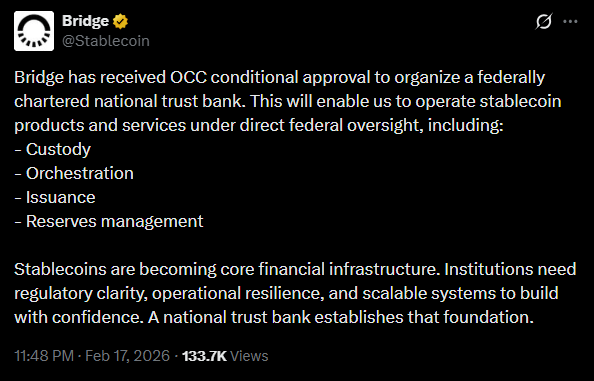
While the regulatory process is ongoing, the conditional approval signals a push toward deeper integration of stablecoins within federally supervised banking frameworks.
The Growing Stablecoin Race in Global Payments
Visa's expanded collaboration with Bridge comes as competition in the stablecoin payments space intensifies. Major card networks and fintech firms are racing to incorporate stablecoins into consumer and merchant payment flows. Mastercard recently enabled stablecoin card spending in the United States through the self-custodial crypto wallet MetaMask, reflecting a similar strategy of blending blockchain assets with existing card networks. The difference now is that the conversation is shifting from spending alone to settlement. While allowing consumers to pay with stablecoins is one milestone, enabling backend settlement directly in stablecoins represents a deeper structural change.
If Visa and Bridge successfully scale stablecoin settlement across more than 100 countries, it could mark a turning point in how digital assets integrate with traditional payments. Merchants would continue to receive funds in familiar ways, but institutions behind the scenes could move value using blockchain-based assets. At the same time, regulatory clarity will remain central. Bridge's conditional approval to form a federally chartered trust bank suggests that stablecoin infrastructure providers are seeking direct oversight.
Closing Thoughts
For Visa, the strategy reinforces its role as a neutral payments network adapting to new forms of money. For Stripe and Bridge, the expansion positions stablecoins as programmable building blocks within global commerce. As stablecoins increasingly bridge blockchain networks and traditional finance, the focus is moving from experimentation to implementation.
READ MORE : MetaMask and Mastercard Launch Self-Custodial US Crypto Card With Up to 3% Onchain Rewards