

Summary:
- A UK resident has accused his estranged wife of stealing 2,323 Bitcoin worth about $176 million from his hardware wallet.
- The husband alleges she used a security camera to capture his seed phrase and wallet access codes.
- The Bitcoin was reportedly transferred to 71 different addresses in December 2023.
- A High Court judge said the husband appears to have a strong chance of succeeding in the case based on available evidence.
- The court has recommended an early trial, citing both security concerns and the volatile price of Bitcoin.
A legal dispute in the United Kingdom has brought attention to one of the largest alleged personal crypto thefts ever presented in court. A UK resident has accused his estranged wife of secretly accessing his hardware wallet and transferring 2,323 Bitcoin, valued at roughly $176 million, without his permission. The case was detailed in a judgment issued by Justice Cotter in the High Court of Justice. According to the filing, the claimant, Ping Fai Yuen, alleges that his wife Fun Yung Li and her sister secretly recorded him using a security camera to capture the sensitive recovery phrase that controls access to his digital assets. The recovery phrase, often referred to as a seed phrase, is the master key used to restore a crypto wallet. Anyone with access to it can take control of the funds stored inside the wallet.
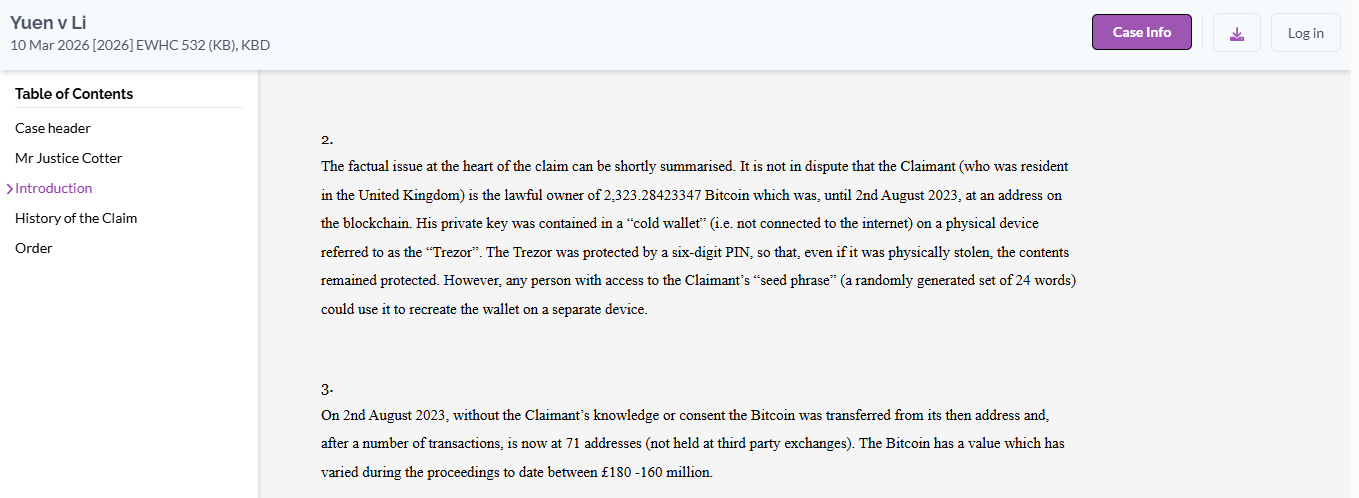
Lawyers representing Ping told the court that the two women allegedly recorded him while he was handling his Trezor hardware wallet, allowing them to obtain the seed phrase and wallet access codes. The claim states that the funds were later transferred to 71 separate Bitcoin addresses, making the movement of the assets harder to track.Ping reportedly became aware of the alleged plot after being tipped off by his daughter. Following the warning, he installed audio recording equipment in his home. According to the court documents, he claims those recordings captured his wife discussing the alleged theft and ways to move large amounts of money without attracting attention from banks or law enforcement agencies. The case also notes that no transactions have occurred from any of the destination wallet addresses since Dec. 21, 2023, suggesting the funds have remained untouched since the alleged transfers took place. Ping reported the incident to authorities shortly after the final transaction in December 2023. Police later arrested his wife and confiscated several items during the investigation, including cold wallets and watches. However, after reviewing the available information, authorities eventually stated that there would be no "further action pending new evidence." His wife was released on bail while the investigation remained open.
Court Battle and Bitcoin Asset Freeze Request
Nearly two years after the alleged theft, the dispute has moved deeper into the legal system. In November of last year, Ping applied to the court for an asset preservation injunction, asking the judge to freeze all cryptocurrency believed to be connected to his wife. Through the request, he also asked the court to formally recognize him as the rightful owner of the Bitcoin and either order its return or grant him the equivalent value in traditional currency. The request reflects a growing challenge within the legal system as courts around the world attempt to deal with digital assets that can move across borders instantly and sometimes anonymously. Ping told the court that he has been actively monitoring the addresses that received the Bitcoin since the alleged transfers occurred. During that time, he said he became concerned after noticing signs that the wallets may have been targeted in a crypto dusting attack.
Dusting attacks involve sending tiny amounts of cryptocurrency to wallets in order to track their activity. The goal is often to analyze transaction patterns and potentially identify the individuals behind large holdings. If successful, attackers may later attempt phishing attacks or other scams aimed at gaining access to those funds. The case also revealed that the relationship between Ping and his estranged wife had deteriorated significantly after the alleged incident. Court documents referenced a separate confrontation in September 2024, which reportedly turned violent. The altercation resulted in criminal charges against Ping, including assault occasioning actual bodily harm and two counts of common assault. Ping later pleaded guilty to those charges. While that incident is separate from the cryptocurrency dispute, it adds another layer of complexity to an already intense legal battle involving both personal and financial conflicts.
READ MORE: Trump Cyber Strategy Puts Crypto and Blockchain Security at Center of U.S. Tech Leadership
Judge Says Evidence Suggests Husband May Win Case
Despite the complicated background of the case, Justice Cotter indicated in his written judgment that the claimant's arguments appear strong based on the evidence presented so far. In his decision, the judge wrote that Ping appears to have a significant chance of succeeding in court, particularly given the lack of explanation regarding how the Bitcoin moved out of the wallet. Justice Cotter stated that Fun had not offered "any alternative (or any) explanation for the movement of the Bitcoin." The judge also emphasized that time could play an important role in the case. Because cryptocurrency prices can change rapidly and digital assets may be vulnerable to security risks, he suggested the matter should be resolved quickly.
Cotter recommended that the case proceed to trial sooner rather than later, describing such a move as "necessary given the security threats to, and volatility of value of, the Bitcoin." The court also noted that if the two parties cannot reach an agreement about the next steps in the legal process, a case management hearing will be scheduled to determine how the dispute should move forward. The outcome of the case could become an important reference point for future crypto-related legal battles. As digital assets become more common in personal finances, courts are increasingly being asked to settle disputes involving wallets, private keys, and blockchain transactions. Unlike traditional bank accounts, cryptocurrency ownership is controlled entirely by cryptographic keys. If those keys are obtained by another person, transferring funds can be done instantly without approval from any central authority.
That reality makes cases like this particularly difficult to resolve, especially when assets have already been moved through multiple wallet addresses. For now, the Bitcoin at the center of the dispute appears to remain untouched. But with the court now signaling that the case may move quickly toward trial, the coming months could determine whether one of the largest alleged personal crypto theft cases in the UK results in the recovery of millions of dollars worth of digital assets.
READ MORE : MEV Bot Nets $9.9M After $50M AAVE Swap Goes Wrong, User Receives Only $36K