

Summary:
- Senator Elizabeth Warren has formally asked Mark Zuckerberg to explain Meta's stablecoin integration plans.
- The request follows Meta's limited USDC payout rollout to creators in Colombia and the Philippines.
- Warren raised concerns about transparency, privacy protections, competition risks, and financial stability.
- The senator asked Meta to provide details by May 20, including launch timelines and third-party stablecoin partnerships.
- The scrutiny comes as US lawmakers continue debating broader crypto legislation through the CLARITY Act.
Massachusetts Senator Elizabeth Warren has formally asked Meta CEO Mark Zuckerberg to provide details about the company's latest stablecoin-related activity, reviving concerns that have followed the social media giant ever since its failed Libra project six years ago. In a letter sent Wednesday, Warren said Meta's lack of public clarity around its stablecoin plans is "deeply troubling," especially given the company's history of attempting to launch its own private digital currency. The request follows reports that Meta has quietly begun a small pilot program allowing select creators in Colombia and the Philippines to receive payouts in USDC, one of the largest US dollar-backed stablecoins in crypto. While Meta previously denied having plans to issue its own stablecoin, Warren said the company had never fully explained what its relationship with outside stablecoin providers might look like, how much influence it could exercise over payment rails running across its platforms, or what protections would exist for users if such integrations expand globally.
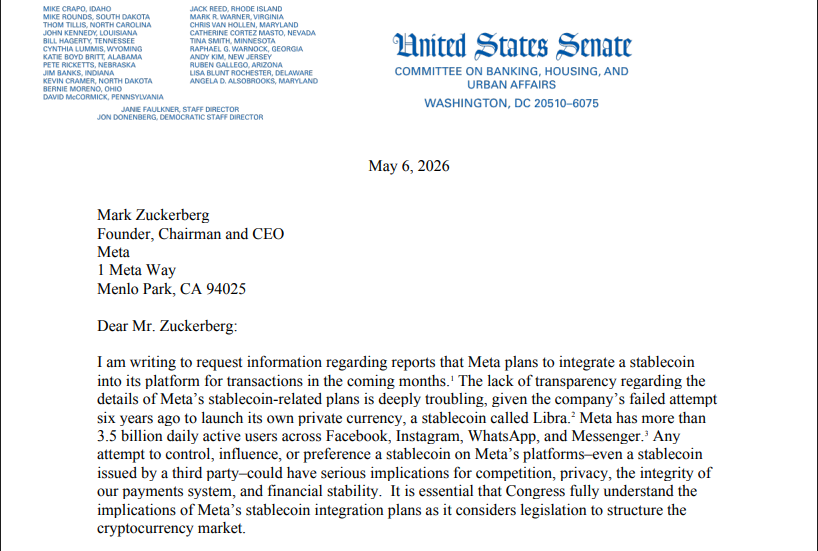
Source: Senator Warren Letter to Meta
Back in 2019, the company then known as Facebook introduced Libra, an ambitious stablecoin project designed to function as a global private payment system. The proposal triggered bipartisan criticism across Washington and alarmed regulators worldwide. Lawmakers feared Meta could gain outsized control over digital payments while collecting financial data from billions o+
f users. Privacy concerns, antitrust fears, and questions about monetary influence eventually forced the company to rebrand Libra as Diem before abandoning the project entirely. Now, Warren says Meta appears to be moving back into similar territory, only this time through third-party stablecoins rather than a Meta-issued token. That distinction may matter technically, but Warren argues the practical concerns remain. With more than 3.5 billion daily active users across Facebook, Instagram, Messenger, and WhatsApp, even limited stablecoin integrations could have enormous consequences if expanded. According to Warren's letter, if Meta gains direct or indirect influence over stablecoin transactions across its ecosystem, it could affect market competition, increase surveillance risks, and create broader concerns around financial stability.
The senator also warned that allowing a private platform of Meta's scale to shape digital payment behavior could raise difficult questions for regulators still working to define how crypto markets should operate in the United States.
READ MORE: SEC Delays Prediction Market ETFs Over Risk and Structure Concerns
Meta's Small Stablecoin Trial
The company has reportedly enabled USDC payouts for select creators in Colombia and the Philippines as part of what it describes as a "small and focused trial." The pilot allows content creators to receive platform-related payments using stablecoins. On the surface, that might seem like a simple payment efficiency test. Stablecoins often settle faster than traditional international bank transfers and can reduce cross-border transaction costs, making them attractive for digital platforms handling creator payouts across multiple countries. But Warren wants far more detail. Her letter asks Zuckerberg to explain exactly when the pilot began, whether Meta plans to expand it, which stablecoin issuers are involved, what contractual relationships exist between Meta and those issuers, and what privacy safeguards have been established.
She also requested information about how Meta plans to prevent transaction data from being leveraged for advertising or broader platform monetization. Those concerns reflect lessons learned from Libra's collapse. Critics of the original Libra proposal argued Meta's business model, built heavily around targeted advertising and user data collection, made it difficult to trust the company with financial infrastructure at global scale. Although Meta has repeatedly said it is no longer pursuing a proprietary stablecoin, lawmakers remain cautious about any crypto-related financial layer tied to its platforms. That caution appears especially strong now because Congress is actively shaping digital asset regulation.
Why This Matters for the CLARITY Act and US Crypto Rules
The timing of Warren's letter arrives when lawmakers continue debating the CLARITY Act, a broader digital asset market structure bill designed to establish clearer rules for cryptocurrencies and stablecoins in the United States. The legislation has faced delays inside the Senate Banking Committee, but momentum returned last week after lawmakers announced a tentative compromise involving stablecoin yield provisions.
That agreement could move the bill closer to committee markup and potentially to a broader Senate vote. Still, several major issues remain unresolved, including ethics safeguards, issuer oversight, and conflicts of interest involving large technology firms entering digital finance. Warren, as ranking member of the Senate Banking Committee, has consistently pushed for tighter guardrails around stablecoins and broader crypto activity. Her letter to Zuckerberg appears designed to force clearer answers before Congress finalizes any framework that could govern platforms like Meta. The bigger question is whether Meta's latest stablecoin experiment signals a genuine return to crypto payments or simply another cautious test of digital settlement infrastructure. Either way, Washington is paying close attention. For now, Zuckerberg has until May 20 to respond.
READ MORE: Colombia President Pushes Bitcoin Mining Plan for Caribbean Coast