

Summary:
- Privacy demand across crypto and institutions is growing fast.
- COTI already operates one of the fastest privacy infrastructures through Garbled Circuits.
- On March 26, 2026, COTI introduced Nightfall, an enterprise-focused Ethereum ZK Rollup.
- Nightfall combines confidential transactions with KYC, auditability, and selective disclosure.
- Built originally by EY, Nightfall is designed for institutions moving real assets on-chain.
- Both COTI GC and Nightfall operate under one ecosystem powered by the same $COTI token.
Over the last few years, the conversation around blockchain privacy has changed completely. At first, transparency was treated as crypto's biggest advantage. Public wallets, open ledgers, visible transfers - everything could be verified by anyone. That model worked well for experimentation and open financial systems. But as larger institutions started exploring blockchain infrastructure, the limitations became impossible to ignore. Like a bank cannot expose transaction details publicly, an asset manager cannot reveal client positions on-chain in real time, a supply chain company cannot allow competitors to monitor pricing data or vendor relationships through a public ledger. This is where the industry started facing a difficult reality. Public blockchains offer security and transparency, but institutions also require confidentiality, compliance, and controlled disclosure.
COTI has spent the last few years building around that exact problem. Its Garbled Circuits Mainnet already operates as one of the fastest and most lightweight privacy infrastructures in Web3. The network delivers encrypted computation with performance levels up to 3,000 times faster and 250 times lighter than many existing alternatives. That infrastructure was designed for builders, applications, DeFi systems, payments, and scalable private computation. But enterprise environments come with different requirements.
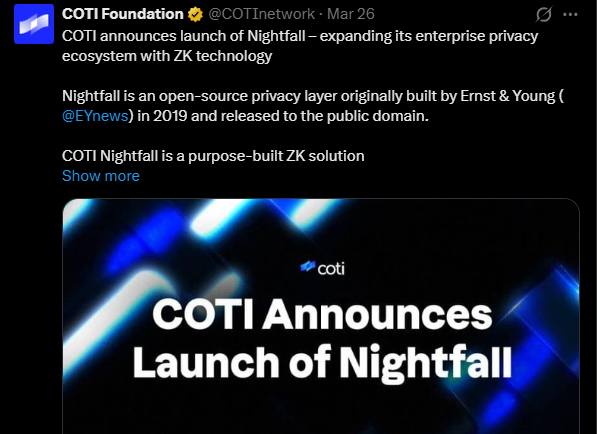
On March 26, 2026, COTI officially expanded its privacy ecosystem with the launch of Nightfall - a Zero-Knowledge Rollup designed specifically for institutions operating on Ethereum-compatible networks. Instead of replacing Garbled Circuits, Nightfall adds another layer to the ecosystem. One optimized for compliance-ready privacy.
What Exactly Is COTI Nightfall
At its core, COTI Nightfall is an Ethereum-focused Zero-Knowledge Rollup built for private and compliant transactions. The technology itself was originally developed by Ernst & Young in 2019 and later released publicly. Over the years, the infrastructure evolved into a more advanced ZK-based system capable of handling confidential transactions while maintaining the security guarantees of Ethereum. COTI is now deploying that technology as its own enterprise-grade privacy layer. The network supports private transfers across multiple token standards, including ERC-20, ERC-721, ERC-1155, and ERC-3525 assets. But Nightfall goes beyond simple token transfers. It also enables confidential smart contracts, encrypted transaction flows, and selective disclosure systems that institutions can use when regulatory reporting becomes necessary.
Many privacy-focused systems force institutions to choose between confidentiality and compliance. Nightfall is structured differently. Transaction data remains private by default, but institutions can selectively reveal information when regulators or auditors require visibility. This creates a middle ground the industry has struggled to achieve for years. The timing also aligns with broader institutional interest in blockchain infrastructure. Tokenized assets, stablecoin settlements, private payments, and on-chain financial operations are all growing rapidly. But most institutions still hesitate because existing public infrastructure exposes too much information. Nightfall attempts to solve that without sacrificing Ethereum compatibility
READ MORE: COTI Expands to Dual-Mainnet with Nightfall ZK Rollup for Institutions
Why COTI Is Running Two Privacy Networks
One of the more interesting parts of COTI's approach is that it is not forcing every use case into a single system. The company already operates its Garbled Circuits-powered Layer 2 network, focused heavily on speed, scalability, and cost efficiency. That environment works especially well for developers building consumer applications, DeFi products, AI systems, payments, and high-volume encrypted computation. Nightfall serves a different role. According to COTI's own explanation, Nightfall acts as the enterprise and compliance layer of the ecosystem. That separation allows each network to specialize. For example, supply chain systems often require sensitive operational data to remain hidden. Vendor pricing, shipment details, supplier relationships, and logistics information cannot be exposed publicly.
Nightfall allows companies to track and verify supply chain activity while keeping confidential business information protected. The same applies to tokenized assets. Institutions moving regulated assets on-chain need private settlement infrastructure. Publicly exposing ownership structures or transaction values creates compliance and competitive risks. Nightfall enables these assets to move securely while still maintaining blockchain verification and auditability. Both Garbled Circuits Mainnet and Nightfall operate using the same $COTI token. No separate token or no additional supply and that creates a unified ecosystem where utility expands across multiple infrastructures instead of fragmenting into isolated networks.
How Nightfall Supports Institutions on Ethereum
The institutional side of Nightfall becomes clearer when looking at its compliance structure. One major feature is KYC-aligned payments. Institutions using the network can execute compliant transactions where participants are verified, while still keeping transaction details hidden from the public. This addresses one of the biggest concerns regulators and enterprises have around privacy systems - anonymous financial activity. Nightfall also introduces enterprise-grade identification requirements through X.509 certificates. These certificates are commonly used in traditional enterprise security systems and digital authentication frameworks.
In practical terms, users interacting with Nightfall for deposits or withdrawals must hold verified identification credentials. That ensures the network operates within controlled institutional environments instead of functioning as an anonymous privacy layer. Then comes selective disclosure. This is arguably one of Nightfall's most important features. Institutions often need privacy during normal operations but must still provide information during audits, compliance reviews, or regulatory investigations. Nightfall allows specific information to be disclosed when required, while keeping broader transactional activity confidential by default. This approach creates something the blockchain industry has struggled to balance for years - privacy without removing accountability and because Nightfall operates on Ethereum infrastructure, institutions still benefit from Ethereum's liquidity, ecosystem depth, and security guarantees.
READ MORE: COTI Partners With Sayfer to Strengthen Web3 Privacy Security
Why EY's Involvement Changes the Conversation
Enterprise adoption often depends on credibility and that is where EY's involvement becomes significant. Nightfall was originally built by one of the world's largest professional services firms. For institutions already familiar with EY's global presence, that background changes how the technology is perceived. COTI's BD Brad, highlighted this directly in its thread:

That credibility matters because institutional blockchain adoption still faces trust barriers. Clare Adelgren, EY Global Interim Blockchain Leader, also emphasized the importance of bringing Nightfall into Ethereum infrastructure:
That statement reflects something larger happening across the industry. Institutions want privacy systems that integrate directly with public blockchain infrastructure while still respecting enterprise requirements. Nightfall is designed around that exact direction.
Final Thoughts
For years, institutions faced the same difficult choice when exploring blockchain infrastructure. Either use public systems and sacrifice confidentiality, or use private systems and lose access to public blockchain liquidity and security. Nightfall attempts to remove that by combining Zero-Knowledge privacy, compliance controls, selective disclosure, and Ethereum compatibility, COTI is building infrastructure designed specifically for how institutions actually operate and importantly, it does this without abandoning the broader Web3 ecosystem.
READ MORE: CZ Says Crypto Is "Too Transparent" - COTI’s Privacy Tech Could Change That