

TL;DR
- COTI has partnered with Zoniqx to advance institutional-grade real-world asset (RWA) tokenization
- The collaboration integrates COTI's programmable privacy into Zoniqx's compliance-native infrastructure
- The goal is to launch the world's first privacy-enabled RWAs on-chain
- The partnership targets regulated assets like equity, debt, real estate, and energy
- Community response shows growing confidence in COTI's institutional direction
Real-world asset tokenization has long been described as one of the most important bridges between traditional finance and Web3. In theory, putting bonds, real estate, funds, or private credit on-chain should make markets more efficient, reduce settlement friction, and expand global access.In practice, progress has been slow. The issue isn't a lack of interest or something. It's structural.
Institutions operate under strict regulatory frameworks and manage highly sensitive financial data. Public blockchains, by default, expose transaction details, balances, and counterparties. That level of transparency works for open systems, but it clashes with how regulated finance actually functions.
Until confidentiality, compliance, and scalability can coexist on-chain, large institutions will remain cautious. This is the problem COTI and Zoniqx are now addressing together.
A Partnership Focused on Infrastructure
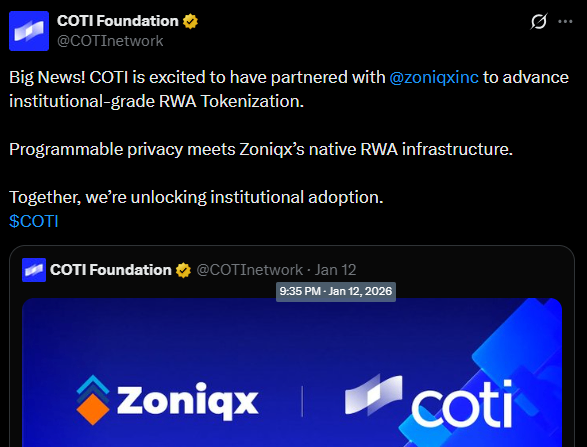
COTI has announced a new partnership with Zoniqx, a Silicon Valley fintech focused on institutional-grade RWA tokenization. The collaboration aims to combine two complementary strengths: Zoniqx's compliance-native tokenization infrastructure and COTI's programmable privacy technology.
The objective is clear. Enable fully compliant, end-to-end, privacy-preserving asset workflows on-chain, without forcing institutions to compromise on regulatory or confidentiality requirements.
COTI confirmed the partnership publicly, stating:
 Source
Zoniqx reinforced the same message from the institutional perspective:
The emphasis from both sides is consistent and It's about building production-ready systems.
What Zoniqx Brings: Compliance at the Token Level
Zoniqx operates as a compliance-native tokenization platform designed for regulated assets across multiple jurisdictions and blockchains.
Instead of treating compliance as an external process, Zoniqx embeds regulatory logic directly into tokens themselves. This includes KYC and KYB requirements, accreditation checks, and jurisdiction-specific rules enforced through smart contracts. The platform supports a wide range of assets, including equity, debt, funds, real estate, and energy. Beyond issuance, Zoniqx also enables distribution, liquidity, and secondary market access through institutional rails such as broker-dealers, exchanges, DeFi integrations, and fiat-to-crypto settlement.
By handling the full lifecycle of tokenized assets within a single infrastructure layer, Zoniqx reduces fragmentation and simplifies cross-border compliance. For institutions, this kind of consolidation is often a prerequisite before committing real capital on-chain.
Why Privacy Is the Missing Piece for Regulated RWAs
While compliance frameworks define who can access assets, privacy determines what information is exposed during transactions. This is where many RWA initiatives struggle. Even if regulatory checks are enforced, sensitive financial data often remains visible on public blockchains. For institutions managing large portfolios, that exposure creates unacceptable risk.
COTI's role in this partnership is to solve that problem directly. COTI is embedding its privacy layer, powered by Garbled Circuits, into Zoniqx's Tokenization Platform as a Service. In simple terms, this allows smart contracts to compute on encrypted data. Transactions can be validated and settled without revealing underlying values, strategies, or counterparties to the public chain.
COTI CEO Shahaf Bar-Geffen explained the focus clearly:
This approach enables confidential issuance, private transfers, and encrypted settlement flows, while still allowing selective disclosure where regulations require it.
From Pilot to Institutional Deployment
The partnership will begin with a pilot program aimed at launching the first privacy-enabled RWAs on-chain.
This initial phase allows both teams to validate workflows, test compliance scenarios, and refine operational processes before broader institutional onboarding. Once complete, the shared infrastructure will be opened to enterprises and institutions looking to tokenize regulated assets with privacy guarantees in place.
Zoniqx Founder and CEO Prasanth Kalangi emphasized why this foundation matters:
The framing here is important. Scaling RWAs isn't just about throughput or fees. It's about trust in the underlying system.
Why This Matters for the RWA Market
Estimates often place the total addressable RWA market in the tens of trillions of dollars. Yet only a small portion has been tokenized so far. The limiting factor isn't demand. It's suitability.
Institutions will not move large volumes of bonds, real estate, private credit, or repos on-chain unless confidentiality and regulatory alignment are guaranteed. Exposing transaction terms, balances, or ownership structures publicly is not compatible with how traditional finance operates. By combining compliance-native tokenization with programmable privacy, COTI and Zoniqx are addressing the final barriers that keep regulated capital off-chain. The goal is not secrecy, but controlled transparency that matches institutional requirements.
Community Sentiment and Excitement
Community reaction to the COTI-Zoniqx partnership has been largely focused on what this signals for the next phase of Web3 - especially where privacy, infrastructure, and real-world use cases intersect. Rather than treating it as just another partnership announcement, many users framed it as a necessary step toward making blockchain systems viable at a global scale.
Several community members highlighted that this isn't about overlap, but alignment. As one commented , "Great to see you guys combining strengths with this partnership, to build the privacy and infrastructure needed for global adoption." That sentiment reflects a broader understanding that privacy and compliance can't be bolted on later - they need to be built into the foundation.
Another community member summed it up by saying, "COTI and Zoniqx are setting new standards for institutional DeFi adoption." The emphasis here isn't hype, but readiness - systems designed to meet the operational and regulatory realities institutions care about. There was also a noticeable sense that this partnership marks a shift in how real-world assets are being approached on-chain. Instead of isolated pilots or proof-of-concept experiments, users see a transition toward production-grade infrastructure. As another comment pointed out, "Partnerships like this show how real-world assets are evolving from experimental pilots to enterprise-ready solutions." That framing matters, especially in a market increasingly focused on durability over short-term narratives.
Taken together, the community response suggests growing confidence - not just in the partnership itself, but in the direction it represents. Privacy, compliance, and real-world integration are no longer treated as optional upgrades. They're becoming baseline requirements. And for many observers, this collaboration feels like a clear acknowledgment of that reality.
Closing Thoughts
This partnership doesn't claim to solve everything overnight. What it offers instead is something more durable: an architecture where privacy, compliance, and scalability are designed together from the start.
For institutions watching from the sidelines, that balance is often the deciding factor. With Zoniqx managing compliance and asset lifecycle complexity, and COTI enabling programmable privacy at the execution layer, the collaboration moves closer to making large-scale RWA tokenization viable.
If real-world assets are going to scale on-chain, this is the direction they'll need to take.