

TL;DR
- Vanguard will now allow ETFs and mutual funds that primarily hold cryptocurrencies to trade on its platform.
- The shift comes after strong demand from both retail and institutional clients, per Bloomberg.
- This contradicts Vanguard's earlier stance - as recently as August 2024, the firm said it had no plans for crypto ETF offerings.
- The decision opens crypto markets to more than 50 million brokerage customers managing over $11 trillion.
- Analysts expect a huge wave of new crypto ETFs in the next six months.
Every so often, traditional finance sends a signal loud enough to shake the ground under crypto. Vanguard - a firm practically synonymous with conservative investing - just sent one of those signals. Bloomberg reported that starting this week, Vanguard clients can trade ETFs and mutual funds that primarily hold cryptocurrencies such as bitcoin, solana, XRP, and ether. For a firm that has spent years resisting any association with crypto assets, this is a clear break from its earlier position. And it's not happening quietly - it's happening under pressure from both retail and institutional clients who want access to digital assets.
The move reflects something simple: demand is no longer ignorable, even for the industry's most cautious giants.
A Reversal Years in the Making
Vanguard has always been one of the most reluctant players when it comes to crypto exposure. Earlier this year, the company publicly avoided participating in the wave of spot bitcoin ETFs, a move that made it stand apart from BlackRock, Fidelity, and other Wall Street firms leaning into digital assets.
As recently as August 2024, CEO Salim Ramji said the firm had no plans to launch crypto ETFs. Fast forward to today - not only is the door open, it's wide enough for both ETFs and mutual funds holding crypto. Bloomberg's coverage explains the shift clearly: client demand pushed the company to revisit its policy, and the internal conversation has been going on since at least September.
Vanguard is now acknowledging that crypto-related funds have reached a level of maturity they can no longer dismiss. Andrew Kadjeski, head of brokerage and investments at Vanguard, put it plainly:
This isn't cautious language - it's acknowledgment. Crypto products have survived stress tests, and investors want them.
Traditional Finance's Slow Merge With Digital Assets
You can look at this moment as another piece of a broader pattern. Over the last two years, the divide between traditional finance and crypto has thinned to the point where both sides depend on each other.
BlackRock and Fidelity opened the door with their bitcoin ETF launches in early 2024. Ether ETFs followed. From there, the wave grew: XRP, Solana, Dogecoin, and Litecoin ETFs entered the market. These aren't fringe assets anymore - they're packaged in products that retirement accounts and mega-funds can hold.
Vanguard was one of the last holdouts. Its decision removes another psychological barrier for many investors who once saw crypto as "too risky" or too unregulated to sit in a brokerage account. Now, 50 million brokerage customers who oversee over $11 trillion in assets can interact with crypto funds directly through the Vanguard platform - a shift with long-term implications.
What This Means for U.S. Crypto ETF Markets
Crypto ETFs in the U.S. didn't explode overnight. They arrived step by step:
- Spot bitcoin ETFs approved in January 2024
- Spot ether ETFs approved six months later
- A slow but steady rollout of additional crypto-tracking funds
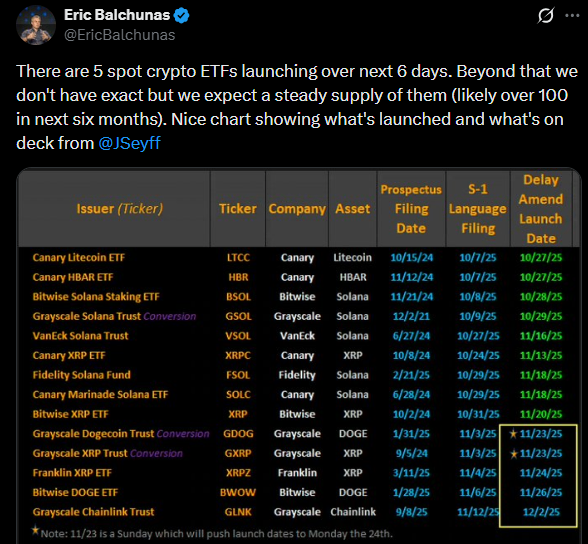
But something changed this year. Instead of a trickle, there's now a pipeline. Bloomberg Senior ETF Analyst Eric Balchunas shared the outlook last week:
 - Source
A hundred new crypto ETFs in six months is more than growth - it's acceleration. Vanguard's policy shift might feel like a simple operational update, but it's happening at a moment when the ETF pipeline is overflowing. More funds, more demand, more liquidity, and now, more access.
Why Vanguard Changed Course
Vanguard's pivot didn't happen overnight. For years, the firm took a conservative stance toward digital assets, even distancing itself from the wave of spot bitcoin ETFs approved in early 2024. But pressure has been building from both sides of the investor base - retail customers who increasingly view crypto as a long-term allocation, and institutional clients who want exposure through regulated, familiar structures. Bloomberg reports that this steady demand ultimately pushed Vanguard to reassess its position and acknowledge that crypto funds have matured in ways that weren't true even a year ago.
Andrew Kadjeski, who heads brokerage and investments at the firm, summed up the shift by pointing out that "Cryptocurrency ETFs and mutual funds have been tested through periods of market volatility, performing as designed while maintaining liquidity." That line reflects the real catalyst: the infrastructure around crypto ETFs finally looks stable enough for a firm of Vanguard's size to feel comfortable servicing them. Internal processes have also evolved - everything from custody to settlement - removing the operational friction that once made digital-asset products feel too experimental for a platform serving more than 50 million customers.
Vanguard's move signals something bigger. It's not just responding to demand; it's acknowledging that digital assets have crossed into the financial mainstream. Even if the firm still has no desire to create its own crypto products, allowing clients to trade third-party ETFs marks a quiet admission that ignoring the asset class is no longer practical. In other words, the shift wasn't ideological - it was inevitable.
What This Means for the Broader Crypto Market
This move doesn't push crypto to new highs by itself, but it does something more important: it normalizes it.
Some implications worth watching:
- More Capital
Even a small percentage of Vanguard's $11 trillion base entering crypto funds creates meaningful inflows. - More Legitimacy
Whether or not people like Vanguard's cautious style, it has influence. Its approval will likely encourage other conservative institutions to soften their stance. - More ETF Diversity
Balchunas' projection of 100+ new ETFs in the next six months becomes even more realistic now that Vanguard is open to listing them. - Stronger Regulatory Comfort
If a firm like Vanguard is comfortable supporting crypto ETFs, regulators will see increased signals of maturity in the asset class.
Final Thought
Vanguard didn't embrace crypto because it suddenly fell in love with blockchain. It embraced crypto because its customers demanded access, the products matured, and the industry shifted around it. Sometimes the clearest sign of change isn't the first domino - it's the last big one. And this feels like one of those moments.
READ MORE: Top Mid Cap 7 Coins to Invest In For 2025