

Summary:
- The miden-para SDK is now live, combining Miden's ZK-first architecture with Para's embedded wallet system.
- Developers can onboard users without complex wallet setup, using familiar React tools and fast scaffolding.
- Both public and private Miden accounts are supported from day one.
- This lowers the barrier for fintech-style apps like private payroll, confidential finance, and compliant onchain services.
- It signals a future where custom blockchain architectures and user-friendly access go hand in hand.
Miden just crossed an important line that the miden-para SDK is now live, and it quietly removes one of the biggest frictions in crypto apps: wallet onboarding. In a recent post, Miden added that "The miden-para SDK is now live, which means your Miden application can onboard users just like any everyday Web2 app” Until now, building on advanced zero-knowledge infrastructure often meant asking users to deal with seed phrases, browser extensions, and flows that feel foreign to anyone outside crypto. This integration changes that dynamic by connecting Miden's privacy-focused system with Para's embedded wallet stack.
According to the post on X, SDK provides:
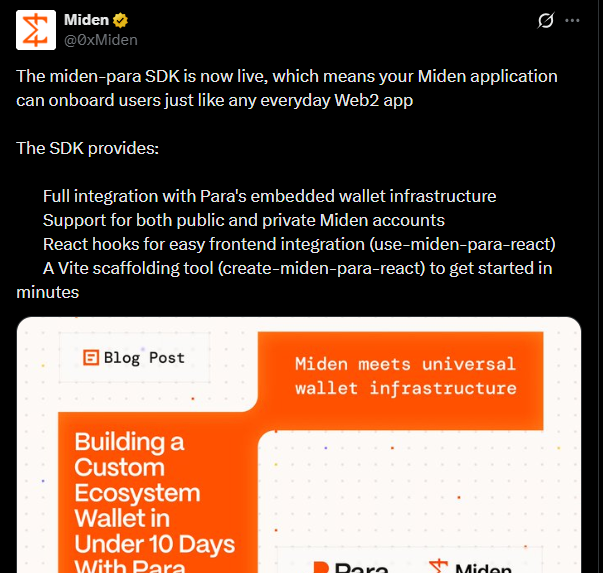
Behind those lines is a practical outcome. Developers can now ship Miden apps where users sign up and interact in a way that feels closer to a typical web app than a traditional crypto dApp.
Why This Changes the Builder Experience
Miden represents a different branch of blockchain design. Instead of shaping itself around EVM compatibility, it is built around zero-knowledge from the ground up. Privacy is a core part of how the system works. That foundation matters for fintech-style use cases. Things like compliant private transactions, confidential payroll, or shielded treasury flows are not side features. They sit at the core of why Miden exists.
The integration with Para brings this architecture closer to real-world product design. Para's wallet infrastructure already supports millions of wallets across many apps. Now that system connects directly with Miden through the SDK. For developers, this means they are not starting from scratch on authentication, key handling, or transaction signing. The heavy lifting around user access is handled by infrastructure that has already been tested at scale. The result is a smoother bridge between advanced cryptography and everyday product UX. A builder can focus on the logic of their application, like private payroll or internal business payments, instead of spending months designing wallet flows.
One example mentioned alongside the integration is Qash Finance, described as a neobank built around private payroll for businesses operating onchain. That kind of app only works if privacy, compliance, and usability sit together. The SDK helps close that triangle.
What's Happening behind the scene
The technical differences between Miden and most chains run deep, but the outcome is very simple. Miden runs on its own STARK-based virtual machine. Instead of asking the network to execute every step of a transaction, users run the logic on their own device and generate a proof that the computation was done correctly. That proof is then verified by the network. This approach is often called client-side proving. In plain terms, the user does the work, and the chain checks the result. That reduces the burden on the network and helps keep sensitive data off the public ledger.
It also enables strong parallelism. Many users can execute their own logic and generate proofs at the same time without competing for the same onchain execution slots. This model fits well with applications that involve heavy logic or large private states. The miden-para SDK does not change these fundamentals. What it changes is how people get into the system. By pairing the Miden SDK with Para's web SDK, developers get both sides, Miden's privacy-preserving ZK architecture and Para's authentication and wallet management layer.
The teams behind the integration shared a few lessons from building it quickly. One theme was abstraction. Para's design separates authentication, key management, and signing in a way that made it easier to adapt to Miden's different execution model. Another theme was partnership. Strong documentation and clear SDK design on the Miden side helped the integration come together fast. Also, not every future chain will look like today's EVM networks. More fintechs and enterprises are expected to build purpose-focused infrastructure tuned for specific needs around privacy, regulation, or performance. Infrastructure that can plug into these varied designs will matter more over time.
What This Means for the Miden Ecosystem
For the Miden ecosystem, it shows that an advanced ZK-first network can plug into familiar frontend stacks and deliver onboarding that does not scare off mainstream users. Builders now have React hooks ready to go and they have a Vite scaffolding tool to spin up projects quickly. They can support both public and private Miden accounts without building separate systems from scratch. That shortens the path from idea to product.
For users, the impact shows up as fewer hurdles. They may not need to understand the underlying VM or how proofs are generated. They just see an app that works, while the system underneath keeps their financial data more contained than typical transparent chains.
Closing Thoughts
Miden's architecture is often described as a ground-up rethink of blockchain computation, built around privacy guarantees that serious financial use cases require. The miden-para SDK brings that design closer to everyday product reality. Instead of choosing between strong privacy and smooth onboarding, builders on Miden now get tools that support both. And that combination is what turns deep protocol design into something people can actually use.