

Summary:
- Pavel Durov criticized Spain's proposed online age verification rules, saying they risk expanding surveillance and weakening anonymity.
- The law would restrict social media access for under-16s and require stricter identity checks on platforms.
- Durov argues the measures could push platforms toward over-moderation and broader user tracking.
- Spanish Prime Minister Pedro Sánchez says stronger controls are needed to protect children online.
- The debate highlights a growing clash between child-safety regulation and digital privacy rights.
Telegram co-founder Pavel Durov has publicly challenged Spain's plan to introduce stricter online age verification and tighter rules for social media platforms, framing the proposal as a turning point for digital privacy in Europe. His message, directed at users in Spain, warned that the policies could stretch far beyond child protection and reshape how identity and speech function online. Durov argued that mandatory verification systems risk normalizing identity checks for everyone, not just minors. In his message, he described
At the center of the dispute is Spain's plan to follow other European countries in requiring platforms to verify users' ages and restrict social media access for those under 16. While child safety is the stated goal, critics worry about how platforms would technically implement such checks. Age verification often relies on identity documents, facial analysis or third-party databases - tools that inevitably link online activity more closely to real-world identity.
Durov's broader point is that infrastructure built for verification can also be used for monitoring. Telegram has long positioned itself as privacy-focused, emphasizing encryption and minimal data collection. His intervention fits that philosophy, but it also reflects a wider debate across Europe about how far governments should go in regulating digital spaces.
Spain's argument for stronger oversight
Spanish Prime Minister Pedro Sánchez has framed the issue differently, focusing on harms faced by minors online. Speaking about social media regulation, he said,
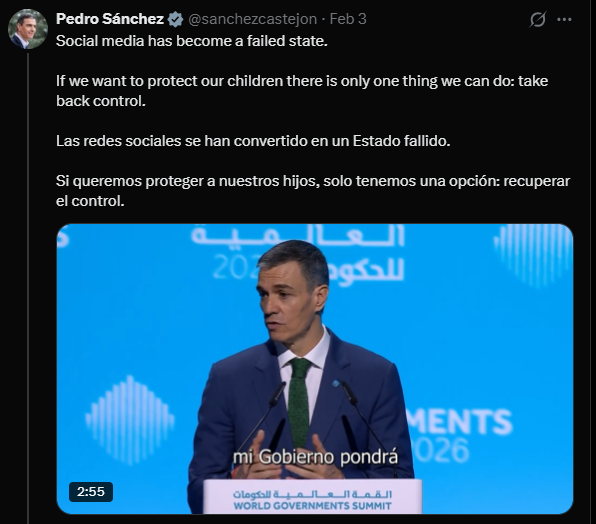
His remarks reflect a growing sentiment among policymakers that platforms have struggled to manage harmful content, especially for younger users. Under the proposed approach, platforms and their leadership could face stricter accountability if illegal or harmful content is not addressed quickly. Supporters of such policies argue that without real consequences, companies have little incentive to prioritize safety over engagement. From this view, stronger rules are a response to years of self-regulation that did not fully solve issues like harassment, exploitation and exposure to inappropriate material.
Still, even among those who back child-protection goals, there are questions about balance. Systems designed to block minors can affect adults as well, especially if verification becomes a gateway requirement for participation. Technical safeguards, oversight and clear limits on data use often become as important as the rules themselves. The Spanish debate is part of a broader European trend. Governments are experimenting with age-gating, platform liability and algorithm oversight, trying to reduce risks without undermining digital rights. Each step, though, adds another layer to how online spaces are governed.
The wider privacy and speech debate
Durov also raised concerns about how liability and content rules might influence moderation decisions. When platform executives face legal exposure, companies may choose to remove content quickly. Critics argue this can chill lawful speech, especially on political or controversial topics, because the safest path for companies is often to take content down first. Another area of tension is algorithmic curation. If laws penalize how platforms amplify certain material, governments effectively gain influence over what content spreads widely. Supporters say this helps limit the reach of harmful material. Opponents counter that unclear definitions of "harmful" or "polarizing" content can shift over time and may be applied unevenly.
The result is a layered debate with no simple resolution. Child safety, privacy, free expression and platform responsibility all pull in different directions. Spain's proposal brings those tensions into sharp focus, and voices like Durov's ensure the privacy side of the argument remains visible.
Closing Thoughts
What happens next in Spain may echo beyond its borders. European digital policy often shapes global norms, especially for large platforms operating across jurisdictions. Whether age verification becomes a narrow tool for youth protection or a broader identity layer for the internet will depend on how laws are written, enforced and challenged.
For now, the exchange between Durov and Spanish leadership shows how deeply the future of online identity and speech is being contested also by the platforms and communities that use these networks every day.