

Summary:
- Blockchain analytics firm Elliptic claims five crypto exchanges are enabling Russian users to bypass sanctions.
- Platforms including Bitpapa, ABCeX, Exmo, Rapira, and Aifory Pro allegedly support ruble-to-crypto conversions.
- The network reportedly expanded after the shutdown of Garantex in March last year.
- Some exchanges have processed billions in crypto transactions tied to sanctioned entities.
- Regulators in both Russia and the European Union are now moving toward stricter crypto rules.
A new report from blockchain analytics firm Elliptic suggests that a small network of cryptocurrency exchanges may be helping sanctioned Russian entities continue accessing global financial systems through digital assets. According to findings released Saturday, exchanges including Bitpapa, ABCeX, Exmo, Rapira and Aifory Pro are allegedly enabling direct ruble-to-crypto conversions. This process allows users to move value across borders without routing funds through traditional financial intermediaries such as banks. In its report, Elliptic stated:
The firm noted that such platforms provide alternative transaction routes for cross-border payments that remain outside the reach of conventional banking oversight. Once converted into cryptocurrency, funds can reportedly be transferred internationally and exchanged into other fiat currencies, effectively bypassing restrictions imposed by global sanctions regimes. The network is said to have grown rapidly following the takedown of Garantex in March last year. The Russia-based exchange had been sanctioned in mid-2022 for allegedly facilitating illicit transactions and supporting financial activity tied to the country's invasion of Ukraine.
Exchange Activity Under Review
Among the five exchanges named, Bitpapa is currently the only one that has already been sanctioned by regulators. The US Treasury's Office of Foreign Assets Control designated the platform in March 2024 for its alleged role in supporting sanctions evasion. Elliptic estimates that approximately 9.7% of Bitpapa's outgoing crypto flows are directed toward sanctioned entities. The firm also claimed that the exchange manages wallet infrastructure in a way that rotates addresses frequently, a kind of tactic it says may help avoid enforcement efforts.
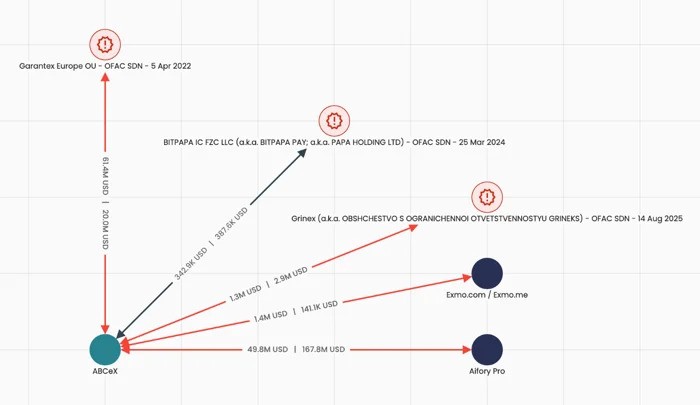
Elsewhere, ABCeX has reportedly processed at least $11 billion in crypto transactions and is said to operate from an office located in Moscow's Federation Tower and that is the same site previously used by Garantex. Elliptic indicated that significant transaction volumes from ABCeX have been sent to both Garantex and Aifory Pro. The report also highlighted activity involving Exmo. While the exchange publicly stated that it exited the Russian market after the invasion of Ukraine by selling its local operations to Exmo.me, Elliptic claims that Exmo.com and Exmo.me continue to share custodial wallet infrastructure. This setup allegedly allows funds originating from Russian-facing services to be co-mingled with those from Western operations.
According to Elliptic's data, the two platforms have conducted more than $19.5 million in direct transactions with sanctioned entities. Rapira, an exchange registered in Georgia but maintaining an office in Moscow, has also been flagged. The firm reportedly engaged in over $72 million worth of direct transactions with the sanctioned platform Grinex, described as a successor to Garantex. Meanwhile, Aifory Pro which serves users in Moscow, Dubai and Türkiye, is said to offer virtual payment cards backed by Tether. These cards can reportedly be used to access foreign services that are otherwise restricted within Russia.
Regulatory Response May Be Incoming
The developments come as Russian authorities continue exploring regulatory frameworks for digital asset usage. Earlier this month, the country's finance ministry and central bank reportedly urged the government to accelerate the rollout of crypto-specific regulations, citing growing domestic adoption. At the same time, policymakers within the European Union are preparing to introduce a new sanctions package that could prohibit all cryptocurrency transactions involving Russia.
The proposed measure is designed to close off digital assets as a potential workaround for international financial restrictions. While enforcement mechanisms for such a ban remain unclear, the move signals an increasing willingness among regulators to address perceived gaps in the global sanctions regime.