

Summary:
- Charles Schwab opens waitlist for direct bitcoin and ether trading
- "Schwab Crypto" accounts expected to launch in the first half of 2026
- Limited rollout planned for Q2 before wider access
- Service will not be available in New York and Louisiana at launch
- Crypto transfers and external wallet support won't be included initially
Charles Schwab is moving forward with its plan to offer direct access to crypto trading, opening a waitlist for calls "Schwab Crypto." The new account will allow clients to buy and sell bitcoin and ether directly, marking a shift in the firm approaches digital assets. A spokesperson confirmed to coindesk that the launch is still on track for the first half of 2026. Early access is already being teased through a banner on the firm's crypto page, inviting users to sign up and get updates.

The product itself won't sit inside Schwab's regular brokerage accounts. Instead, it will be offered through its banking arm, Charles Schwab Premier Bank, SSB. That said, users will still need an existing Schwab brokerage account to qualify. This is meant to act as a direct entry point into crypto for existing clients. The page describes it as "your new gateway to buy and sell Bitcoin and Ethereum cryptocurrencies." But there are limits right from the start. The service won't be available in New York or Louisiana at launch, and it also won't extend to U.S. territories or international users. On top of that, eligibility may vary. Accounts could be restricted or even closed if a client moves to a location where the service isn't supported. There's also a clear disclaimer around risk. Crypto held through the bank won't be treated like traditional financial assets. Cryptocurrencies held through Premier Bank "are not securities, are not protected by the SIPC, are not insured by the FDIC, are not deposits; and may lose value,"
That is still a different asset class, even when accessed through a familiar platform.
A Controlled Rollout With Key Limitations
Rick Wurster shared earlier that the company plans to begin with a limited release in Q2. It will first be tested internally with employees, then opened to a smaller group of users before expanding further. This kind of staged rollout suggests Schwab is taking a careful approach. It allows the firm to test systems, gather feedback, and manage risk before making the service widely available. There are also some notable restrictions that stand out. At launch, users won't be able to deposit or withdraw crypto from external wallets or exchanges. That means if someone already holds bitcoin or ether elsewhere, they won't be able to move those assets into Schwab right away. This is a key detail, especially considering earlier comments from Wurster.
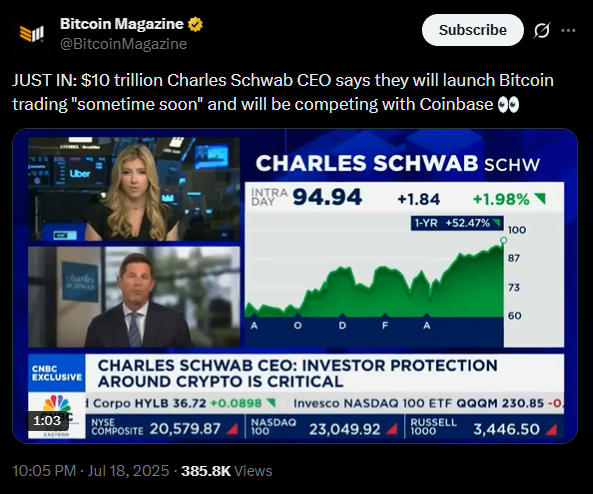
In a past interview, he noted that many clients holding crypto on platforms like Coinbase "really want to bring it back to Schwab." For now, that won't be possible. Details around fees and custody are also still missing. These are likely to shape how competitive the offering becomes, especially with established crypto platforms already offering similar services. Still, the intent is clear that Schwab wants to offer a simple, familiar way for its clients to access crypto without needing to leave its ecosystem.
READ MORE : Former UK PM Boris Johnson Says Bitcoin Is a Ponzi Scheme
From Skepticism to Entry
Back in 2019, Schwab described crypto as "purely speculative." At the time, the firm kept its distance from direct involvement. That position started to shift over the next few years. By 2021, Schwab was exploring ways to offer crypto access through partnerships. In 2023, it backed EDX Markets, a platform designed for institutional crypto trading. These steps didn't put Schwab directly in the market, but they showed growing interest. By mid-2025, the tone had changed further. Wurster pointed out that Schwab clients already hold more than 20% of all crypto exchange-traded products across the industry. He also made it clear the firm is looking to compete more directly with existing platforms.
That includes firms like Coinbase, which currently dominate retail access in the U.S. Now, with "Schwab Crypto," the company is stepping into a more direct role. It's not a full-featured crypto platform yet. There are still gaps, especially around asset transfers and broader availability. For existing Schwab clients, this could lower the barrier to entry. They'll be able to access crypto within a system they already use. At the same time, the limitations show this is just the beginning. The structure, rollout pace, and missing features suggest Schwab is still shaping how this offering will evolve. For now, the waitlist is open, and the first phase is getting closer.
READ MORE: CFTC Chair Signals Readiness to Regulate Entire Crypto Market as Policy Debate Continues