

Summary:
- MoneyGram has launched MGUSD, a US dollar-backed stablecoin built on the Stellar network.
- The stablecoin will be integrated directly into the MoneyGram app through a self-custodial wallet.
- Users will be able to hold digital dollars, send funds globally, and convert balances into local currencies.
- MGUSD is issued through Bridge, Stripe's stablecoin platform, with infrastructure support from M0 and Fireblocks.
- The launch highlights the growing role of stablecoins in cross-border payments and remittances.
Money transfer giant MoneyGram has officially entered the stablecoin issuance space with the launch of MGUSD, a US dollar-backed stablecoin built on the Stellar network. The announcement marks one of the company's most significant blockchain initiatives to date. While many payment firms have experimented with stablecoins behind the scenes for settlement and treasury operations, MoneyGram is bringing the technology directly to consumers. According to the company, MGUSD will be integrated into the MoneyGram mobile app through a self-custodial wallet. Users will be able to hold dollar-denominated balances, transfer funds internationally, and convert those balances into local currencies when needed.
The rollout begins in the United States, with plans for broader international expansion in the future. MoneyGram says MGUSD is designed around real-world payment needs. The company serves more than 60 million active customers across one of the largest global payments networks in the world, reaching nearly 500,000 retail locations. More than 70% of its transactions are now conducted digitally, giving the company a large audience for stablecoin-powered financial services. Explaining the strategy behind the launch, MoneyGram Chairman and CEO Anthony Soohoo said:
The statement highlights a broader move happening across the payments industry. Stablecoins are increasingly being viewed as payment infrastructure capable of moving value quickly across borders. For MoneyGram, MGUSD appears to be the next phase of that evolution.
Built on Stellar and Backed by Major Industry Infrastructure
Behind the scenes, MGUSD is supported by several established companies operating in the digital asset sector. The stablecoin is issued through Bridge, Stripe's stablecoin platform. Bridge received conditional approval from the US Office of the Comptroller of the Currency earlier this year to operate as a federally chartered national trust bank, giving it a stronger regulatory footing than many stablecoin issuers currently enjoy. The mint-and-burn infrastructure that manages token creation and redemption is powered by M0, while digital asset custody and wallet infrastructure comes from Fireblocks. MoneyGram also chose the Stellar network as the foundation for MGUSD. The company and the Stellar Development Foundation have worked together for years on blockchain-based payment initiatives, making Stellar a natural choice for the launch. MoneyGram is positioning MGUSD as a core layer of its future payment network. Luke Tuttle, Chief Product and Technology Officer at MoneyGram, explained the approach:
That idea may be one of the most important aspects of the launch. Most consumers do not necessarily care whether a payment travels through traditional banking systems or blockchain networks, matters is speed, cost, and reliability. MoneyGram's goal appears to be making the underlying technology largely invisible while using stablecoins to improve the user experience. The launch also reflects a growing trend among payment companies to move beyond simply integrating third-party stablecoins. Increasingly, firms are creating their own digital dollars to gain more control over payments infrastructure and customer experiences.
READ MORE: Fake Google Ads Targeting Uniswap Users Steal $400K, Analysts Warn
Why Remittance Companies Are Turning to Stablecoins
Cross-border payments remain one of the most expensive and inefficient areas of global finance despite years of modernization efforts. According to a 2026 report from the Bank for International Settlements (BIS), international payments continue to be "more costly, less accessible, slower, and less transparent" than domestic payment systems. For millions of migrant workers and families sending money across borders, those costs add up quickly. World Bank data shows that sending $200 internationally cost an average of 6.36% during the third quarter of 2025. In practical terms, that means roughly $12.72 in fees and foreign exchange costs are deducted from a $200 transfer.
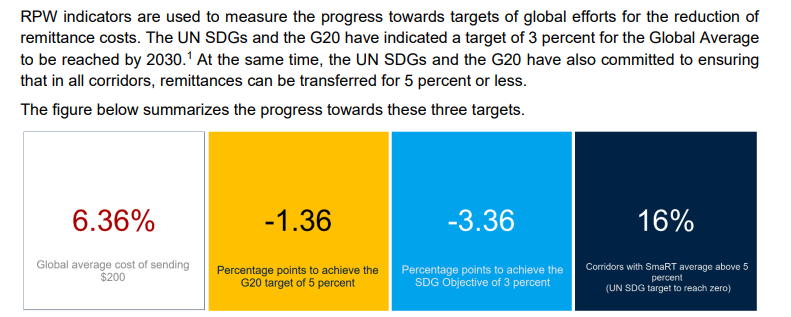
That remains well above the United Nations Sustainable Development Goal target of 3%. Stablecoins offer a potential alternative. While users may still encounter costs related to currency conversion, banking services, or local cash payouts, the blockchain settlement itself can be extremely inexpensive. According to Stellar's developer documentation, the network's minimum transaction fee is just 0.00001 XLM per operation. At current prices, that translates to a tiny fraction of a cent. As a result, many payment companies are increasingly viewing blockchain networks as infrastructure capable of reducing costs and improving settlement speeds. The launch of MGUSD comes at a time when the stablecoin sector itself is growing rapidly. Data from DefiLlama places the total stablecoin market capitalization at roughly $320 billion. Meanwhile, banking giant Citi projected in late 2025 that stablecoin issuance could reach approximately $1.9 trillion by 2030 under its base-case scenario. That growth is already influencing corporate strategy across the remittance industry. Earlier this year, MoneyGram partnered with the crypto exchange Kraken to allow users to convert digital assets into cash pickup services across more than 100 countries. The company also partnered with Tempo, a blockchain company incubated by Stripe, to support stablecoin settlement and remittance validation. MoneyGram rival Western Union recently launched its own dollar-pegged stablecoin, USDPT, on the Solana network. The rollout began in Bolivia and the Philippines, with plans to expand into more than 40 countries during 2026.
For decades, remittance providers focused on building physical distribution networks and banking partnerships. Today, many are adding blockchain infrastructure alongside those existing systems. With MGUSD, MoneyGram is making a direct bet that stablecoins will become a central part of that future. Rather than simply supporting third-party digital assets, the company is building its own dollar-based payment layer and placing it at the center of its global network.
READ MORE: US Seized Nearly $1 Billion in Iranian Crypto, Treasury Secretary Says