

Summary:
- Sui Network plans to roll out native confidential transactions this year, marking one of its biggest protocol upgrades yet.
- The feature will introduce private payments directly at the protocol level.
- Mysten Labs says the system is designed for privacy while still allowing user-controlled disclosures for regulators and auditors.
- Internal testing reportedly showed private transaction throughput reaching 866 transactions per second.
- The announcement sparked strong market reaction, with SUI climbing 22% after the news and nearly 40% over the week.
Privacy has slowly become one of crypto's most difficult conversations. For years, public blockchains focused almost entirely on transparency. Every transfer, every wallet movement, every smart contract interaction could be inspected by anyone with an internet connection. That openness helped create trustless systems, but it also introduced obvious limitations for businesses and users who need confidentiality. Now, Sui is moving to address that problem. Adeniyi Abiodun, co-founder and chief product officer at Mysten Labs, confirmed this week that confidential transactions are coming to the network later this year. The announcement signals a major step for the layer-1 blockchain, which has spent much of the past two years building a reputation around speed and developer-friendly architecture. Abiodun kept the message simple in his post:

The statement quickly caught attention across the crypto market. It was because of the privacy angle and what Sui appears to be building underneath it. Unlike many blockchain privacy systems that require users to opt into separate applications or secondary protocols, Sui's approach is being built directly into the network's core transaction layer. That matters because privacy becomes part of the standard user experience rather than a specialized tool for advanced users. This is a different direction from older privacy-focused networks that often struggled to balance compliance concerns with full anonymity. The design reportedly allows users to keep financial activity private while still maintaining what Mysten calls user-controlled disclosure. In simple terms, users can choose when and how transaction details are shared with auditors, institutions or regulators if needed.
For institutions, this solves one of the biggest blockers to blockchain adoption. They need confidentiality for commercial transactions, supplier payments, treasury movements and internal settlements. But they also need auditability when required by law. Sui is trying to deliver both at the same time. That balance is becoming one of the most important technical challenges in blockchain today.
READ MORE: SEC Delays Prediction Market ETFs Over Risk and Structure Concerns
Why Private Payments Are Becoming Essential Infrastructure
As blockchain technology moves deeper into finance, stablecoins, payments and enterprise settlement systems, complete transparency often becomes a disadvantage. Like, No business wants competitors seeing payment flows in real time, no payroll system should expose employee compensation on a public ledger and no institution moving large sums wants transaction details permanently visible to the world. Traditional financial systems solved this through closed banking infrastructure. Crypto still hasn't solved it cleanly at scale and this is where Sui's comes in. The network says internal testing has already demonstrated confidential transaction throughput of 866 transactions per second while preserving privacy guarantees. That level of performance is important because privacy tools have historically slowed blockchain systems down.
Transactions become slower on the other hand verification becomes expensive. Sui's architecture was designed differently from older chains, using parallel transaction processing and an object-based execution model that lets activity scale more efficiently. That technical foundation appears to be what makes confidential payments possible without forcing users to accept major delays or high fees. Mysten's broader goal is to make private stablecoin transfers feel as fast and cheap as sending a message online. Cross-border payroll, international contractor payments, private subscription services and institutional settlement rails all become easier if transactions remain cheap, instant and confidential. Abiodun's description of "free payments with privacy, at scale" sounds ambitious, but it reflects a wider shift already happening across crypto infrastructure. Payments are becoming the real battleground and privacy is quickly becoming non-negotiable.
Compliance and Quantum Resistance
There is another layer to Sui's strategy, The network is also working on quantum-resistant signature technology, with testing already active and deployment planned within the same development cycle. That may sound distant, but it addresses a growing concern across the blockchain industry. Future advances in quantum computing could eventually weaken today's cryptographic systems. While practical attacks are still years away, major blockchain networks are beginning to prepare now. Sui appears determined to future-proof itself before the issue becomes urgent. Combined with compliant private payments, this points to a broader vision.
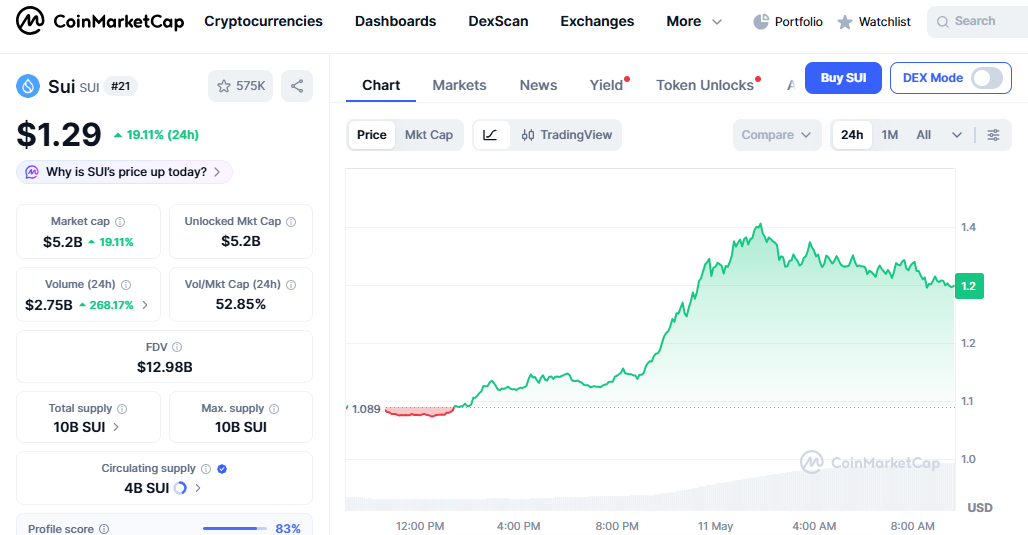
Mysten is adding privacy features to attract and It is positioning Sui as financial infrastructure built for the next decade. Markets seem to be responding. Following the announcement, SUI climbed roughly 22% in price, extending weekly gains to nearly 40% according to CoinMarketCap data. Price action reflects growing confidence that privacy-focused infrastructure is becoming a serious competitive edge. Crypto's next phase will likely be defined by usable financial rails. Sui is betting that if those pieces come together inside one scalable network, it could become far more than another layer-1 blockchain. Also, It could become the payment layer the internet has been missing.
READ MORE: Colombia President Pushes Bitcoin Mining Plan for Caribbean Coast