

Summary:
-
Matt Western urged a temporary moratorium on crypto donations to UK political parties.
-
The proposal would be added to the Representation of the People Bill until formal guidance is issued.
-
Concerns center on foreign state interference and anonymous funding risks.
-
Western also proposed stricter source-of-funds checks and new enforcement powers.
-
The debate follows growing political acceptance of crypto donations in the UK.
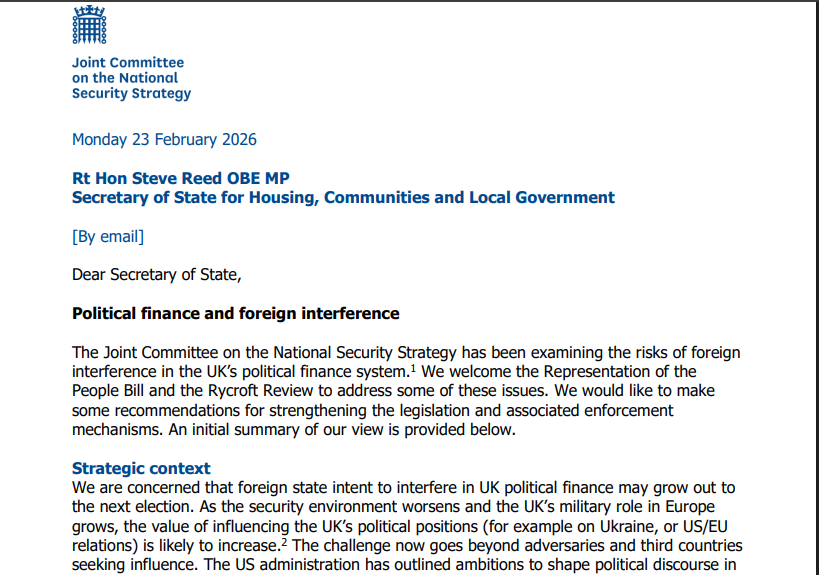
The chair of the UK's Joint Committee on the National Security Strategy has called on the government to temporarily halt cryptocurrency donations to political parties, warning that digital assets could create new channels for foreign interference. In a letter sent Monday to Steve Reed, Matt Western recommended adding a "temporary moratorium" on crypto donations to the upcoming Representation of the People Bill. Under his proposal, the pause would remain in place until the Electoral Commission issues statutory guidance on how such donations should be handled. "We are concerned that foreign state intent to interfere in UK political finance may grow out to the next election," Western said. In the same letter, Western expanded on his concerns, arguing that the current geopolitical climate heightens the risks of political influence operations.
The next UK general election must take place by August 15, 2029, while the Representation of the People Bill is scheduled for its second reading in the House of Commons on March 2.
From Full Ban Proposal to Temporary Moratorium
This is not the first time Western and fellow lawmakers have raised the issue. In January, a group of MPs who chair parliamentary committees including Western advocated for a complete ban on crypto donations in the legislation. They warned that foreign states could potentially exploit digital asset transfers to influence UK politics. However, when the bill was introduced to the House of Commons on February 12, it did not include a full prohibition on cryptocurrency contributions.
Western's latest approach stops/proposes a temporary suspension until clearer regulatory standards are in place. His recommendations include requiring political parties to accept cryptocurrency only through service providers registered with the Financial Conduct Authority. He also argued that donations involving crypto mixers services that obscure transactions or funds originating from unknown sources should be prohibited. Additionally, political parties receiving digital assets should convert them into fiat currency within 48 hours to reduce exposure to volatility and compliance risks.
The renewed debate comes against the backdrop of growing acceptance of digital assets in British politics. The Reform UK party became the first in the country to accept cryptocurrency donations in May last year. Its leader, Nigel Farage, announced that the party would accept Bitcoin and other cryptocurrencies as part of its funding model.
Broader Enforcement and Oversight Proposals
Western outlined longer-term structural reforms aimed at strengthening oversight of political finance. Among his proposals is the creation of a national police force dedicated specifically to overseeing political finance and countering foreign interference. He also recommended implementing stricter source-of-wealth checks for donors, reviewing sentencing guidelines for electoral finance offenses, increasing penalties for breaches and granting enhanced investigative powers to the Electoral Commission.
The underlying concern is about anonymity and cross-border financial flows that may be harder to trace than traditional bank transfers. While blockchain transactions are publicly recorded, identifying the individuals or entities behind digital wallets can be challenging without proper compliance frameworks. At the same time, critics of a moratorium argue that digital assets can be monitored effectively when routed through regulated exchanges and that outright restrictions may slow innovation in political fundraising. The debate highlights a broader tension facing policymakers: balancing technological adoption with safeguarding democratic processes.
As the Representation of the People Bill advances through Parliament, lawmakers will need to decide whether temporary restrictions are necessary to maintain public trust or whether regulatory guidance alone can address the perceived risks.
READ MORE: The One Thing Ethereum Still Can't Do - That COTI Already Solved