

Summary:
- US President Donald Trump raised the newly announced global tariff rate from 10% to 15% with immediate effect.
- The move comes after the United States Supreme Court struck down his use of emergency powers to impose tariffs.
- The administration is now using alternative legal routes under existing trade laws.
- Bitcoin held near $68,000 while Ethereum stayed close to the $2,000 level.
Just a day after announcing a fresh 10% global tariff, US President Donald Trump confirmed that the rate would now be increased to 15%, effective immediately. The decision follows a recent ruling by the United States Supreme Court, which blocked the administration's attempt to use emergency powers under the International Emergency Economic Powers Act (IEEPA) to impose broad tariffs during peacetime. In a Truth Social post, Trump strongly criticized the court's judgment and stated:
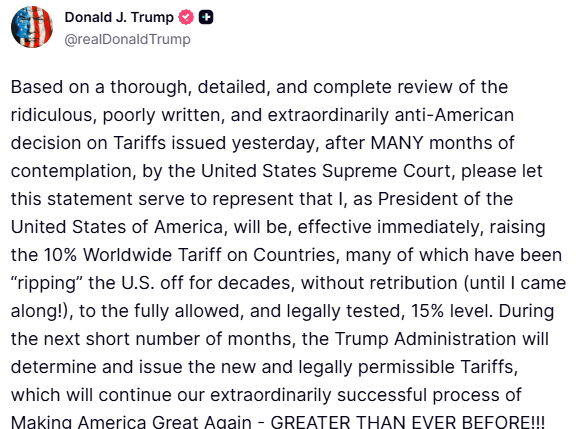
Following the ruling, the White House has begun exploring alternative legal pathways to enforce tariffs. Officials have pointed to the Trade Expansion Act of 1962 and the Trade Act of 1974 as the statutory basis for maintaining or adjusting trade duties without relying on emergency declarations. Critics argue that even these alternative routes may face legal review, especially as the court previously ruled that national security claims could not justify sweeping tariffs in a peacetime environment. Still, the administration appears determined to press forward using what it describes as "legally tested" mechanisms.
Crypto Markets Show Unusual Stability
Historically, major tariff announcements from Washington have rattled financial markets. Both equities and digital assets have tended to react sharply to signs of rising trade tensions or policy uncertainty. Earlier tariff moves during Trump's presidency often triggered rapid drawdowns in risk assets, including cryptocurrencies. Market participants would typically interpret aggressive trade actions as signals of potential economic slowdown or geopolitical stress - both of which tend to weigh on speculative investments.
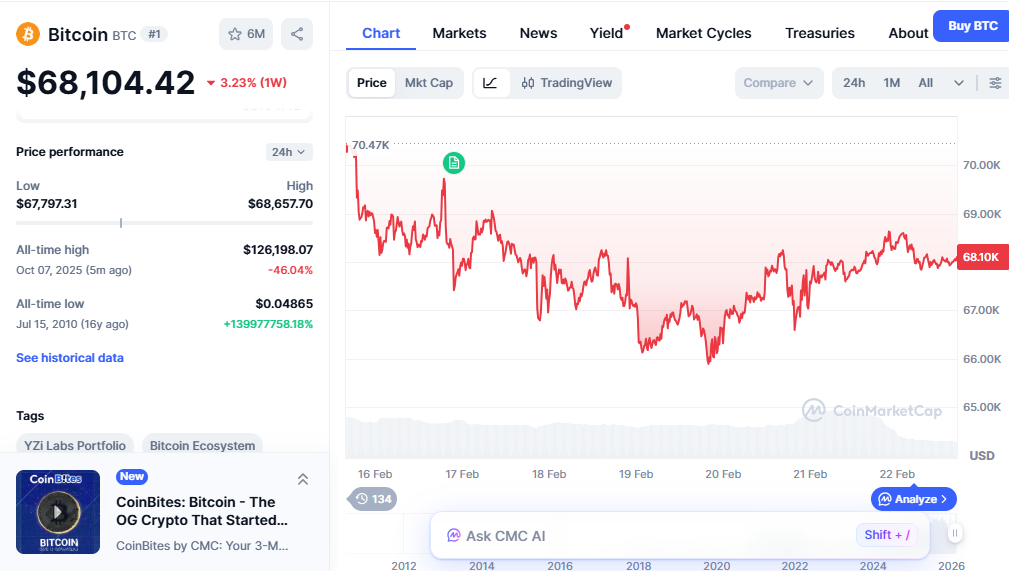
This time, however, the reaction has been noticeably muted. Despite the escalation from 10% to 15%, crypto markets held their ground over the weekend. Bitcoin remained steady near the $68,000 level, showing minimal movement from its Friday close. Ethereum also stayed firm around $2,000, suggesting that traders may already have priced in policy risks or are viewing the legal uncertainty around enforcement as a limiting factor. The calm response could also reflect a broader shift in how digital asset markets interpret macroeconomic developments. As institutional participation has grown in recent years, crypto investors may be more focused on underlying liquidity conditions and interest rate expectations.
While traditional markets often respond immediately to tariff adjustments due to direct implications for trade flows and corporate earnings, cryptocurrencies operate in a more globally distributed environment. That may help explain why the latest developments in US trade policy have not yet moved into major volatility across blockchain-based assets.
Legal Pathways and Market Implications
The administration's reliance on trade laws such as the Trade Expansion Act of 1962 could open the door to a prolonged legal battle over presidential tariff authority. Courts may ultimately need to determine whether these statutes provide sufficient justification for wide-ranging duties outside of emergency conditions. For now, the crypto market appears to be taking a wait-and-see approach. Traders are watching closely to assess whether the tariffs will face additional challenges or if implementation proceeds without interruption.
In previous cycles, tariff disputes have influenced capital flows across global markets, sometimes pushing investors toward alternative assets. Whether that pattern will repeat in the current environment remains uncertain. So at least for the moment, digital asset markets are behaving differently. Even as trade tensions resurface and legal debates intensify in Washington, cryptocurrencies have remained relatively stable.
READ MORE: Launch Your Idea on COTI and Earn Up to 50,000+ COTI