

Summary:
- Cardano Foundation has canceled the planned Cardano Summit 2026 after a treasury funding proposal failed to reach the required two-thirds approval threshold.
- A revised request for 7.8 million ADA (around $2 million) received majority support but finished at 65.21%, just below the 66.67% requirement.
- Cardano founder Charles Hoskinson and Foundation CEO Frederik Gregaard publicly supported the proposal before voting closed.
- The result highlights the growing influence of Cardano's decentralized governance system, where treasury spending faces increasing scrutiny from community representatives.
- While the summit proposal failed, EMURGO's separate TOKEN2049 sponsorship proposal was approved and will move forward.
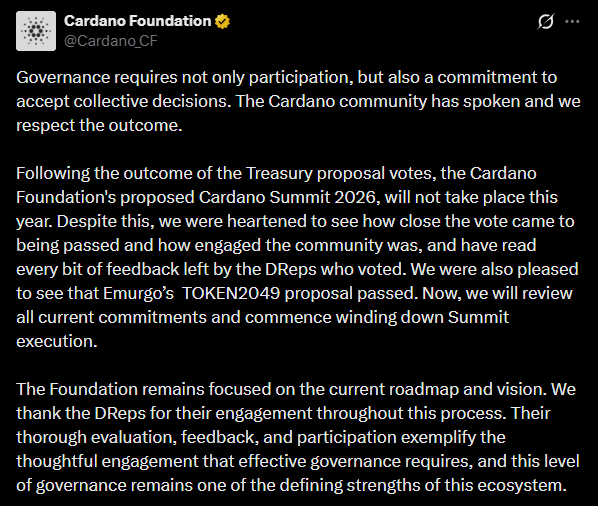
The Cardano Foundation has officially confirmed that the proposed Cardano Summit 2026 will not take place after a treasury funding vote failed to secure the supermajority required under Cardano's governance rules. In a statement shared on X, the Foundation acknowledged the outcome and said it would begin winding down plans for the event.
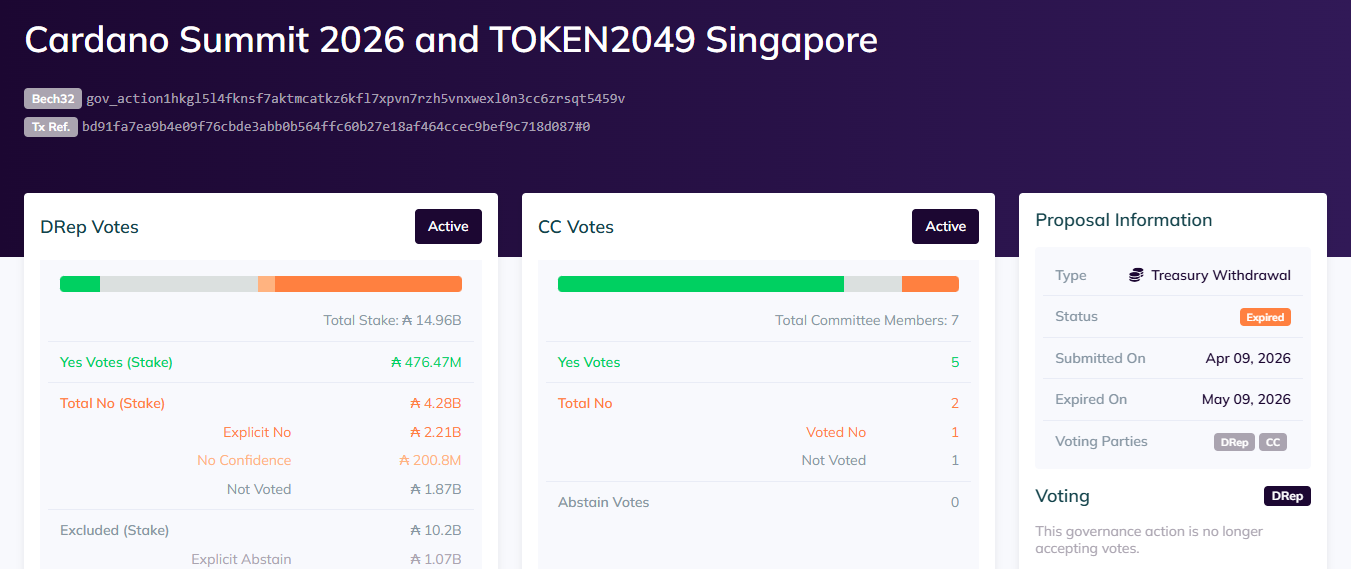
The vote closed on May 29 and centered around a revised treasury proposal requesting approximately 7.8 million ADA, valued at roughly $2 million. The funds would have been used to organize a two-day Cardano Summit in Singapore scheduled for October 5-6. At first glance, the proposal appeared to have enough support to pass. More than twice as many delegated representatives (DReps) voted in favor as opposed it, with 135 supporting the measure compared to 61 against and 24 abstaining. The Constitutional Committee also approved the proposal. However, Cardano's treasury governance framework requires more than a simple majority. Treasury withdrawals must receive support from at least 66.67% of participating DRep stake. The proposal ultimately finished at 65.21%, narrowly missing the threshold and automatically failing. The outcome demonstrates one of the defining characteristics of Cardano's governance model. Major funding requests must achieve a higher level of consensus before community funds can be released. That distinction may seem small numerically, but in practice it carries significant weight. A proposal can receive broad backing and still fail if it cannot convince enough voting power across the network.
A Scaled-Down Proposal Could Not Cross the Finish Line
The failed proposal was already the result of significant revisions. The original funding request sought 14.07 million ADA, worth approximately $3.66 million, and included both the Cardano Summit and an EMURGO-led sponsorship package for TOKEN2049 in Singapore. Following community feedback and concerns about spending levels, the Foundation separated the initiatives into individual proposals. The revised summit proposal reduced the requested budget by more than 20%, lowering the treasury ask to roughly 7.8 million ADA. Additional safeguards were also introduced. According to proposal updates, the revised version included audited fund management processes, milestone-based payment releases, and an independent oversight committee intended to improve transparency and accountability.
These changes were designed to address concerns raised by DReps and community members during earlier discussions. As voting approached its final hours, some of Cardano's most influential figures publicly encouraged support for the proposal. Cardano founder Charles Hoskinson and Cardano Foundation CEO Frederik Gregaard both voiced support for the revised funding request before voting closed. Interestingly, despite supporting the event, the Cardano Foundation chose to abstain from the vote itself. The organization stated that it did not want to directly influence the outcome and preferred to allow the community governance process to operate independently. Although the summit proposal failed, the broader Singapore strategy was not entirely rejected. EMURGO's separate TOKEN2049 Platinum Sponsorship proposal successfully passed, ensuring that Cardano will still maintain visibility at one of the crypto industry's largest annual conferences. The Foundation also voted in favor of the TOKEN2049 proposal after it had been separated from the summit funding request. The contrast between the two outcomes suggests that DReps were not necessarily opposed to promoting Cardano globally.
READ MORE: Iran War and AI Spending Could Push Bitcoin to $126K in 2026, Says Arthur Hayes
What the Vote Says About Cardano's Governance Evolution
Beyond the cancellation of a single event, the result may signal a broader shift taking place across the Cardano ecosystem. Throughout 2026, delegated representatives have become increasingly willing to challenge treasury proposals linked to major organizations within the network. Funding requests connected to the Cardano Foundation, EMURGO and Input Output Global have all faced tougher scrutiny than in previous years. Several proposals have been revised, reduced, or delayed after governance discussions revealed concerns around budget size, accountability, and long-term value creation. The summit vote appears to fit into that wider trend. DReps are increasingly acting as independent decision-makers. The narrow failure of the summit proposal highlights how Cardano's governance system is beginning to function as intended, even when outcomes may disappoint influential stakeholders.
From one perspective, the failed vote could be seen as a setback. The Cardano Summit has historically served as a major gathering for developers, businesses, community members and ecosystem partners. Canceling the event removes an important opportunity for networking, announcements and ecosystem promotion. From another perspective, supporters of decentralized governance may view the result as evidence that Cardano's treasury process is maturing. Community representatives evaluated the proposal, weighed the costs and benefits, and ultimately made a decision that reflected the voting thresholds established by the network. The fact that the proposal missed approval by such a narrow margin may also fuel future discussions about treasury governance itself. Some community members may argue that the high threshold protects treasury funds from unnecessary spending. Others may question whether proposals supported by a majority of voters should be blocked because they fall slightly below a supermajority requirement. Those conversations are likely to continue as Cardano expands its governance system and treasury management framework.
For now, however, the result is final. Cardano Summit 2026 will not move forward, and the Foundation has made clear that it intends to respect the decision. The vote offered a clear demonstration of something Cardano has spent years building toward a governance system where even major organizations must earn community approval before accessing treasury funds.
READ MORE: US Seized Nearly $1 Billion in Iranian Crypto, Treasury Secretary Says