

Summary:
- Coinbase has made an undisclosed investment in ProShares' GENIUS Money Market ETF (IQMM).
- The ETF is designed around assets that qualify as reserves under the GENIUS Act.
- IQMM invests in short-term US Treasury securities and cash-equivalent instruments.
- Coinbase says the investment supports the infrastructure needed for growing stablecoin adoption.
- The move comes as lawmakers continue debating the CLARITY Act and whether stablecoin issuers should be allowed to offer yield-bearing products.
Coinbase is making another move in the stablecoin sector, the company is investing in the financial infrastructure that sits behind stablecoin reserves. The crypto exchange announced that it has made an undisclosed investment in the ProShares GENIUS Money Market ETF (IQMM), a fund specifically designed to hold assets that qualify as reserves under the recently enacted Guiding and Establishing National Innovation for US Stablecoins (GENIUS) Act. The investment highlights how the stablecoin market is entering a new phase. For years, discussions around stablecoins focused largely on adoption, payments, and trading activity. Now, attention is increasingly shifting toward reserve management, regulatory compliance, and the financial products that support billions of dollars in tokenized dollars. In a statement shared on X, Coinbase framed the investment as part of its broader stablecoin strategy:

The announcement comes at a time when stablecoins are becoming a central focus of both crypto companies and traditional financial institutions. With regulators now providing clearer rules around reserve requirements, firms are looking beyond token issuance and into the systems that manage the assets backing those tokens. For Coinbase, which plays a major role in the USDC ecosystem, the quality and availability of reserve-management tools could become increasingly important as the stablecoin market expands.
Why IQMM Matters in the Post-GENIUS Era
The GENIUS Act fundamentally changed the regulatory landscape for payment stablecoins in the United States. The legislation requires issuers of dollar-pegged stablecoins to maintain reserves consisting of highly liquid and relatively low-risk assets. These include cash, bank deposits, and short-term US Treasury securities. The goal is to ensure that stablecoin holders can redeem their tokens at any time without concerns about reserve quality or liquidity. That regulatory framework has created demand for investment products built specifically around those approved reserve assets. Launched in February, IQMM was designed to meet that need. According to ProShares, the ETF invests exclusively in short-term US Treasury securities and cash-equivalent instruments with maturities of 93 days or less. The structure mirrors many of the assets stablecoin issuers are expected to hold under the new regulatory framework. As a publicly traded fund, IQMM offers market participants exposure to the same category of assets increasingly being used to back digital dollars. Coinbase believes that kind of infrastructure will become more important as stablecoins move deeper into mainstream finance. The company also highlighted ProShares' experience in traditional financial markets, noting:
The comment reflects a broader trend currently unfolding across the industry. The lines separating crypto markets and traditional finance are becoming less distinct. Stablecoins now sit in the middle of that convergence, connecting blockchain-based payment networks with conventional financial assets such as Treasury bills and money market instruments. For Coinbase, supporting products like IQMM is also about helping build a financial ecosystem capable of supporting larger stablecoin adoption in a regulated environment. That connection is particularly relevant given Coinbase's relationship with USDC. As one of the primary infrastructure providers for the stablecoin, the company has a direct interest in ensuring that reserve-management options remain liquid, transparent, and compliant with evolving regulations.
READ MORE: Coinbase Returns to India With Direct Rupee Transfers After Regulatory Approval
Stablecoin Regulation Moves Forward as CLARITY Debate Continues
While the GENIUS Act has already become law, the broader regulatory debate surrounding digital assets in the United States is far from over. Lawmakers are now focused on the Digital Asset Market Clarity Act, commonly known as the CLARITY Act. The legislation would establish a wider framework for crypto markets, define regulatory responsibilities, and provide greater certainty around how digital assets are classified and supervised. One of the most closely watched issues within the debate involves stablecoin yields. Some lawmakers and industry participants support allowing stablecoin issuers to offer interest-bearing products tied to token holdings. Others argue that such offerings could blur the line between banks and crypto companies, creating competitive and regulatory concerns.
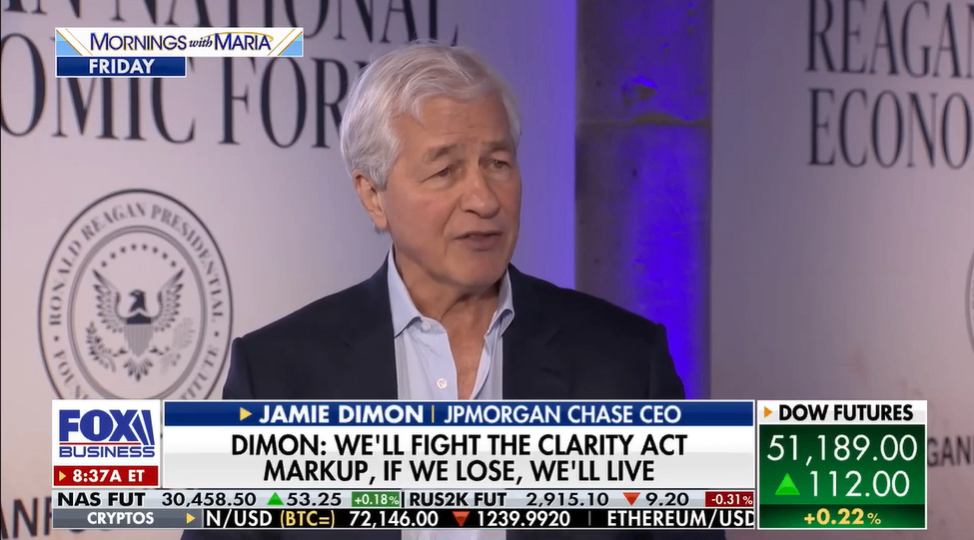
The bill recently advanced through the Senate Banking Committee, moving one step closer to a full Senate vote. However, significant disagreements remain. Some lawmakers continue pushing for stronger ethics rules and conflict-of-interest provisions related to digital assets. Meanwhile, the banking industry has become increasingly vocal in its opposition. JPMorgan CEO Jamie Dimon recently criticized the current version of the legislation, arguing that allowing crypto firms to pay yield on stablecoin balances could place banks at a disadvantage while subjecting crypto companies to fewer regulatory requirements. Those concerns have become one of the major points of friction in ongoing negotiations. Despite the uncertainty, many in the industry view the CLARITY Act as a critical next step for US crypto regulation. Coinbase Chief Policy Officer Faryar Shirzad described it as the: "biggest financial regulatory bill" since Dodd-Frank.
The outcome of that debate could have significant implications for the future of stablecoins, reserve-management products, and the broader relationship between crypto firms and traditional financial institutions. Against that backdrop, Coinbase's investment in IQMM looks like a strategic position on where the industry is heading. As stablecoin adoption grows, the focus is expanding beyond the tokens themselves to the infrastructure that supports them. Reserve assets, money market funds, Treasury-backed products, and regulatory frameworks are becoming just as important as wallets and blockchain networks. The GENIUS Act has already established the foundation for that transition. Now companies like Coinbase are positioning themselves around the financial infrastructure that could power the next phase of stablecoin growth.
READ MORE: US Seized Nearly $1 Billion in Iranian Crypto, Treasury Secretary Says