

Summary:
- Fidelity International has launched its first tokenized liquidity fund, called FILQ, using blockchain infrastructure connected to Chainlink and Sygnum Bank.
- The fund received a AAA-mf assessment from Moody's Ratings, signaling strong liquidity and credit quality.
- Chainlink will provide real-time onchain NAV and distribution data, while JPMorgan supplies approved daily pricing information.
- The launch adds to growing institutional adoption of tokenized real-world assets.
- Major financial firms are increasingly moving traditional money market products onto blockchain rails.
Fidelity International, which manages roughly $1 trillion in client assets globally, has launched the Fidelity USD Digital Liquidity Fund (FILQ), a blockchain-based liquidity product designed for regulated digital markets. The launch represents a clear signal that large financial firms are moving beyond pilot programs and toward practical financial products designed to operate across both traditional and blockchain-based systems. The fund was launched using infrastructure provided by Sygnum Bank and connected to the blockchain through Chainlink, which will deliver onchain pricing and distribution data in near real time. That means investors can track the value of the fund and monitor distributions continuously instead of relying solely on delayed financial reporting.
That level of transparency is becoming one of the biggest advantages tokenized products offer over traditional fund structures. The launch also received a strong external assessment. According to Sygnum, Moody's assigned FILQ a AAA-mf rating, one of the highest classifications used for money market-style products. The rating signals confidence in the fund's liquidity quality and credit profile. For institutions watching the tokenized asset space, it suggests these products are starting to meet the standards traditional investors expect before allocating serious capital. Fatmire Bekiri, Head of Tokenization at Sygnum, described the launch as a major step for financial markets.
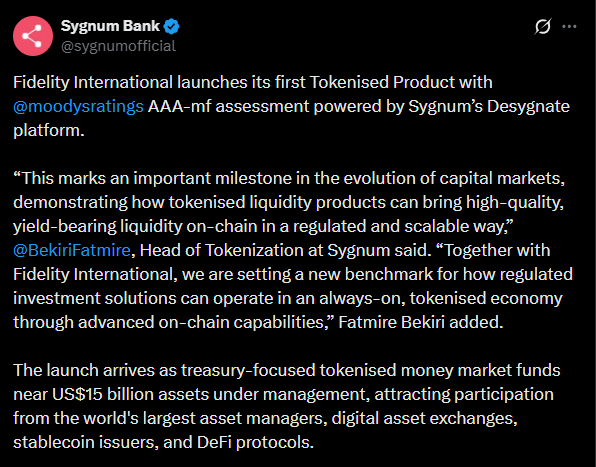
That framing reflects where tokenization is heading. It is increasingly about how quickly they can scale regulated products once the infrastructure proves reliable.
Chainlink's Growing Role in Institutional Tokenization
For Chainlink, the FILQ launch adds another major institutional use case to its expanding real-world asset footprint. Chainlink's role in tokenized markets has grown steadily as financial firms need trusted external data to bridge traditional financial systems with blockchain-based settlement layers. Blockchains cannot natively verify offchain fund prices or distribution records. For FILQ, Chainlink will deliver verified net asset value data and payout information directly onchain, allowing investors to track official fund performance continuously. The system gives digital markets access to trusted pricing data that traditionally sits inside closed institutional systems. Chainlink highlighted the importance of the launch in its own announcement:

JPMorgan also plays a central role here . The bank will provide approved daily NAV data for the fund, giving institutional-grade validation to the pricing structure being reflected onchain. That combination matters because trust remains one of the biggest barriers between traditional finance and blockchain adoption. Institutional investors need assurance that tokenized representations reflect real underlying value. Fernando Vazquez, President of Capital Markets at Chainlink Labs, said the launch shows that tokenized products are entering a more mature phase.
The tokenized asset market is shifting from proof-of-concept into production-grade financial infrastructure.
READ MORE: Iran War and AI Spending Could Push Bitcoin to $126K in 2026, Says Arthur Hayes
Tokenized Funds Are Becoming a Serious Institutional Market
Across the financial sector, large firms are increasingly placing traditional short-term yield products onto blockchain rails. Earlier entrants like BlackRock and Franklin Templeton launched tokenized money market products designed to offer regulated yield exposure through digital infrastructure. These products aim to bring familiar low-risk treasury and liquidity instruments into markets that operate around the clock. That matters because traditional settlement systems still close overnight and on weekends. Blockchain-based liquidity products remain accessible 24 hours a day. For institutional treasury management, that flexibility is becoming increasingly valuable. JPMorgan recently filed with US regulators to launch its own tokenized money market structure on Ethereum, a move widely viewed as another sign that major banks see tokenized reserves as a future part of digital financial infrastructure. Fidelity itself has already been active in the space. Its earlier launch of the Fidelity Digital Interest Token involved collaboration with Ondo Finance , with Ondo's OUSG fund acting as the primary anchor investor. That earlier move showed Fidelity's interest in testing blockchain-native fund structures. FILQ pushes that effort much further.
The inclusion of Moody's assessment, institutional pricing support from JPMorgan, and live blockchain transparency through Chainlink creates one of the clearest examples yet of traditional financial products being rebuilt for digital rails without abandoning regulatory standards. Products like FILQ show how legacy finance and blockchain infrastructure can increasingly work together and with trillion-dollar firms now launching production-ready tokenized funds, that future is arriving faster than many expected.
READ MORE: Crypto and AI Face Trust Crisis as Millions Flow Into 2026 Elections, New Poll Shows