

Summary:
- The Ethereum community has officially launched Clear Signing, a new security standard designed to replace confusing transaction approvals with readable transaction details.
- The feature is backed by major wallet and infrastructure providers including Ledger, Trezor, MetaMask, WalletConnect and Fireblocks.
- The Ethereum Foundation says blind signing has been a major security weakness behind billions in crypto losses.
- The update introduces "What You See Is What You Sign" transaction verification.
- The move follows rising concerns around wallet exploits, including the $1.4 billion Bybit attack.
For years, Ethereum users have been asked to approve transactions that looked more like machine code than financial instructions. A wall of unreadable hexadecimal data would appear on a wallet screen, and users were expected to trust that what they were approving matched what they intended to do. That process became known as blind signing, and it quietly became one of crypto's biggest security weak points. Now the Ethereum ecosystem is trying to change that. The Ethereum Foundation announced the official rollout of Clear Signing, a security standard built to replace those unreadable prompts with plain, human-readable transaction details. The foundation described the issue directly:
The organization called blind signing a "structural flaw" that has contributed to billions of dollars in losses across the crypto industry, including the massive Bybit exploit that shook the market last year. The launch introduces what Ethereum developers describe as a "What You See Is What You Sign" approach. Wallets will now display clear information about the transaction actually does before a signature is confirmed. That means users can verify whether they are approving a token transfer, granting contract permissions, interacting with a DeFi application, or signing something malicious disguised as a normal request.
Wallet Giants Back the New Standard
Some of the biggest names in self-custody infrastructure have already committed to integrating Clear Signing. That includes Ledger, Trezor, MetaMask, Keycard, WalletConnect, Argot, Sourcify, Zama, ZKnox and Fireblocks. The Ethereum Foundation framed the initiative as a network-wide effort. It also issued a direct message to developers:
That line matters because Clear Signing only works if every part of the stack participates. Wallet providers must display readable transaction details. Application developers must supply accurate descriptions of contract behavior. Security reviewers must verify those descriptions are correct. The system depends on cooperation. Ethereum appears to understand that solving trust problems requires ecosystem-wide standards. The Foundation also made its long-term goal clear:
It signals Ethereum sees usability and trust as necessary infrastructure if blockchain is expected to support large-scale financial activity.
READ MORE: Vitalik Buterin Unveils Quantum-Resistance Roadmap for Ethereum, Targets Signatures, Data and Proofs
Why This Matters After Bybit and What Comes Next
Crypto security has improved in recent years, but attackers have become more sophisticated. The biggest recent reminder came with the Bybit exploit, the largest crypto theft on record. That attack succeeded by compromising a third-party service provider and manipulating transaction signatures, showing how dangerous unclear signing flows can be. When users cannot verify what they are approving, attackers only need to disguise malicious instructions behind familiar wallet prompts. That turns every transaction approval into a potential trap. Clear Signing directly targets that weakness. The Ethereum Foundation reinforced the importance of the launch on social media, writing:
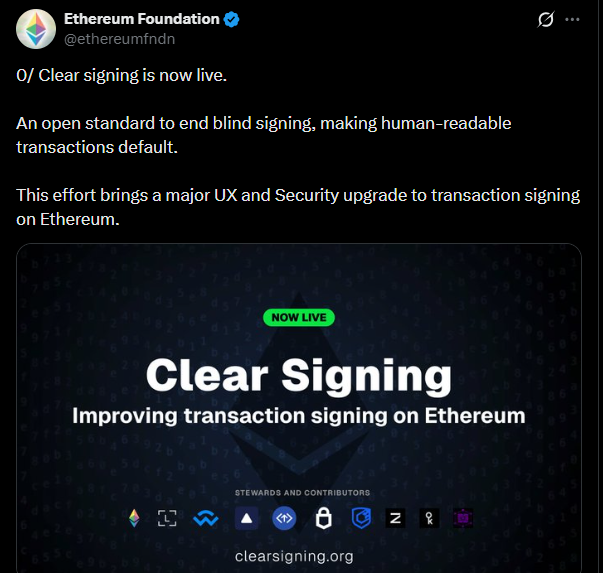
This is part of Ethereum's broader push to mature into infrastructure that institutions and mainstream users can trust. For years, critics argued crypto security often depended too heavily on technical literacy. Users were expected to understand cryptographic mechanics or risk losing funds. Clear Signing changes that assumption and It shifts responsibility away from users needing deep technical knowledge and toward software making actions understandable by default. If widely adopted, it could become one of Ethereum's most practical security improvements in years.
READ MORE: Crypto and AI Face Trust Crisis as Millions Flow Into 2026 Elections, New Poll Shows